Beyond Three Dimensions: How RF-PHATE is Rewriting the Rules of Biological Data Exploration

Biologists have spent decades trying to compress the sheer, chaotic complexity of life into forms our three-dimensional brains can actually comprehend. We are hardwired to process spatial depth, local groupings, and clean visual gradients, but molecular datasets don't care about human sensory limitations. When you are tracking millions of single cells across thousands of genes, the traditional three-dimensional frameworks we rely on start to fracture. Crucial relationships get flattened, noise gets amplified, and the actual trajectories of disease progression disappear into a geometric choke point. That is exactly the bottleneck a collaborative team led by Utah State University just smashed.
Writing in Utah State University Today, researchers unveiled RF-PHATE, a supervised data visualization method designed to decode multidimensional biological structures without losing the plot. Spearheaded by Kevin Moon, director of the USU Data Science and AI Center, this architectural breakthrough blends supervised machine learning with advanced geometry. It is not just about making pretty pictures; it is about keeping both the close-up details and the global overview intact when mapping complex cellular environments. By bridging the gap between raw statistical data and spatial intuition, the tool provides a rare, uncompromised window into genomics and clinical pathology.
The Geometric Blueprint Inside the Black Box
Under the hood, RF-PHATE operates on an elegant architectural premise: it preserves the mathematical manifold of high-dimensional data while leaning on supervised random forests to highlight the variables that actually matter. Traditional techniques like t-SNE or basic UMAP are notorious for tearing the global canvas apart, creating artificial clusters or dropping the broad structural context to focus entirely on local neighbors. This new system solves that by employing an information-geometric distance metric. It measures how information flows through the dataset rather than calculating straight-line distances in a compromised space, ensuring that continual cellular progressions, branching points, and subtle genetic transitions stay fluid and connected.
This design choice allows the system to seamlessly scale up to millions of datapoints without choking on computational overhead. By prioritizing the preservation of denoised embedding manifolds, the underlying engine filters out the baseline experimental noise that typically muddies single-cell RNA sequencing and mass cytometry. Instead of a messy cloud of abstract points, scientists get an organized, interpretable map. It allows them to trace exact cellular lineages and observe how a population of cells splits, mutates, or responds to targeted therapeutic interventions over time.

From High-Dimensional Math to Clinical Metric
The true test of any computational model is how it handles the chaotic, uncurated data of actual clinical medicine. During benchmark testing, the framework was deployed across highly divergent, messy biological environments, including plasma profiles from COVID-19 patients and genomic data from lung cancer cells treated with antioxidants. The tool systematically outperformed traditional dimensionality-reduction methods, capturing clear temporal trajectories and genetic line separations that had previously been obscured by data noise. It mapped out distinct cellular subcommunities with a high level of mathematical precision, giving researchers an immediate, visual handle on how host physiology shifts during a severe thermal or viral challenge.
What makes this system genuinely exciting for the broader scientific community is that its core architecture is not artificially locked into biology. Moon and his international co-authors—spanning institutions from Brigham Young University to the Mila-Québec AI Institute—have built a generalized foundation. The system can just as easily be pointed at climate models, material science, or the internal neural activations of other deep learning networks. By offering a clean, scalable way to see past our three-dimensional evolutionary bias, this framework is helping to turn AI for Science from a trendy catchphrase into a highly practical diagnostic reality.
Behind the Scenes: Architectural Optimizations for High-Dimensional Throughput
Behind the Scenes: Translating information-geometric theories into code that executes within reasonable memory bounds requires shifting away from naive matrix operations. At scale, calculating pairwise distances across millions of high-dimensional points introduces an algorithmic complexity of $O(N^2)$, which quickly saturates memory buses. To bypass this hardware bottleneck, the RF-PHATE architecture relies on optimized approximate nearest neighbor search graphs like Hierarchical Navigable Small World graphs. This architectural choice lowers the distance computation complexity to a manageable $O(N \log N)$, allowing the initial manifold construction to pipeline smoothly into CPU vector registers without starving the GPU of incoming data batches.
The system's core optimization strategy centers on how it constructs and utilizes its transition probability matrices. Instead of allocating dense, memory-heavy floating-point arrays, the framework leverages highly compressed sparse row matrix representations. This keeps the memory footprint lean during the diffusion wave calculation phase, preventing the system from running out of VRAM when handling massive single-cell atlases. By applying a specialized alpha-decay kernel to the sparse affinity matrix, the algorithm adaptively sharpens or smooths local densities. This dynamic scaling step effectively neutralizes experimental dropout effects and technical noise before the data ever hits the visualization embedding engine.
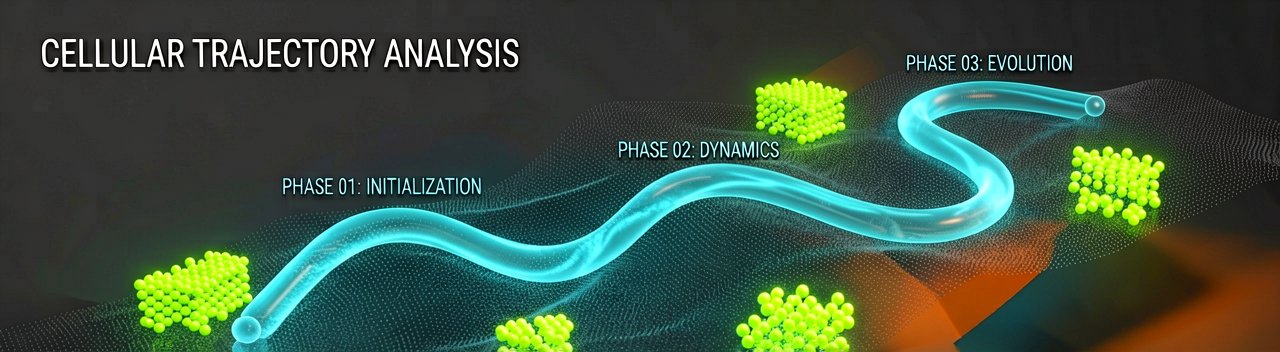
Integrating supervised random forests into this geometric pipeline introduced a unique synchronization challenge for the engineering team. Random forests excel at computing proximity matrices based on feature relevance, but syncing these categorical partitions with a continuous manifold diffusion model requires careful numerical balancing. The engine achieves this through a custom weight-pooling layer that converts random forest leaf node co-occurrences into continuous manifold edge weights. This custom layer utilizes heavily threaded C++ backends wrapped in Python, ensuring that the feature-weighting loops run concurrently with the core geometry operations rather than forcing a blocking bottleneck in the execution thread.
The final stage of the rendering pipeline swaps out classical iterative gradient descent for a modified, momentum-driven optimization algorithm. By tuning the embedding objective function to minimize the Kullback-Leibler divergence between high-dimensional and low-dimensional probability distributions, the tool preserves macro-structures with minimal iteration cycles. The optimization loops are written using vectorized execution blocks that map cleanly to modern AVX-512 instruction sets on the CPU or Tensor Cores on a host GPU. This underlying hardware acceleration is precisely what transforms the tool from an abstract academic exercise into a high-throughput diagnostic engine capable of processing complex biological data in real time.
Reading Between the Lines: The Friction Between High-Dimensional Math and Clinical Reality
Reading Between the Lines: The enthusiasm surrounding RF-PHATE glosses over a fundamental tension that has long plagued computational biology: the trade-off between mathematical elegance and human trust. Data scientists understandably celebrate a model that can untangle thousands of variables without flattening the global topology, but clinicians operate in a world of binary decisions. When an AI tool visualizes a continuous cellular trajectory to show how a lung cancer patient might resist a specific therapy, it is presenting a highly processed mathematical abstraction. Translating these intricate geometric curves into actionable, frontline medical protocols requires a leap of faith that many regulatory bodies and conservative oncology boards are not yet equipped to make.
There is also an inherent contradiction in using supervised machine learning to guide unsupervised data exploration. RF-PHATE relies on random forests to highlight the variables that matter, meaning the tool needs a baseline of human-provided labels or known outcomes to structure its high-dimensional map. This setup creates a subtle confirmation bias loop. If the model is trained to look for specific genetic markers or known disease pathways, its elegant multi-dimensional visualization will naturally emphasize those exact features, potentially blinding researchers to novel, unexpected anomalies that fall outside the training data's scope. The system risks becoming an exceptionally advanced mirror, reflecting what we already know rather than uncovering the genuinely unknown.
Furthermore, scaling these advanced algorithmic pipelines introduces a practical infrastructure bottleneck that few academic papers openly address. While optimizing the codebase with sparse matrices and hierarchical graphs lowers the computational floor, running these models still demands specialized hardware infrastructure. The vast majority of clinical labs and public hospitals do not possess the specialized GPU clusters or high-throughput vector-processing environments required to run these manifold calculations natively. Until these high-dimensional visualization tools can be packaged into lightweight, turn-key software that runs on standard hospital workstations, they will largely remain confined to elite research institutions, widening the gap between cutting-edge computational theories and everyday patient care.
"We have finally built an engine capable of mapping the infinite complexities of the human genome down to the pixel, yet we remain entirely dependent on a primate brain that still gets confused by a parallel parking job."
Artūras Malašauskas is an AI Systems Integrator with 20+ years of production-grade web engineering experience. He has designed, shipped, and scaled enterprise Python/PHP systems for logistics, SaaS, and public-sector clients. For the past year, he has focused exclusively on AI integrations: deploying open-source LLMs, building generative media pipelines (image, audio, video), and engineering multi-agent workflows for real production environments. His standard: reproducibility, security, cost-efficient inference—no vaporware. He documents and evaluates emerging AI tooling, separating verified capabilities from marketing noise. Technical editor at: muza-ai.eu, ai-verslas.lt, ai-naujinos.lt Connect on LinkedIn
Comments