Claude Science: Anthropic Directs Generative AI Strategy Toward Vertical Pharmaceutical Innovation
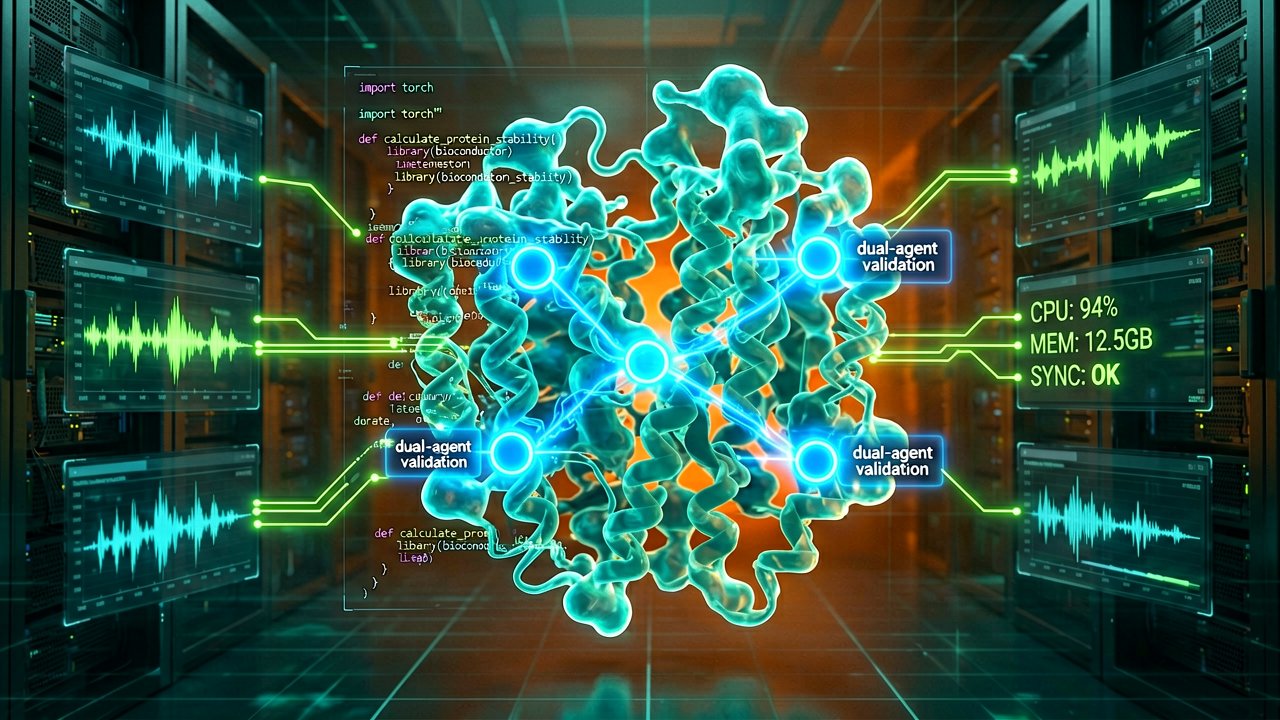
The field of generative artificial intelligence has entered a crucial consolidation phase, shifting focus from generalized chat assistants toward highly verticalized, domain-specific environments. In a significant structural move, Anthropic announced the launch of Claude Science, a dedicated desktop application and research workbench tailored explicitly for life sciences, drug discovery, and advanced computational workflows. The platform operates on existing foundation models but shifts the user experience entirely by embedding more than 60 pre-configured scientific databases, native rendering engines for 3D protein structures, and complex high-performance computing (HPC) job management directly into a single workspace.
This product launch signals a direct market escalation against rival OpenAI, which introduced its own research-focused platform, GPT-Rosalind, earlier this year. Rather than limiting its scope to software provisioning, Anthropic has simultaneously initiated its own internal pre-clinical drug programs aimed at neglected tropical and rare diseases. This dual-pronged strategy establishes the company both as an enterprise platform vendor and an active biological developer, accelerating the commercial convergence between big tech and the pharmaceutical sector.
Strategic Implications for Pharmaceutical R&D
The core value proposition of the new workbench centers heavily on the concept of data provenance and scientific reproducibility, a historic bottleneck for machine learning implementations in medicine. Standard large language models routinely struggle with version control, non-transparent code execution, and unverified source data. The architecture solves this via a dual-agent configuration where a specialized reviewer agent cross-examines data outputs, flagging untraceable numbers or mismatching figures before final presentation. By linking localized scripting capabilities in Python or R with tools like NVIDIA’s BioNeMo Agent Toolkit, researchers can execute complex genomics or proteomics pipelines while keeping sensitive clinical assets entirely within local firewalls or private cloud nodes.
Market Landscape and Competitive Dynamics
As foundation model capabilities reach relative parity, the primary software moat moves away from context windows toward operational integration. Enterprise life science vendors and global biotechs are increasingly reluctant to subscribe to general-purpose interfaces that require extensive customization or risk proprietary compound exposure. Market details published via Reuters highlight how beta testers experienced pronounced compression in operational timelines, with some molecular epidemiology tasks experiencing tenfold velocity increases. By addressing structural biology, single-cell RNA sequencing, and cheminformatics natively, the vendor seeks to anchor itself as an indispensable orchestration layer for the multi-billion-dollar pharmaceutical R&D infrastructure.
Commercial Outlook and Ecosystem Integration
The release strategy reflects a clear roadmap intended to capture high-margin corporate licensing revenue ahead of an anticipated public market debut. Official distribution details outlined by Anthropic confirm immediate beta accessibility for Pro, Max, Team, and Enterprise tier subscribers across macOS and Linux operating systems. To stimulate grassroots institutional adoption, the firm has also structured an "AI for Science" grant framework offering up to $30,000 in computational platform credits for academic labs. The critical determinant of long-term commercial success will depend on how cleanly the environment handles specialized multi-agent routing when coordinating massive cloud training runs alongside traditional laboratory electronic notebooks.
Behind the Scenes: Inside the Computational Shift
What Most Reports Miss about the current artificial intelligence deployment wave is that raw compute scale has stopped being the primary differentiator for laboratory environments. For years, major pharmaceutical giants treated generalized large language models as highly advanced reading assistants capable of parsing legacy patents or summarizing clinical trial PDF packets. However, the introduction of specialized research workbenches like Claude Science marks a permanent structural migration from simple information retrieval to live, closed-loop experimental design. By moving the model directly into the computational environment where structural biology and cheminformatics operate, the technology bypasses the traditional text prompt interface entirely, becoming an orchestration layer for physical data architecture.
Historically, the standard workflow for identifying a viable small-molecule inhibitor involved a deeply fragmented handoff between computational chemists, software engineering teams, and bench scientists. A single molecular simulation might require spinning up an isolated high-performance computing cluster, running a custom script, extracting the structural data, and manually feeding the results into a separate visualization program. This operational fragmentation created immense friction, often stretching initial screening timelines across multiple months. The enterprise consolidation seen today aims to fuse these disconnected silos by allowing an engineer to write, test, and execute data pipelines across external infrastructure without ever leaving the core research environment.
The Realities of Institutional Adoption
From the perspective of data officers at global biotechs, the primary hurdle to deploying these tools has never been technical capability, but rather the strict regulatory and safety mandates governing therapeutic development. Standard cloud-based software architectures often present unacceptable compliance risks regarding proprietary molecular structures and patient genetic data. To achieve meaningful market penetration, specialized toolsets must be built to support strict data provenance protocols, ensuring that every automated step in an experimental pipeline can be tracked, audited, and reproduced to satisfy rigorous regulatory standards.

This strict structural constraint explains why the latest wave of industry-specific AI focuses heavily on deterministic accuracy and dual-agent validation systems. By pairing creative generative capabilities with separate, specialized reviewer agents that cross-examine mathematical and chemical outputs against established scientific databases, platforms can significantly mitigate hallucination risks. As these localized, highly secure model architectures become deeply integrated into corporate infrastructures, the competitive focus shifts completely away from building larger baseline context windows toward creating the most reliable, compliant, and deeply integrated ecosystem for high-stakes enterprise discovery.
Reading Between the Lines: The Cost of Automation vs. The Reality of the Lab
Reading Between the Lines: The sudden enthusiasm for verticalized scientific workbenches ignores a glaring contradiction in the business model of generative artificial intelligence providers. Software developers consistently promise that automated platforms will compress pharmaceutical discovery timelines from years to days, yet this narrative conflates virtual simulation velocity with the unyielding physical realities of laboratory validation. An algorithm can easily hallucinate or accurately predict ten thousand promising molecular candidates in an afternoon, but the real-world bottleneck remains firmly rooted in the physical world. Human scientists must still source scarce chemical reagents, cultivate living cell cultures, and physically run assays in wet labs to prove efficacy, meaning that doubling computational speed does not automatically equate to doubling the pace of medicine.
Furthermore, the sudden pivot toward creating enterprise life sciences platforms exposes a deeper strategic vulnerability among major AI developers. Having spent billions of dollars training massive foundation models, tech firms are discovering that general-purpose chat utilities lack the high-margin monetization potential required to sustain their massive infrastructure costs. By rapidly engineering vertical workbenches for specialized sectors, these firms are essentially trying to build proprietary software moats before their underlying models become completely commoditized by open-source alternatives. This creates an awkward dynamic where pharmaceutical giants are being asked to lock their most valuable intellectual property into closed corporate ecosystems, even though the long-term architectural stability of these AI vendors remains largely unproven.
The long-term risk of this rapid integration is the subtle erosion of independent scientific skepticism within research teams. When a multi-agent system handles the data ingestion, writes the code, executes the pipeline, and synthesizes the final report, human researchers risk becoming passive proofreaders of automated outputs rather than active critical thinkers. If a baseline foundation model harbors a subtle, systemic bias regarding specific protein families or chemical interactions, that bias can effortlessly propagate across thousands of automated experiments before being detected. Over-reliance on unified digital workbenches may inadvertently create a generation of R&D pipelines that excel at finding mathematically flawless solutions that ultimately fail to perform in complex biological systems.
"We are rapidly approaching a future where AI will effortlessly design a flawless cure for a disease in three seconds flat, which will then spend the next nine years sitting in a folder waiting for a human laboratory technician to find a clean pipette and a free afternoon to test it."
Artūras Malašauskas is an AI Systems Integrator with 20+ years of production-grade web engineering experience. He has designed, shipped, and scaled enterprise Python/PHP systems for logistics, SaaS, and public-sector clients. For the past year, he has focused exclusively on AI integrations: deploying open-source LLMs, building generative media pipelines (image, audio, video), and engineering multi-agent workflows for real production environments. His standard: reproducibility, security, cost-efficient inference—no vaporware. He documents and evaluates emerging AI tooling, separating verified capabilities from marketing noise. Technical editor at: muza-ai.eu, ai-verslas.lt, ai-naujinos.lt Connect on LinkedIn
Comments