NVIDIA XR AI Powers VITURE Helix's Real-Time Spatial Computing Breakthrough
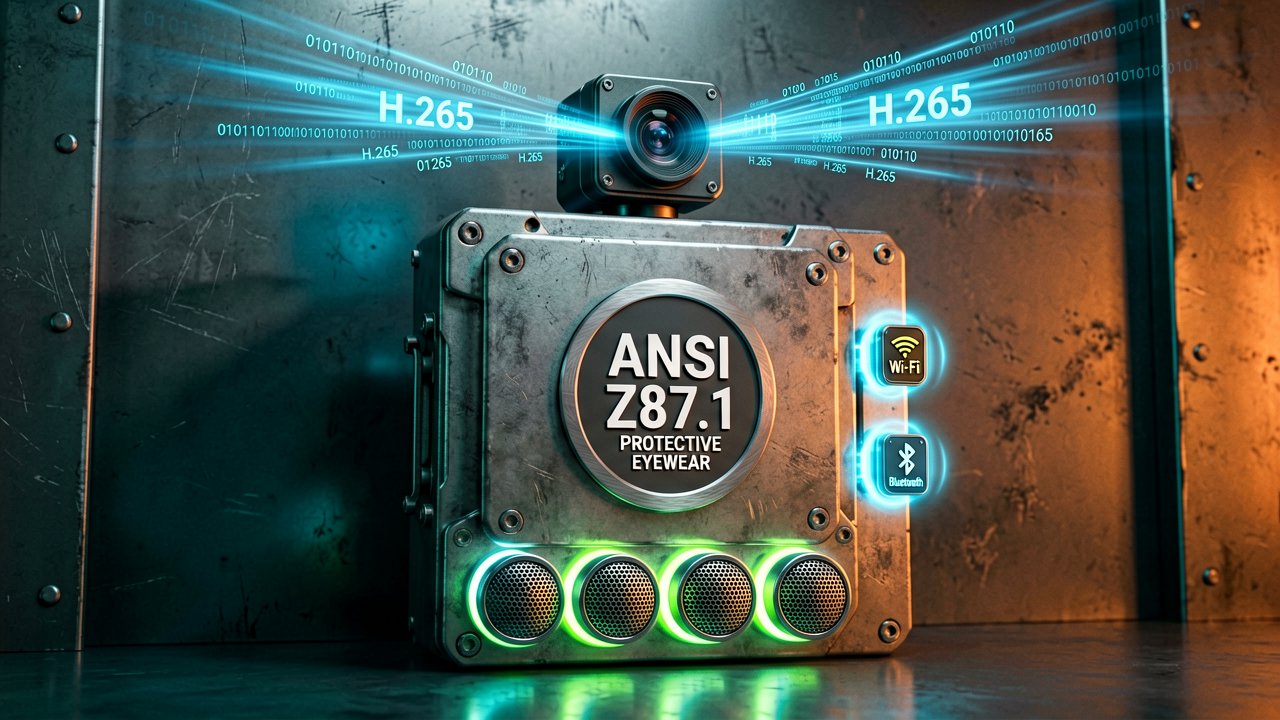
Consumer augmented reality might still be searching for its killer app, but VITURE is bypassing the living room entirely to drop artificial intelligence straight onto the factory floor. Unveiled at the Augmented World Expo (AWE) 2026, the newly announced VITURE Helix represents a massive shift for the company, moving from consumer display wearables into heavy-duty enterprise hardware. Built as the first AI-native safety eyewear powered by NVIDIA's XR AI Platform, the Helix strips away the traditional, bulky AR display entirely, opting instead for an audio-and-vision co-pilot designed to guide industrial operators through complex tasks without forcing them to look away from their hands.
The core architecture flips the script on traditional smart glasses by treating the wearable as a standalone, direct-to-cloud edge sensor rather than a smartphone accessory. Encased in an industrial-grade frame aiming for ANSI Z87.1-2025 compliance, the hardware packs a 12MP first-person camera, a sophisticated four-microphone array, stereo speakers, and built-in Wi-Fi and Bluetooth 5.3 modules. This allows the headset to stream exactly what the worker sees and hears to a localized, multimodal model. This edge-to-cloud synergy delivers real-time coaching for standard operating procedures, effectively providing an omnipresent expert on the bench who can flag errors or verify compliance as it happens.
Academic Origins and Real-World Metrics
This is not just a speculative concepts-stage play; the infrastructure has already been proven in high-stakes research environments. The platform emerged from a joint collaboration involving VITURE, NVIDIA, Stanford University's Le Cong Lab, and Princeton University's Mengdi Wang Lab, where earlier iterations managed workflows across complex clinical and life sciences wet-labs. By pushing first-person data through NVIDIA's accelerated pipelines, the platform logs full operational provenance for organizations while continuously updating the underlying AI model based on real-world edge scenarios. According to details shared on the official VITURE Helix Product Page, the device guarantees over 60 minutes of continuous, charge-while-using battery performance, fitting comfortably into demanding enterprise shifts. It is a calculated grab for a burgeoning B2B space, backed by market data from the IDC Worldwide AR/VR Headset Tracker showing VITURE already commanding the top spot for Western AR display glasses shipments. Individual reservations for the first production batch are open ahead of a Q1 2027 shipping window, with pricing set to start at $600.
Behind the Scenes: Bridging the physical and digital worlds requires a system architecture that minimizes latency, as even minor delays in processing can disrupt industrial workflows. The VITURE Helix achieves this by deploying a distributed compute model that balances light workloads on the edge device with heavy processing tasks in the cloud. Instead of loading heavy transformer models directly onto the eyewear, the device operates as an optimized sensor hub. First-person video streams are encoded using a hardware-accelerated H.265 pipeline directly at the 12MP image sensor level, compressing spatial data before it transits the local Wi-Fi stack. This architecture ensures that telemetry packets hit the local edge node with minimum serialization delay, freeing up local silicon to handle high-rate IMU tracking and audio preprocessing.
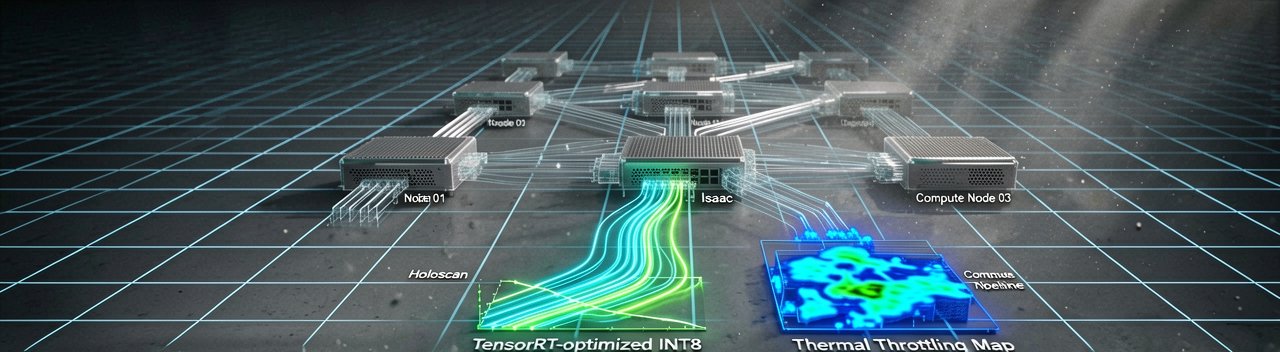
At the heart of this real-time pipeline sits NVIDIA's Holoscan and Isaac platforms, which orchestrate the intake of multimodal data. The four-microphone array relies on localized, hardware-level beamforming algorithms to isolate the operator's voice from ambient factory noise. Once the audio and video streams reach the local network edge, the NVIDIA XR AI platform takes over, synchronizing the temporal video frames with the audio timeline. This synchronization relies on hardware-timed timestamps generated at the glass level, allowing the multimodal models to analyze gestures and spoken commands simultaneously. By offloading these intensive matrix multiplications to local AI enterprise infrastructure, the system maintains a low motion-to-response loop that keeps operator guidance tightly synchronized with real-world movements.
Optimizing the Inference Pipeline
To prevent network congestion from halting an entire production line, the system relies on TensorRT-optimized inference loops that prioritize critical safety streams over analytical logging. The software stack uses dynamic batching at the edge server to process incoming telemetry from multiple headsets concurrently without resource starvation. If bandwidth drops, a localized fallback routine on the Helix shifts the video capture to a lower framerate while preserving audio telemetry, ensuring that step-by-step procedural verification remains uninterrupted. Furthermore, the platform utilizes quantized INT8 models for routine gesture and object recognition tasks, maximizing throughput and reducing power draw on the server side while maintaining FP16 precision strictly for complex anomaly detection.
This deep hardware integration extends to the operational lifecycle management of the headset. Continuous streaming at high resolutions typically leads to thermal throttling or rapid battery drain, but the Helix bypasses this through a duty-cycle management algorithm. The device dynamically adjusts camera capture parameters based on spatial movement; if the IMU registers that an operator is stationary and focused on a static assembly board, the video encoder drops its bitrate until a new spatial state change is triggered. This intelligent throttling allows the wearable to operate continuously within safe thermal limits, proving that the real breakthrough of the Helix isn't just the AI itself, but the underlying engineering that makes spatial computing practical for real-world deployments.
Reading Between the Lines: While the technical synergy between VITURE's hardware and NVIDIA’s XR AI platform looks flawless on paper, the pivot from consumer entertainment glasses to industrial safety gear introduces a harsh set of physical realities. For years, enterprise augmented reality has been haunted by the ghost of Google Glass—devices that promised to revolutionize the deskless workforce but ultimately faltered due to battery limitations, awkward ergonomics, and the sheer unpredictability of industrial environments. By stripping away the visual display entirely to focus on an audio-and-vision co-pilot, VITURE smartly sidesteps the weight, thermal, and optical calibration nightmares that have sunk rival AR headsets. Yet, this strategic retreat from complex optical overlays raises a crucial question: at what point do "spatial computing safety glasses" simply become an incredibly expensive, head-mounted webcam with a microphone array?
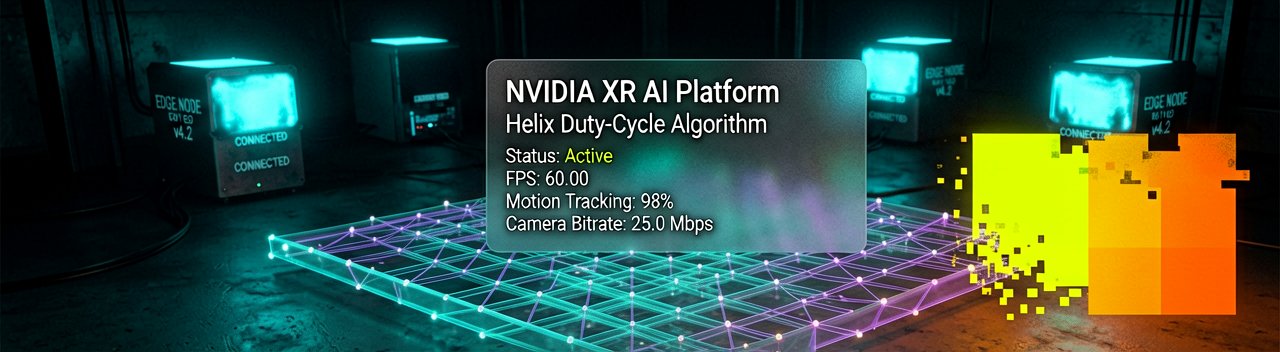
The reliance on a persistent edge-to-cloud connection exposes a glaring contradiction in the pitch for high-stakes industrial deployment. VITURE touts a low-latency pipeline capable of guiding a technician through complex wet-lab protocols or factory operations in real-time, but this architecture assumes a pristine, uninterrupted network environment. In the real world, factory floors, aircraft hangars, and heavy industrial facilities are notorious for dead zones, electromagnetic interference, and strict data-localization policies that balk at streaming first-person video data to external servers. If a local network node stutters or drops a packet during a critical assembly sequence, the fallbacks to lower frame rates and audio-only telemetry mean the AI's contextual awareness drops precisely when the operator might need it most.
The Real Cost of Enterprise Autonomy
Furthermore, the economics of shifting the heavy computational lifting to NVIDIA's enterprise AI infrastructure introduces a hidden financial hangover for adopting organizations. The $600 hardware price point is surprisingly aggressive for industrial-grade equipment, but it represents only the tip of the iceberg. Maintaining real-time, multimodal TensorRT inference loops across an entire workforce requires a substantial, ongoing investment in on-premise server hardware or high-tier cloud compute credits. For small to mid-sized enterprises, the promised operational savings of having an automated "expert on the bench" could quickly be cannibalized by the escalating maintenance costs of the specialized AI pipelines required to keep those glasses intelligent.
Ultimately, the true test for the Helix will not be its performance in controlled academic labs at Stanford or Princeton, but its ability to survive the cultural friction of the workforce. Wearable technology in industrial spaces faces a steep uphill battle regarding user adoption; workers are notoriously unforgiving of any gear that adds friction to their shift, requires frequent recharging, or feels like a tool for management surveillance. VITURE’s managed duty-cycle algorithm and charge-while-using capability are clever engineering answers to the battery dilemma, but they must contend with human habits. If the device feels even slightly cumbersome over an eight-hour shift, or if the AI co-pilot misinterprets a gesture one too many times, these advanced safety glasses are at risk of ending up exactly where so many enterprise AR innovations go to die: gathering dust in a locker room drawer.
"We have spent a decade trying to build augmented reality glasses that can project a perfect digital world into our eyes, only to realize that the most practical enterprise solution might be a pair of blind safety goggles that just quietly tell us what to do so we don't accidentally blow up the factory."
Artūras Malašauskas is an AI Systems Integrator with 20+ years of production-grade web engineering experience. He has designed, shipped, and scaled enterprise Python/PHP systems for logistics, SaaS, and public-sector clients. For the past year, he has focused exclusively on AI integrations: deploying open-source LLMs, building generative media pipelines (image, audio, video), and engineering multi-agent workflows for real production environments. His standard: reproducibility, security, cost-efficient inference—no vaporware. He documents and evaluates emerging AI tooling, separating verified capabilities from marketing noise. Technical editor at: muza-ai.eu, ai-verslas.lt, ai-naujinos.lt Connect on LinkedIn
Comments