Workforce and Marketing Tech Converge as Sage, Contentful, and Peers Unveil AI-Driven Innovations

The enterprise technology ecosystem is witnessing a historic convergence between backend operational workflows and frontend customer engagement strategies. Historically separated by rigid software silos, workforce management and marketing automation platforms are rapidly unifying around advanced agentic artificial intelligence architectures. This cross-industry evolution is driven by the structural requirement to turn unstructured enterprise data into immediate, revenue-generating actions. As organizations combat rising content creation volumes and complex compliance mandates, the deployment of transparent, context-aware AI agents has shifted from an experimental advantage to a baseline operational necessity.
Recent major enterprise portfolio rollouts illustrate how this convergence is taking hold across enterprise resource planning (ERP), information governance, and digital experience platforms. Software providers are moving past standard large language model (LLM) text-generation wrappers to build native, graph-powered automation layers. By anchoring intelligent agents directly within corporate knowledge databases, vendors are allowing enterprises to bridge the gap between back-office supply chains and front-office brand management. This ensure absolute data consistency across every public and private touchpoint.
Sage Expands Operational Intelligence and Accountability in ERP
In a direct bid to eliminate "black box" algorithmic ambiguities within enterprise resource planning, Sage has introduced significant AI-driven updates tailored for complex industrial supply chains. Built explicitly for mid-market manufacturers and distributors, the enhancements focus on embedding trust, auditability, and control into operational workflows. These features are designed to mitigate manual processing friction and improve multi-channel visibility by leveraging AI-powered insights for real-time decision-making. Simultaneously, the company's broader strategic pivot emphasizes transparent AI workflows across finance, human resources, and back-office operations, ensuring every AI-generated financial recommendation remains verifiable by human auditors.
M-Files Introduces Context-Aware Knowledge Graph Agents
Addressing the critical need for absolute governance within distributed workforce workflows, M-Files has officially launched its new suite of native M-Files AI agents. Built natively on top of the provider’s Enterprise Knowledge Graph, these autonomous agents bring context-first intelligence to document management and unstructured information silos. The agents automate highly complex processes, including metadata enrichment, secure conversational access, and automated information retrieval across disparate repositories. By prioritizing structured governance and absolute transparency, the system mitigates the risks of compliance breaches, allowing workers to quickly query corporate files while ensuring rigorous access controls remain intact.

Contentful Launches Palmata to Capture AI Answer Engine Visibility
On the customer engagement side, the mechanics of marketing discovery are shifting dramatically as consumers increasingly bypass traditional search engines in favor of LLM summary boxes. Recognizing this behavioral shift, digital experience platform Contentful has announced the general availability of Palmata. This new offering is designed specifically to help organizations evaluate, track, and optimize how their brand is portrayed across conversational AI engines. Powered by an underlying discovery agent that continuously assesses public digital footprints, Palmata turns AI visibility risks into data-driven growth roadmaps. The solution helps marketing teams ensure that their product details remain machine-readable, highly accurate, and frequently referenced by external AI models.
Strategic Imperatives for Modern Enterprise Leaders
The simultaneous arrival of these innovations highlights a clear directive for modern technology decision-makers: operational data and customer-facing content can no longer live in isolation. If a company's internal supply chain data or compliance documentation fails to seamlessly sync with its external digital experience platform, generative AI engines will surface outdated or conflicting details to prospective buyers. Success in this agentic era requires deploying unified data structures that fuel both internal workforce automation and external marketing engines. Only by establishing a singular, highly structured source of corporate truth can enterprises maintain operational resilience while maximizing their presence across an AI-dominated consumer marketplace.
The Hidden Cost of Algorithmic Insulation
Behind the Scenes: The rapid convergence of corporate workforce automation and outward-facing marketing tech exposes a widening ideological rift between chief information officers focused on risk mitigation and chief marketing officers demanding rapid deployment cycles. Historically, the back-office ERP and the front-office digital experience platform operated as two separate software layers with very different risk profiles. Today's generative AI frameworks demand an unfiltered pipeline between these two realms to stay accurate. This pipeline forces engineers to balance the strict security requirements of financial record-keeping with the fluid, high-velocity demands of modern digital marketing teams.
This organizational friction is driven by the limitations of early generative AI rollouts, which frequently suffered from "hallucinations" and a lack of source-verifiable data tracking. Industry leaders are realizing that feeding isolated marketing data into customer-facing LLMs inevitably creates a disconnect if the underlying business logic, supply chains, or compliance rules are stored in a separate silo. When an AI service agent references outdated pricing data or promises inventory that the enterprise ERP knows is unavailable, the resulting breakdown harms brand reputation and erodes consumer trust. Resolving this issue requires building a shared, verifiable knowledge framework that anchors every automated system to a single source of corporate truth.
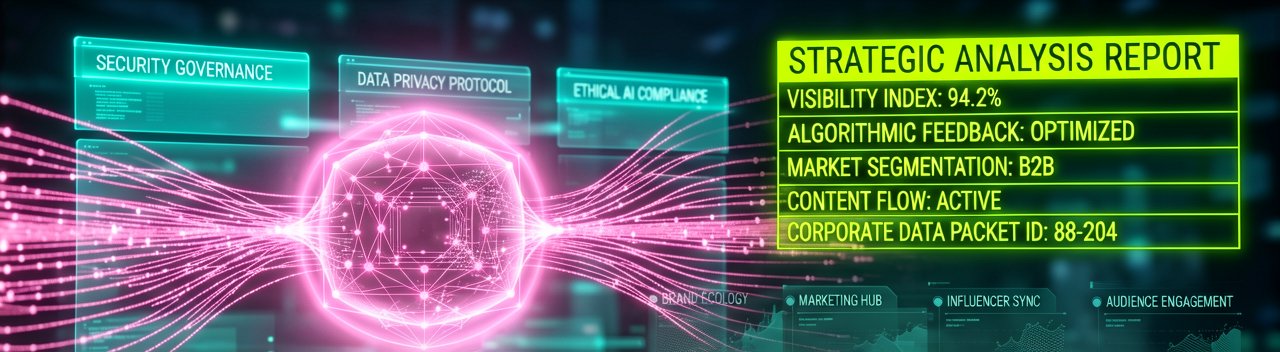
This push for total system transparency is fundamentally reshaping modern enterprise software vendor negotiations. Enterprise buyers are moving away from traditional, opaque AI models in favor of open, verifiable graph architectures that track exactly how data is used to generate each response. Platforms like Sage and M-Files are seeing strong demand for this auditability, especially as global compliance frameworks place greater accountability on autonomous software. For technology executives, the priority is shifting away from simply tracking worker productivity toward building an infrastructure where every automated action can be fully traced and audited by human teams.
At the same time, this architectural shift is changing how brands protect their public reputation across external consumer touchpoints. As AI answer engines replace conventional search interfaces, marketing teams can no longer rely on classic search engine optimization strategies to drive brand visibility. Platforms like Contentful's Palmata highlight the emergence of a new operational standard where corporate content must be optimized for both human consumers and external machine-learning crawlers. To remain discoverable, organizations must maintain highly structured, accurate public documentation that external AI engines can easily read and cite.
Ultimately, the successful convergence of workforce management and marketing automation hinges on an organization's ability to clean and structure its internal information data lakes. Companies that continue to operate with disconnected departments will struggle with fragmented data, while teams that build a unified data foundation will be well-positioned to scale their automated systems safely. As these intelligent systems become the primary layer for both internal company workflows and external customer interactions, maintaining absolute data consistency across the entire business portfolio becomes an essential strategy for long-term operational resilience.
The Mirage of Frictionless Automation
Reading Between the Lines: The corporate rush to deploy autonomous agents across both internal supply chains and public marketing engines rests on a highly optimistic assumption: that enterprise data is clean enough to be trusted. While software vendors paint a picture of seamless, context-aware automation, the reality on the ground is that most corporate repositories remain an unorganized mess of conflicting documents and outdated files. Forcing autonomous AI agents into these messy data environments doesn't instantly solve the problem; it frequently just accelerates the rate at which bad data can spread throughout an organization. This creates an awkward catch-22 where businesses must spend months manually cleaning their data infrastructure just to prepare for the systems that were supposed to automate that exact maintenance work.
This dynamic reveals a fundamental tension between the goals of the vendors and the actual needs of the enterprise. On one side, marketing tech platforms encourage brands to optimize their content so external AI search bots can easily scrape it. On the other side, workforce and information governance systems are hardening their defenses to protect intellectual property from being crawled by those exact same external models. This structural conflict pits an organization's public marketing strategy directly against its internal security policies. Businesses are being forced to walk a tightrope, deciding exactly which parts of their corporate knowledge graph should be open to the public web for maximum visibility, and which parts must remain locked down behind strict security parameters.
Furthermore, the industry's newfound obsession with AI auditability and transparency may be a classic case of over-promising. Software providers are eagerly marketing "explainable AI" and verifiable graph architectures to ease the worries of nervous compliance officers. However, as these neural networks grow larger and their training datasets become more entangled, tracking the exact root cause of an automated error remains incredibly difficult in practice. Presenting a neat, user-friendly audit log gives executives a comforting sense of control, but it often masks the deeper, unpredictable nature of large language models. This creates a false sense of security that could leave organizations vulnerable when an automated system eventually makes an unpredictable error during a live operations or marketing push.
Looking ahead, the long-term impact of this software convergence will likely trigger a wave of vendor consolidation rather than a true golden age of corporate efficiency. As the boundaries separating ERP, content management, and marketing automation continue to blur, enterprise buyers will grow tired of managing dozens of niche AI agents that require constant integration. The market will inevitably favor massive, all-in-one software ecosystems that can natively bridge the gap between back-office data and front-office delivery. For smaller, specialized tech vendors, this shift means that simply offering a clever agentic tool will no longer be enough to survive without being swallowed up by a larger platform.
The corporate dream of a fully automated enterprise is finally within reach, provided you don't mind spending half your fiscal budget paying human consultants to constantly monitor the AI agents that were originally hired to replace them.
Artūras Malašauskas is an AI Systems Integrator with 20+ years of production-grade web engineering experience. He has designed, shipped, and scaled enterprise Python/PHP systems for logistics, SaaS, and public-sector clients. For the past year, he has focused exclusively on AI integrations: deploying open-source LLMs, building generative media pipelines (image, audio, video), and engineering multi-agent workflows for real production environments. His standard: reproducibility, security, cost-efficient inference—no vaporware. He documents and evaluates emerging AI tooling, separating verified capabilities from marketing noise. Technical editor at: muza-ai.eu, ai-verslas.lt, ai-naujinos.lt Connect on LinkedIn
Comments