Active AI ETFs Redefine Investment Strategies in the Race for Next-Gen Tech Giants

The investment landscape for artificial intelligence is undergoing a significant structural shift as pioneering actively managed ETFs emerge to challenge passive index concentration. While early-stage AI investing largely functioned as a concentrated bet on megacap silicon providers, institutional money managers are pivoting toward agile, active strategies designed to identify the next generation of hardware and software leaders. According to analysis tracked by Morningstar, these next-gen investment vehicles bypass traditional, market-cap-weighted indices to uncover underappreciated firms building the physical infrastructure, customized accelerators, and foundational software layers required to rival established incumbents.
This tactical evolution comes at a critical juncture for tech sector valuations. While passive thematic funds remain heavily concentrated in dominant megacaps, dynamic actively managed solutions leverage expert human oversight to navigate the volatile tech ecosystem. Active managers capitalize on intra-quarter market corrections and individual stock mispricings to gain tactical exposure to emerging sub-sectors. These portfolios frequently tilt toward custom connectivity chips, enterprise optimization networks, and high-performance hardware interfaces that are actively chipping away at early hardware monopolies.
The Migration From Passive Beta to High-Alpha AI Infrastructure
The first wave of AI exchange-traded funds focused primarily on passive, top-heavy tech indices where a single chipmaker dominated overall returns. However, recent data highlights an aggressive expansion into secondary and tertiary infrastructure layers. Industry projections tracked by the Dell'Oro Group indicate that global data center capital expenditures will surpass $1 trillion. This massive expenditure wave is shifting Wall Street's attention toward critical ancillary verticals, such as advanced thermal management, optical connectivity, and specialized memory architectures.
Active Management Triumphs Over Rigid Indexing in Volatile Markets
Navigating the extreme volatility of early-stage technologies remains a prominent hurdle for retail and institutional portfolios alike. Proprietary fund performance metrics from Morningstar demonstrate that active tech portfolios have successfully outpaced both the Russell 3000 Growth Index and passive AI benchmarks during major tech sector rallies. By utilizing strict active risk mandates, fund managers can rapidly rotated assets out of overvalued, high-multiple chip stocks and redirect capital into undervalued business-software leaders and high-bandwidth storage providers before the broader market re-prices those metrics.
Diversification Beyond the Monopolistic Silicon Moat
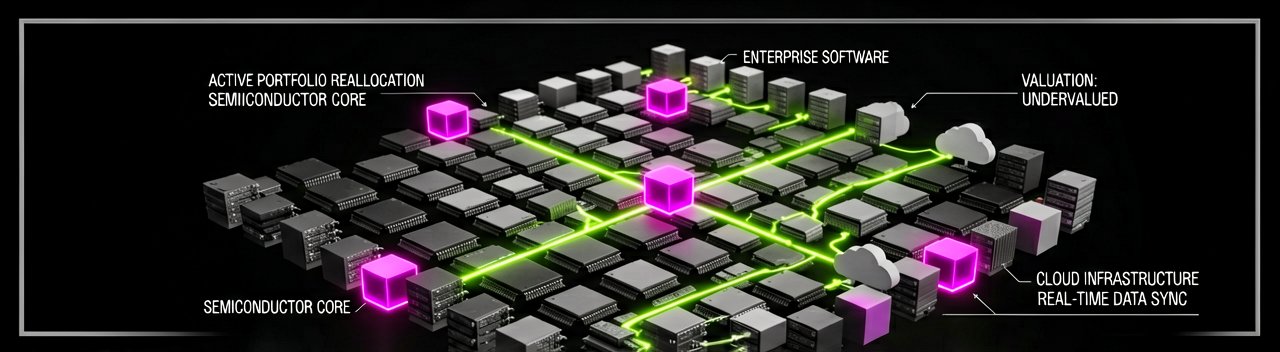
The primary mandate of next-generation active AI funds is to look beyond the obvious megacap hardware plays. Portfolio disclosures indicate that tactical managers are steadily building out-of-index positions in networking semiconductor innovators and cloud-neutral edge computing software providers. This diversification strategy helps insulate investors from sudden regulatory changes or supply-chain corrections that pose tail risks to heavily concentrated index funds. By prioritizing specialized patent portfolios and scalable enterprise revenue streams over pure market capitalization, active ETFs are redefining how global investors capture the long-term economic upside of the evolving machine learning supercycle.
Behind the Scenes: Inside the High-Stakes Battle for Algorithmic Alpha
What Most Reports Miss: The current pivot toward actively managed artificial intelligence ETFs is not simply a search for cheaper stocks, but a structural rebellion against the rigid mechanics of passive indexing. Institutional asset managers are increasingly vocal about the structural vulnerabilities of market-cap-weighted indices, which have inadvertently concentrated billions of dollars into a handful of mega-cap silicon providers. Prominent actively managed vehicles, such as the Roundhill Generative AI & Technology ETF, are designed from the ground up to counteract this distortion. By utilizing dynamic investment committees rather than fixed index adjustment schedules, these funds actively reallocate capital away from overextended monopolies and toward emerging software layer opportunities.
From a trading desk perspective, the operational superiority of active management manifests during periods of extreme sector volatility. Traditional tech indices are bound by strict, quarterly rebalancing schedules that force them to buy high and sell low when tracking sharp market shifts. Conversely, portfolio managers leveraging data insights from platforms like Morningstar can execute intra-day tactical adjustments. This rapid execution protocol allows active funds to capture immediate mispricings during sudden market corrections, insulating retail investors from the cascading sell-offs that frequently plague hyper-concentrated passive instruments.
The strategic shift also introduces a brand-new mandate for security selection that targets the entire global AI value chain rather than standalone hardware plays. Fund researchers are deeply analyzing secondary layers of infrastructure, heavily weighting companies that specialize in advanced liquid cooling systems, high-bandwidth memory, and optical connectivity networks. This deliberate diversification beyond the silicon moat ensures that the portfolios remain highly resilient even if hardware margins across the broader semiconductor industry begin to normalize over the next multi-year market cycle.

Ultimately, this regulatory and tactical evolution represents a maturation of the thematic technology fund landscape. By placing experienced human stewards at the helm of sophisticated asset allocation models, actively managed ETFs successfully bridge the gap between speculative venture capital agility and liquid public equity accessibility. The ongoing capital migration into these active strategies proves that surviving the next wave of technological disruption requires a flexible, unconstrained approach to global portfolio construction.
Reading Between the Lines: The Actively Managed Mirage and the Valuation Trap
Reading Between the Lines: The promotional narrative surrounding active AI ETFs presumes that human stock-pickers possess a structural advantage over passive algorithms in identifying future market leaders. However, history suggests that outperforming a hyper-concentrated index during a parabolic tech cycle is an exceptionally rare feat for active managers. Wall Street marketing departments frequently conflate the agility of active trading with an ability to predict technological breakthrough points. In reality, shifting capital away from dominant megacaps prematurely can severely drag down relative performance, as many fund managers discovered while watching pioneering silicon giants defy traditional valuation models year after year.
A fundamental contradiction lies at the heart of these next-generation investment vehicles. While these funds claim to protect retail portfolios from the volatility of concentrated passive indices, their search for alternative alpha routinely drives them into highly speculative, illiquid small-cap and mid-cap technology stocks. By substituting the systemic risk of an overvalued megacap for the idiosyncratic risk of unproven software startups, these portfolios can inadvertently amplify downside volatility during broader market corrections. Furthermore, the higher management fees associated with active oversight place an immediate, compounding drag on net returns, meaning active managers must achieve near-flawless execution just to match the baseline performance of a low-cost index tracking the broader tech landscape.
The long-term operational viability of these specialized portfolios faces an impending test as enterprise AI monetization matures. The financial industry's projection of a multi-trillion-dollar spending boom assumes that corporate buyers will indefinitely fund massive capital expenditures without seeing immediate improvements in profit margins. If the enterprise software layer fails to generate tangible efficiency gains over the coming quarters, capital expenditures will sharply contract across the entire infrastructure ecosystem. Actively managed funds, despite their promised flexibility, will find few safe havens in a sector-wide re-pricing where both the legacy hardware giants and the speculative infrastructure challengers face simultaneous valuation corrections.
Ultimately, the rapid proliferation of active AI investment vehicles reflects the cyclical nature of financial product manufacturing rather than a guaranteed roadmap to superior alpha. Wall Street consistently engineered specialized funds to capture retail enthusiasm at the peak of previous tech cycles, only for those vehicles to quietly merge or close once market hype normalized. While the flexibility to adjust portfolio weightings on short notice is a powerful asset in theory, the ultimate success of these funds hinges entirely on whether human managers can outsmart a market that has historically rewarded patient, passive exposure to the largest and most capitalized tech giants on earth.
"Investing in a fund that promises to find the next generation of artificial intelligence hardware giants is a bit like hiring a scout to locate a better wheel; you are paying a premium fee for the privilege of hoping that someone, somewhere, somehow manages to reinvent something that already works perfectly."
Artūras Malašauskas is an AI Systems Integrator with 20+ years of production-grade web engineering experience. He has designed, shipped, and scaled enterprise Python/PHP systems for logistics, SaaS, and public-sector clients. For the past year, he has focused exclusively on AI integrations: deploying open-source LLMs, building generative media pipelines (image, audio, video), and engineering multi-agent workflows for real production environments. His standard: reproducibility, security, cost-efficient inference—no vaporware. He documents and evaluates emerging AI tooling, separating verified capabilities from marketing noise. Technical editor at: muza-ai.eu, ai-verslas.lt, ai-naujinos.lt Connect on LinkedIn
Comments