Nebius AI Cloud 3.6 Pulls AI Out of the Sandbox and Into the Enterprise

For a long time, the real headache in artificial intelligence hasn't been building a cool model; it's been keeping that model from breaking the bank, leaking data, or crashing when it hits real-world scale. The newly unveiled Nebius AI Cloud 3.6, internally dubbed "Aether," directly attacks this operational friction. By combining a suite of advanced governance frameworks with streamlined developer tools, the platform focuses heavily on giving enterprises the control and confidence they need to shift their workloads from experimental sandboxes to heavily regulated, production-grade environments.
Instead of forcing engineers to juggle complex configurations, Nebius is leaning into automation and natural language. The standout developer upgrade is Nebius Echo, an integrated AI assistant that gives engineers conversational control over their infrastructure right from the web console. Crucially, it features built-in guardrails to stop any accidental, multi-million-dollar deployment disasters. For the compliance crowd, version 3.6 brings a Key Management Service with customer-managed encryption keys, Workload Identity Federation for credential-free authentication, and a "Bring Your Own Image" option within Managed Kubernetes to satisfy strict regulatory audits. FinOps teams also get a nod with new granular budget controls and threshold alerts designed to curb runaway cloud spending.
Eliminating the Storage Bottleneck
You can't talk about enterprise AI without talking about massive data pipelines, and that is where the architecture translates directly into raw performance metrics. Nebius 3.6 tackles typical training and inference bottlenecks by deploying local SSDs directly on GPU servers for hyper-fast caching. Meanwhile, a new Intelligent Object Storage Class cuts down on long-term data management costs by automatically tiering archived data without hitting users with request or egress fees. On the performance front, the upgraded storage class boosts single-threaded read bandwidth by 30%. The shared filesystem sees an even sharper jump: 4K file operations deliver 3x more IOPS, while metadata-heavy workloads get up to a 100x IOPS surge on validated clusters scaling up to 100 PB. It is a clear sign that Nebius wants to be taken seriously as a full-stack, enterprise-ready powerhouse.
Behind the Scenes: Building a cloud architecture that can handle modern large language models requires looking past standard compute infrastructure. While standard enterprise workloads bottleneck on CPU-to-memory channels, massive deep learning pipelines stress-test the cloud's underlying networking fabric and storage layout. The "Aether" release re-engineers how data sits relative to the compute core by modifying the internal scheduling mechanisms within Managed Kubernetes. Instead of treating storage as an external target, Nebius maps high-speed local NVMe scrapers directly into the container storage interface pods, entirely cutting out standard virtualized volume layers during checkpointing cycles.

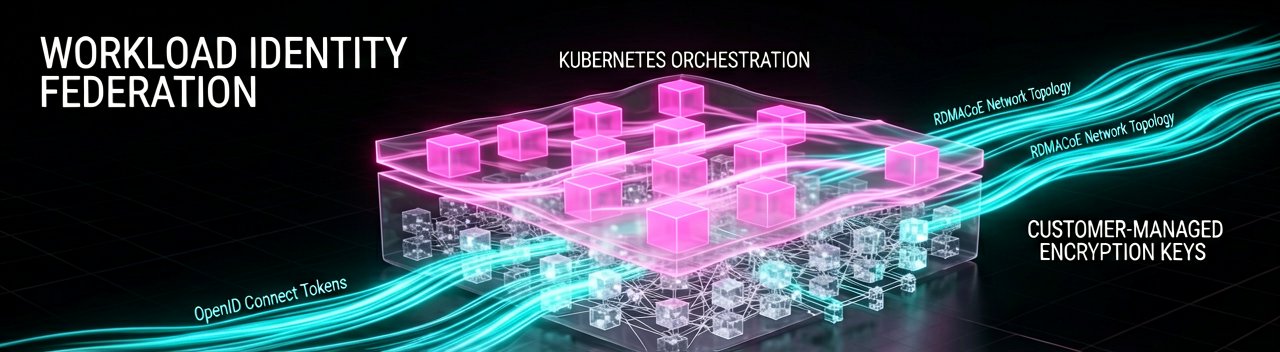
From a systems perspective, the most critical shift is how the platform handles cross-rack communications during massive distributed training runs. The architectural backbone utilizes a flat, non-blocking network topology that heavily relies on Remote Direct Memory Access over Converged Ethernet. By moving to this setup, the platform avoids traditional kernel network stack overheads, enabling GPU clusters to communicate memory-to-memory. Systems engineers know that a single delayed worker can stall an entire synchronous training iteration; by minimizing jitter at the hardware layer, the platform maintains a highly consistent execution timeline even when scaling up to thousands of interconnected chips.
Optimizing the I/O Path
The performance breakthroughs in version 3.6 stem directly from how the engineering team restructured metadata processing within the shared filesystem. In typical object storage architectures, querying a directory containing millions of tiny weights or tokenized text files creates a severe metadata bottleneck. Nebius solves this by introducing a distributed, in-memory metadata caching layer that completely decouples namespace lookups from the underlying object storage blocks. This architectural separation explains the massive 100x IOPS spike on metadata-heavy operations, effectively preventing the compute clusters from sitting idle while waiting for file tables to resolve.
On the security and compliance front, integrating Workload Identity Federation directly into the core orchestration layer removes the need for long-lived, hardcoded API keys. Systems administrators can map OpenID Connect tokens directly to granular cloud permissions. This means a continuous integration worker can authenticate, provision a cluster, and spin down without ever exposing a static credential. By weaving security into the low-level infrastructure rather than treating it as an afterthought, the platform successfully balances strict enterprise governance with raw hardware efficiency.
Reading Between the Lines: While Nebius AI Cloud 3.6 presents a compelling blueprint for corporate-compliant AI infrastructure, the industry-wide rush toward natural-language governance demands a healthy dose of skepticism. The introduction of Nebius Echo as a conversational control mechanism for cloud infrastructure sounds revolutionary on paper, but it sits on a delicate edge. Entrusting an AI agent with the keys to complex, multi-million-dollar environments relies entirely on the assumption that its built-in guardrails are foolproof. In reality, the systems community knows that deterministic software rules still outclass probabilistic AI models when it comes to preventing absolute catastrophic misconfigurations.
There is also a fascinating paradox in the way this release balances cost control with performance upgrades. Nebius rightfully champions its new FinOps budget controls and threshold alerts to curb runaway cloud spending, yet simultaneously boasts of architectural overhauls that make it easier than ever to scale workloads up to 100 PB. Providing a sleeker, faster pipeline to consume compute inevitably induces demand. Enterprises may find that the efficiency gains from local SSD caching and zero-egress storage tiering simply encourage developers to run heavier, more frequent training jobs, effectively neutralizing the promised budgetary guardrails.
The Realities of Sovereign AI Compliance
Furthermore, the push for customer-managed encryption keys and Workload Identity Federation highlights the growing fragmentation of the global AI cloud market. By designing features specifically for strict regulatory audits, Nebius is leaning into the "Sovereign AI" narrative to carve out a niche against hyperscale incumbents. However, adding layers of external key management and federated identity invariably introduces operational overhead. For many mid-sized enterprises, the human capital required to manage these advanced security configurations without locking themselves out of their own infrastructure might outweigh the plug-and-play simplicity they initially sought in a specialized AI cloud.
Ultimately, the true test for version 3.6 will not be its theoretical IOPS metrics, but how it behaves under the chaotic, mixed-workload conditions of a multi-tenant enterprise environment. Synthetic benchmarks on validated clusters rarely match the messy realities of data pipelines scraped together by disparate engineering teams. Nebius has built an impressive, high-performance sandbox with serious enterprise ambitions, but the burden now falls on enterprise IT departments to prove they can wield these advanced governance tools without choking their own development velocity.
"We are rapidly approaching an era where we use AI to manage the cloud, more AI to monitor that AI, and a third AI to audit the budget—meaning the ultimate bottleneck in enterprise deployment won't be GPU availability, but rather the sheer amount of coffee required by the humans supervising the algorithms."
Artūras Malašauskas is an AI Systems Integrator with 20+ years of production-grade web engineering experience. He has designed, shipped, and scaled enterprise Python/PHP systems for logistics, SaaS, and public-sector clients. For the past year, he has focused exclusively on AI integrations: deploying open-source LLMs, building generative media pipelines (image, audio, video), and engineering multi-agent workflows for real production environments. His standard: reproducibility, security, cost-efficient inference—no vaporware. He documents and evaluates emerging AI tooling, separating verified capabilities from marketing noise. Technical editor at: muza-ai.eu, ai-verslas.lt, ai-naujinos.lt Connect on LinkedIn
Comments