Claude Tag's Autonomous Workflows Signal Shift in Enterprise AI Adoption
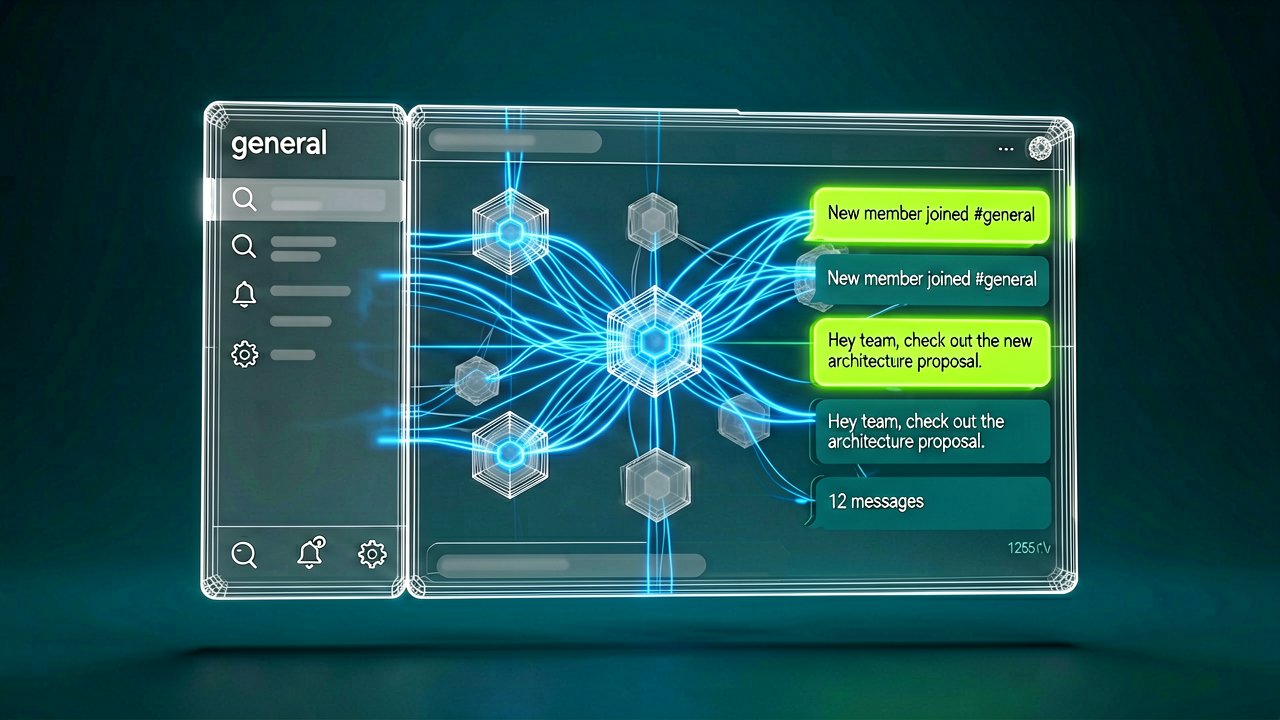
The enterprise artificial intelligence landscape has advanced from passive chat interfaces to active digital colleagues. Anthropic highlighted this shift by launching Claude Tag, a persistent, self-learning AI agent built directly into modern communication channels. Operating natively within workspace environments using the Opus 4.8 model, the system replaces traditional, isolated chatbot interactions by maintaining real-time awareness across team channels. The deployment signals a strategic push by Anthropic to integrate its technology into everyday organizational operations, transforming AI from a basic productivity utility into an active participant in team workflows, as detailed in the Anthropic Official Blog.
This rollout highlights a fundamental change in how software platforms deploy automation. Instead of forcing users to navigate away from their primary communication hubs to interact with isolated applications, Claude Tag introduces a shared, persistent presence that adapts to a company's internal knowledge base. Market competition for corporate context has intensified rapidly, with major infrastructure providers positioning themselves to control the shared data layers that power autonomous agents. Industry reporting from TechCrunch notes that platforms like Microsoft Graph, Snowflake, Databricks, and Glean are competing directly to serve as the intelligence engine that contextualizes enterprise data for AI systems.
Multiplayer Collaboration and Ambient Enterprise AI
The core structural innovation of this agent architecture is its public, multiplayer design pattern. Traditional AI tools function through isolated back-and-forth interactions between a single employee and a model. Claude Tag functions transparently within shared channels, allowing entire teams to view its operations, review its outputs, and update ongoing tasks. Administrators can activate ambient behavior to let the agent proactively track unresolved threads, monitor connected data pipelines, and flag urgent updates without requiring manual prompts. This transition turns software from a standard, on-demand utility into an independent assistant capable of managing complex workflows over extended periods.
Granular Compliance and Identity-Driven Data Security
Enterprise adoption of autonomous software relies heavily on strict security frameworks and access controls. To mitigate compliance risks, data access parameters are strictly compartmentalized by channel configurations rather than broadly applied across an entire organization. Administrators can restrict the agent's memory retention to designated working groups, creating isolated digital identities tailored to distinct departments like engineering, legal, or sales. This decentralized security approach ensures that sensitive operational information remains protected within its original context, preventing unauthorized internal data exposure while maintaining comprehensive audit logs and consumption limits.

Software Development Lifecycles Powered by Autonomous Code
The practical viability of persistent agents is demonstrated by their role in active software development environments. Internal usage metrics reveal that these systems can independently execute sophisticated development tasks, including generating complex scripts, debugging codebases, and managing active pull requests. According to statements published by Reuters, Anthropic relies heavily on internal iterations of its agent technology to manage its own infrastructure, with approximately 65% of the company's product team code now generated autonomously through these workflows. This high level of internal implementation proves that modern AI agents have moved beyond simple conceptual testing and are now capable of executing core technical tasks at scale.
Architectural Realignment and the Race for Organizational Graph Dominance
Beneath the Product Surface: The introduction of persistent agents reveals a fundamental shift in how enterprise software architectures manage real-time enterprise data. For years, workplace communication platforms operated primarily as passive message logs and static file repositories. By embedding a self-learning agent directly into these active communications, the underlying system shifts from a simple storage archive to a dynamic organizational memory network. Tech industry veterans recognize this transformation as part of a larger, highly competitive push to control the "organizational graph"—the central web of relationships, historical context, and specialized data that defines how a modern enterprise operates.
This structural change reshapes long-standing boundaries between developer toolkits, enterprise security, and the software interface layer. In standard enterprise setups, an employee must manually extract data from disparate applications, synthesize the information, and then write a prompt to an external AI model. Persistent agents eliminate these disjointed steps by remaining actively aware of changing channel contexts, shifting roles, and ongoing project adjustments. Early feedback from IT administrators shows that this design drastically reduces the need for manual prompt engineering, though it requires a significant upgrade in how organizations manage data access and verify identity within conversational threads.
From a product management standpoint, this rollout reflects a calculated move away from the traditional, siloed app store model. Rather than relying on third-party developers to build specialized tools on top of an LLM API, foundational model providers are moving upstream to build the core collaboration layer themselves. This approach lets them capture valuable operational context that third-party integrations usually obscure. While this development offers corporate clients smoother workflows right out of the box, it challenges independent software vendors who built their businesses on connecting large language models to everyday office applications.

The operational logic behind these systems also alters how businesses evaluate productivity and compute costs. Legacy AI assistants use a predictable cost structure tied to a user's direct, active queries. In contrast, an ambient assistant operating continuously across multiple shared channels runs asynchronous background processes that monitor streams of information even when users are offline. This continuous operation forces financial officers to move away from old per-user subscription metrics and adopt new, consumption-based resource tracking models designed for a workforce where digital agents and human employees collaborate in real time.
The Technical Friction of Unsupervised Enterprise Automation
Reading Between the Lines: The industry's rapid embrace of persistent, self-learning teammates ignores a fundamental paradox in modern software engineering: the friction between absolute predictability and non-deterministic systems. Corporate software infrastructure is built entirely on the expectation of reliable, reproducible outcomes, where an identical input always yields the exact same result. Flooding these brittle, high-stakes environments with autonomous agents introduces a permanent element of unpredictability into daily operations. While tech teams celebrate the efficiency of auto-generating 65% of their internal code repositories, security engineers are quietly warning about the long-term maintenance debt created by unvetted, AI-generated infrastructure changes.
This reality exposes a clear contradiction in the enterprise AI narrative regarding data privacy and ambient monitoring. Companies routinely claim to protect data boundaries by restricting an agent's memory to specific communication channels rather than applying it globally across the organization. Yet, the real-world utility of a self-learning assistant relies entirely on its ability to spot subtle patterns across different corporate departments, such as connecting product engineering bugs with customer support complaints. By strictly locking down data access to satisfy compliance departments, companies strip these agents of the broad context they need to deliver on their promise of autonomous, intelligent automation.
Furthermore, shifting from standard per-user licensing fees to consumption-based resource tracking introduces unpredictable, volatile expenses to IT departments. When software runs passively in the background—independently reading chat threads, checking server logs, and running scripts—the business is no longer paying for direct human utilization, but for a machine's continuous processing cycle. A single loop in an agent's reasoning process or an unoptimized automated script could quietly exhaust an organization's monthly compute budget over a weekend. As companies deploy these systems at scale, the primary barrier to adoption will likely shift from basic data security concerns to the unpredictable operational costs of keeping these digital assistants running around the clock.
"The ultimate irony of the autonomous workplace is that in our frantic race to replace humans with tireless digital teammates, we are creating a corporate ecosystem so complex, unpredictable, and expensive that we will eventually have to hire an entire new department of actual humans just to make sure the AI isn't hallucinating its way through the quarterly budget."
Artūras Malašauskas is an AI Systems Integrator with 20+ years of production-grade web engineering experience. He has designed, shipped, and scaled enterprise Python/PHP systems for logistics, SaaS, and public-sector clients. For the past year, he has focused exclusively on AI integrations: deploying open-source LLMs, building generative media pipelines (image, audio, video), and engineering multi-agent workflows for real production environments. His standard: reproducibility, security, cost-efficient inference—no vaporware. He documents and evaluates emerging AI tooling, separating verified capabilities from marketing noise. Technical editor at: muza-ai.eu, ai-verslas.lt, ai-naujinos.lt Connect on LinkedIn
Comments