IBM's OpenAI Cybersecurity Alliance Signals New Era in AI-Driven Threat Defense
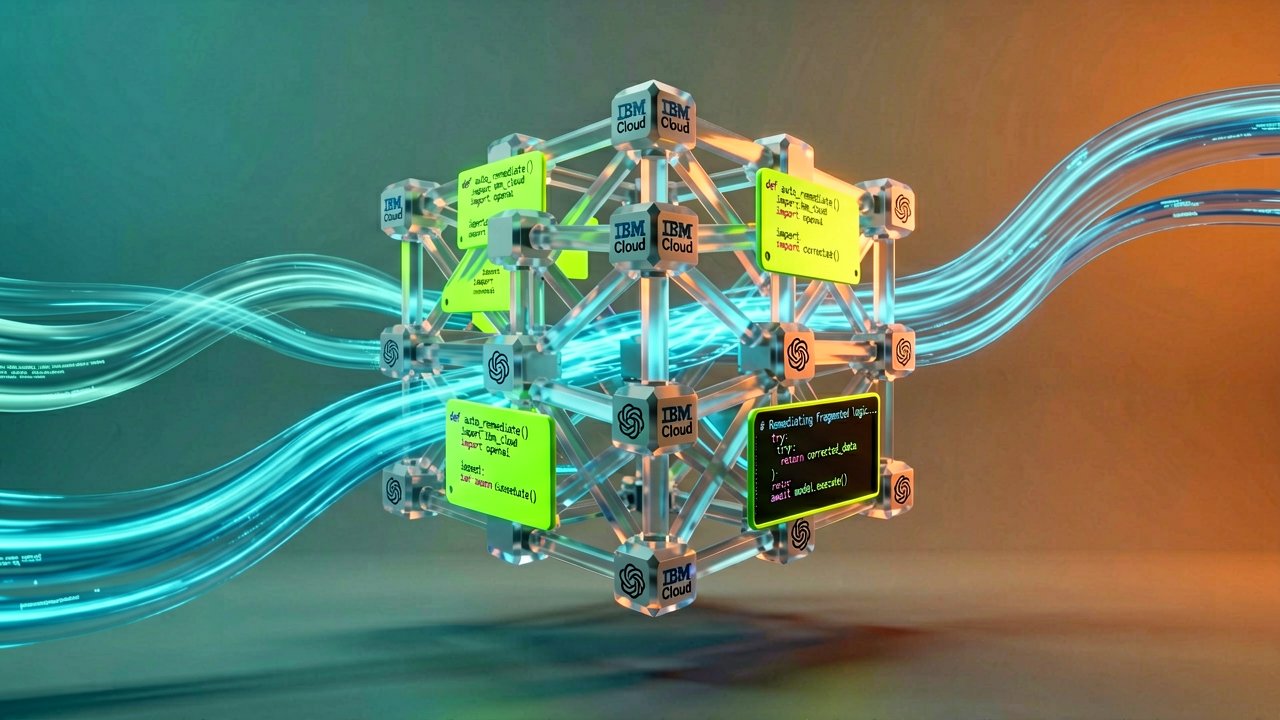
In a major consolidation of enterprise cloud infrastructure and frontier artificial intelligence, IBM has officially joined the newly unveiled OpenAI Daybreak Cyber Partner Program. This strategic alliance marks an industry shift toward automated, machine-speed defense mechanisms designed to counter adversarial AI attacks. Alongside the partnership announcement, IBM launched a dedicated application security service powered by OpenAI’s proprietary cyber-focused models. The integration aims to deliver precise software vulnerability scanning and remediation at scale, addressing a critical bottleneck in modern enterprise DevSecOps pipelines.
The market responded immediately to the news, reflecting strong investor confidence in the revenue potential of enterprise-grade AI defense tools. Following the disclosure, IBM shares climbed 3.6% in after-hours trading, emphasizing the premium Wall Street places on actionable enterprise AI deployments over speculative use cases. The new security service operates through the IBM Consulting Advantage platform, offering controlled, read-only repository integration to surface hidden architectural risks. This architecture ensures strict data compliance while utilizing generative AI to evaluate software weaknesses before they can be exploited in the wild.
This cyber defense push is heavily anchored by IBM and Red Hat’s massive $5 billion funding commitment toward Project Lightwell, an open-source security initiative launched in May 2026. The new OpenAI-backed application security service integrates directly into the Project Lightwell framework, combining OpenAI’s capabilities with other advanced models to review and patch complex open-source codebases. By embedding advanced frontier intelligence directly into business operations, the corporate alliance signals a definitive pivot from passive monitoring to proactive, automated code hardening.
Market Implications and Corporate Strategy
The alliance underscores a structural evolution in the cybersecurity ecosystem. Historically, legacy tech providers relied on static code analysis and heuristic filtering, systems that are increasingly inadequate against AI-orchestrated exploits. By anchoring its defensive strategy to OpenAI’s advanced capabilities, IBM positions its enterprise footprint as an indispensable layer for fortune 500 companies seeking automated resilience. The move directly challenges standalone security vendors, forcing a consolidation trend where infrastructure giants must align with top-tier AI model developers to maintain market relevance.

The Defensive AI Arms Race Intensifies
According to an official statement on the IBM Newsroom , the collaboration is explicitly designed to help enterprises keep pace with machine-speed threats. Tech industry reporting from Reuters indicates that OpenAI’s capabilities will run alongside other frontier LLMs within the Project Lightwell ecosystem to accelerate defensive workflows. Furthermore, an analysis by Quartz highlights that this partnership lands amid a fierce defensive AI arms race, noted by OpenAI's deployment of specialized models like GPT-5.4-Cyber and Anthropic's competing $100 million Glasswing initiative. By deploying these tools through IBM's extensive consulting network, both companies establish a standardized, highly regulated framework for utilizing generative AI within ultra-sensitive government and financial sectors.
Anatomy of a Strategic Deflection
Behind the Scenes: The IBM-OpenAI alliance is more than a standard corporate partnership; it is a calculated defensive maneuver designed to insulate both companies from shifting market vulnerabilities. IBM, long dependent on its legacy mainframe and hybrid cloud revenue streams, desperately needed to inject modern, high-profile generative AI capabilities into its enterprise security portfolio. While IBM’s own Granite models excel at highly specific, compliance-driven enterprise tasks, they lack the multi-modal agility required to counter the dynamic, multi-stage attack vectors currently being deployed by adversarial threat groups. By integrating OpenAI’s frontier intelligence, IBM effectively patches its own technological gaps while leveraging its unmatched consulting apparatus to monetize the deployment.
For OpenAI, the motivation centers entirely on enterprise trust and regulatory survival. The AI pioneer has repeatedly faced scrutiny regarding corporate data leakage, intellectual property compliance, and model hallucinations. By anchoring its specialized cyber models within IBM’s heavily regulated, read-only framework, OpenAI gains a secure environment to prove its enterprise utility without exposing sensitive intellectual property to public training sets. This structured deployment allows OpenAI to counter market narratives that describe generative AI as an inherent corporate security liability, instead repositioning its technology as an indispensable corporate shield.
This partnership also marks a fundamental shift in how corporations approach the software development lifecycle. For years, DevSecOps pipelines relied on static application security testing that generated high volumes of false positives, forcing human developers to spend hours vetting alerts. The introduction of OpenAI-powered remediation engines within the Project Lightwell ecosystem fundamentally alters this dynamic by shifting the burden from detection to automated code hardening. Enterprise stakeholders are increasingly prioritizing these autonomous systems, recognizing that human engineering teams cannot scale to meet the volume of software vulnerabilities introduced by AI-assisted code generation.

The broader tech landscape is already feeling the ripple effects of this consolidation, which places standalone cybersecurity providers in a precarious market position. Smaller, niche security firms that specialized purely in automated vulnerability scanning now find themselves competing against a vertically integrated stack that combines OpenAI’s reasoning capabilities with IBM’s massive deployment infrastructure. As fortune 500 enterprises migrate toward unified, platform-centric security solutions, the industry is likely to see an acceleration of mergers and acquisitions, with infrastructure giants absorbing legacy security tools to maintain pace with the IBM-OpenAI blueprint.
The Paradox of Automated Resilience
Reading Between the Lines: The corporate enthusiasm surrounding this alliance obscures a fundamental contradiction inherent to the current AI-driven security market. IBM and OpenAI are marketing a solution to a problem that their own industry accelerated. The exponential rise in sophisticated software vulnerabilities is heavily driven by the mass adoption of AI code-generation assistants, which frequently introduce subtle, hard-to-detect architectural flaws into production pipelines. By positioning this new partnership as the definitive antidote to machine-speed threats, both companies are effectively monetizing both sides of the cybersecurity equation: selling the generative tools that inflate the threat landscape, and then selling the frontier models required to clean up the resulting mess.
Furthermore, the reliance on automated remediation engines introduces an entirely new class of operational risk that enterprise leadership has yet to fully reconcile. Trusting an AI model to autonomously rewrite code repositories to patch security flaws assumes a level of deterministic accuracy that generative models simply do not possess. A flawed patch applied at scale across a financial institution or infrastructure provider could easily trigger widespread system outages that mirror the catastrophic impacts of an actual cyberattack. The industry is rushing toward autonomous defense without establishing clear legal or operational frameworks for who bears liability when an automated security patch inadvertently brings down a critical enterprise system.
There is also deep irony in OpenAI acting as a vanguard for enterprise data security given its historical struggles with model data governance and transparency. IBM’s emphasis on a restricted, read-only framework is a tacit admission that corporations remain deeply distrustful of how frontier AI developers handle proprietary codebases. While this controlled setup protects intellectual property, it simultaneously limits the real-time learning potential of the defensive models. By restricting the AI's ability to ingest and learn from active enterprise telemetry, the alliance may find itself permanently a step behind adversarial hackers who face no such ethical, legal, or architectural constraints when training their offensive toolkits.
Ultimately, this partnership may do less to revolutionize threat defense than it does to solidify a market duopoly. Under the guise of fostering open-source resilience through Project Lightwell, IBM and OpenAI are constructing a proprietary gatekeeping mechanism around corporate compliance standards. Smaller security firms and independent developers will find it increasingly difficult to compete or integrate with enterprise systems that mandate OpenAI-validated code signatures. Rather than democratizing cyber defense, the alliance risks creating a closed ecosystem where enterprise safety is a premium subscription service that only the wealthiest corporations can afford.
"We have officially entered an era where corporate networks are defended by the digital equivalent of an automated immune system, which is comforting until you remember that the same tech sector designed the pathogens, owns the digital pharmacy, and reserves the right to update the side effects during business hours."
Artūras Malašauskas is an AI Systems Integrator with 20+ years of production-grade web engineering experience. He has designed, shipped, and scaled enterprise Python/PHP systems for logistics, SaaS, and public-sector clients. For the past year, he has focused exclusively on AI integrations: deploying open-source LLMs, building generative media pipelines (image, audio, video), and engineering multi-agent workflows for real production environments. His standard: reproducibility, security, cost-efficient inference—no vaporware. He documents and evaluates emerging AI tooling, separating verified capabilities from marketing noise. Technical editor at: muza-ai.eu, ai-verslas.lt, ai-naujinos.lt Connect on LinkedIn
Comments