Samsung Accelerates Mega-Fab Expansion to Feed the Insatiable AI Boom

Samsung Electronics is officially throwing its immense financial weight behind an accelerated expansion of its mega-fab facilities to secure a dominant footprint in the exploding AI semiconductor landscape. In an aggressive bid to outpace rivals, the tech giant has accelerated the construction timeline for its massive Pyeongtaek semiconductor complex by roughly six months, hitting the gas on both the P4 and P5 lines to handle the industry's soaring hunger for advanced high-bandwidth memory (HBM) and next-generation DRAM nodes. This decisive production ramp-up comes as major global tech firms scramble for reliable chip allocation amid a historic bottleneck in the global AI hardware supply chain.
Chasing the AI Super-Cycle
According to a corporate filing and details reported by Reuters , Samsung’s leadership team under semiconductor chief Jun Young-hyun committed to a staggering capital and R&D investment of more than 110 trillion won—roughly $73.3 billion—slated for deployment throughout the year. Rather than spreading its bets thin, the enterprise is laser-focused on upgrading its infrastructure to mass-produce advanced sixth-generation 1c DRAM and cutting-edge HBM4 silicon, components that act as the fundamental backbone for training complex generative AI models and filling the server racks of modern hyperscale data centers. A recent report by KED Global notes that once the newest phases are fully realized, the combined capacity will push wafer output closer to Samsung's entire current manufacturing baseline, allowing it to offer massive volume to enterprise clients desperate to escape strict allocation caps elsewhere in the market.
A High-Stakes Geopolitical Gambit
This massive, multi-billion-dollar acceleration isn't just about adding cleanroom space; it's a calculated offensive to rewrite the hierarchy of global chip production. By combining line conversions in South Korea with its simultaneous multi-billion dollar manufacturing footprint expanding overseas in Texas, Samsung is deploying a "Shell First" strategy that installs cleanrooms well ahead of immediate tool orders so it can pivot production lines on a dime. This immense capital outlay comfortably eclipses the annual expenditure plans of its nearest foundry competitors, turning the current hardware shortage into a war of attrition where only a select few players possess the capital required to compete at the bleeding edge.
Behind the Scenes of the $73 Billion Cleanroom Race
What Most Reports Miss: Samsung’s massive multi-billion-dollar acceleration isn't just a reaction to current market shortages; it is a calculated structural defense of its foundational market share. While typical semiconductor facility buildouts require years of methodical preparation, Samsung’s use of its specialized "Shell First" strategy allows the company to erect the physical hulls of its Pyeongtaek P4 and P5 lines long before final tool configurations are set [Digitimes]. This approach grants them the unique logistical agility to convert empty factory floors into active production lines for HBM4 or 1c DRAM practically on a dime, depending on which way the winds of the AI chip market blow [Chosun]. It is a brutal, capital-intensive play that forces competitors to match pace or risk being structurally locked out of future volume contracts.

The urgency behind this deployment became glaringly obvious following strategic corporate maneuvering in the spring. In March, Samsung Electronics Vice Chairman and CEO Young Hyun Jun formally hosted AMD Chair and CEO Dr. Lisa Su at the Pyeongtaek campus to finalize an expanded partnership centered around next-generation HBM4 supply for AMD Instinct AI accelerators, as detailed by an official announcement on the Samsung Global Newsroom . Securing these high-profile, long-term enterprise commitments provides Samsung with the guaranteed demand required to justify burning through roughly $73.3 billion in a single calendar year, a budget that comfortably eclipses the total projected capital expenditures of even specialized leading foundries like TSMC [Bloomberg].
Furthermore, internal shifts within the Pyeongtaek campus illustrate how the tech giant is rethinking factory efficiency from the ground up to protect its margins. Beyond scaling up raw silicon wafer volume, Samsung is actively deploying purpose-built AI agents, autonomous digital-twin-integrated environmental safety systems, and specialized operating robotics throughout these new lines to optimize manufacturing workflows, according to operational strategies reported by Samsung Mobile Press. By turning these mega-fabs into fully autonomous, AI-driven factories, leadership aims to insulate its manufacturing yields from human error and volatile labor costs. This operational evolution ensures that when the next inevitable cyclical shift in the memory industry arrives, the Pyeongtaek complex will boast the lowest cost-per-bit production profile anywhere on the planet.
The Mirage of the Silicon Guarantee
Reading Between the Lines: The sheer scale of Samsung’s multi-billion-dollar cleanroom acceleration masks a delicate strategic tightrope walk that tech purists are observing with intense scrutiny. Historically, the semiconductor business operates on a ruthless cycle of feast and famine. By doubling down on massive physical infrastructure while the generative AI frenzy is at its peak, Samsung is placing an immense bet that the current exponential demand for hardware will remain linear for years to come. If big tech's massive cloud expenditures slow down before these triple-stacked cleanrooms reach optimal capacity, the company risks saddling its Device Solutions division with crushing depreciation costs reminiscent of the memory slumps that forced them to halt this exact same project just a couple of years ago.
There is also a glaring contradiction embedded within Samsung's dual identity as both an independent memory manufacturer and a contract foundry competitor. While the firm aggressively pitches its advanced 1c DRAM nodes and groundbreaking HBM4 modules as the ultimate "one-stop shop" solution for hyper-scalers, its corporate customers remain wary of over-reliance on a single entity. Tech giants frequently prefer to diversify their supply chains, separation being the preferred shield against antitrust friction and manufacturing bottlenecks. Samsung's massive push to absorb every layer of the AI stack under one roof might accidentally alienate fabless clients who are hesitant to hand over their proprietary designs to an enterprise that operates a rival contract foundry.
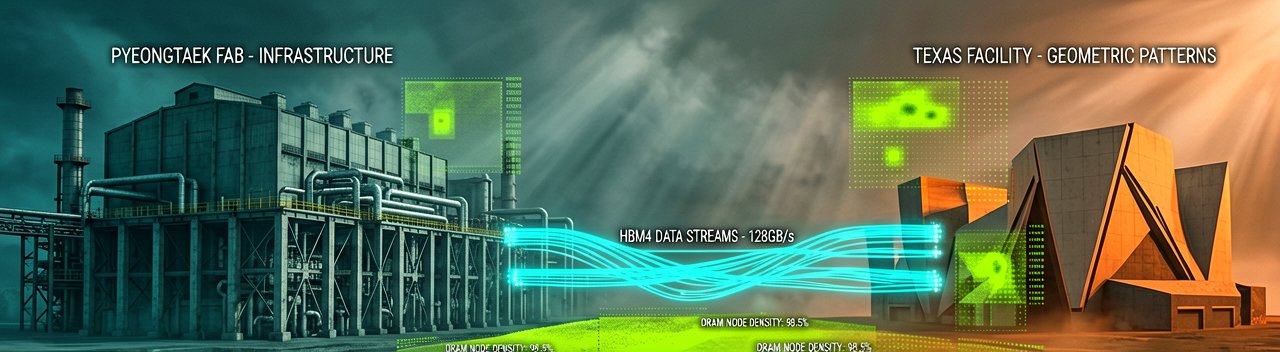
Furthermore, the physical realization of these mega-fabs relies heavily on external supply chains that Samsung cannot entirely dictate. Rushing the structural completion of the P4 and P5 lines by several months means nothing if the specialized extreme ultraviolet (EUV) lithography systems from Europe face shipping constraints, or if domestic energy grids cannot keep up with the soaring electricity demands of a fully automated mega-complex. If any of these peripheral dependencies buckle under pressure, Samsung's accelerated cleanrooms will sit as incredibly pristine, whisper-quiet monuments to executive ambition, waiting for the tools that make them profitable.
"Building a semiconductor empire on the back of an AI boom is a lot like pitching a massive tent during a gold rush: you might end up owning the most impressive piece of canvas in the valley, but you're still entirely dependent on the gold not running out before you finish driving the stakes."
Artūras Malašauskas is an AI Systems Integrator with 20+ years of production-grade web engineering experience. He has designed, shipped, and scaled enterprise Python/PHP systems for logistics, SaaS, and public-sector clients. For the past year, he has focused exclusively on AI integrations: deploying open-source LLMs, building generative media pipelines (image, audio, video), and engineering multi-agent workflows for real production environments. His standard: reproducibility, security, cost-efficient inference—no vaporware. He documents and evaluates emerging AI tooling, separating verified capabilities from marketing noise. Technical editor at: muza-ai.eu, ai-verslas.lt, ai-naujinos.lt Connect on LinkedIn
Comments