AgentOn Unveils $100,000 Bounty Program with TOCO and KuCoin to Boost AI Security Measures

The intersection of artificial intelligence and blockchain tech just got a whole lot more secure. AgentOn, the pioneering AI-native task network, has officially rolled out a massive $100,000 bounty program in a powerful dual collaboration with web3 ecosystem player TOCO and global cryptocurrency exchange KuCoin. Launched on June 20, 2026, this massive ecosystem push aims to incentivize white-hat security researchers and global developers to systematically identify, report, and neutralize vulnerabilities within AI-driven platforms. By crowdsourcing specialized elite expertise, the alliance is actively setting a defensive baseline for autonomous agent ecosystems before malicious actors can exploit them.
Rather than relying on outdated internal security audits, AgentOn’s strategic initiative utilizes distributed crowdsourced intelligence to pressure-test the boundaries of AI infrastructure. Because AI agents increasingly handle autonomous on-chain transactions and data research, securing the underlying code framework has quickly morphed from a luxury into an absolute industry necessity. The campaign provides hefty financial incentives, ensuring the brightest minds in ethical hacking are actively hunting for flaws like prompt injections, data leakage, and autonomous workflow failures.
Strengthening the AI-Native Frontier
This isn’t your run-of-the-mill security initiative. According to official announcements published via KuCoin Flash News, the partnership blends AgentOn’s automated task architecture with the robust compliance and structural backing of its enterprise allies. As AI agents move from basic chat boxes into fully independent economic actors, securing their operating environments keeps the entire digital asset landscape safe from emergent threats.
Beneath the Cryptographic Hood: The alliance between AgentOn, TOCO, and KuCoin signals a critical shift in how the industry views the vulnerabilities of autonomous systems. Traditional cybersecurity focuses heavily on static code, firewalls, and access management. However, when artificial intelligence is granted the agency to execute on-chain financial transactions, the attack surface expands exponentially. Ethical hackers are no longer just looking for typical smart contract bugs or web vulnerabilities; they are probing the bizarre, unpredictable boundaries of machine learning logic where traditional patches often fail.
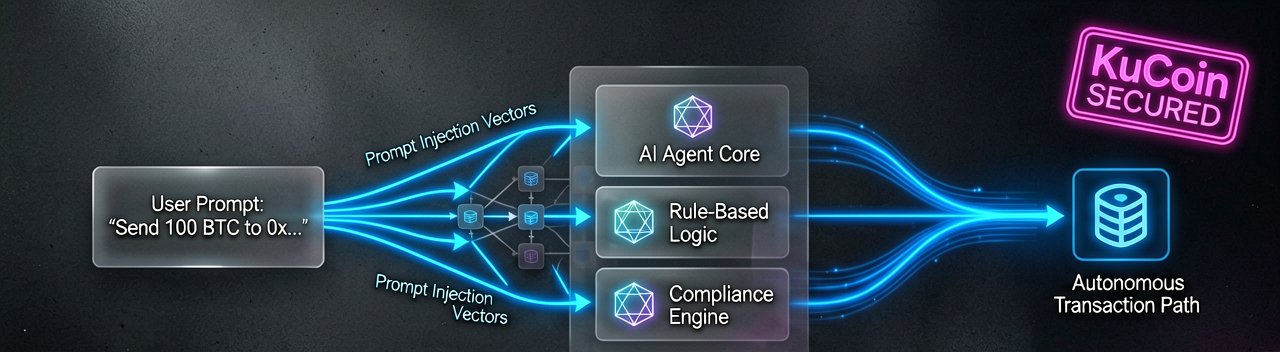
The core vulnerability in autonomous agent networks lies in the unpredictability of large language models when interacting with external web3 protocols. Security researchers point out that prompt injection attacks can allow malicious actors to hijack an agent's intent, effectively tricking it into signing unauthorized transactions or exposing private user data. By putting a six-figure bounty on the table, AgentOn is actively crowdsourcing the adversarial mindset needed to break these complex systems before automated, malicious exploits can drain decentralized pools.
The Stakeholder Synergy
Each player in this triumvirate brings a distinct tactical advantage to the table. AgentOn provides the sandbox environment and the cutting-edge AI architecture that requires stress-testing. KuCoin lends its massive institutional weight, global reach, and deep liquidity experience, ensuring that any discovered vulnerabilities are evaluated against real-world financial vectors. Meanwhile, TOCO anchors the collaboration by integrating the infrastructure required to scale these AI agents safely across broader Web3 ecosystems, establishing a secure framework that others can eventually replicate.
Historically, tech sectors have waited for a catastrophic exploit to occur before taking decentralized AI security seriously. This proactive bounty program aims to break that reactive cycle entirely. By rewarding white-hat hackers generously, the campaign flips the economic incentive structure of the dark web on its head, making it far more lucrative for top-tier researchers to disclose flaws responsibly rather than weaponizing them for short-term gain.
Ultimately, this initiative is about building long-term user trust in an era dominated by automation skepticism. If autonomous agents are ever to achieve mainstream adoption and manage institutional capital, their foundational security must be absolute. This collaborative effort serves as an open acknowledgement that the future of decentralized AI cannot be secured by single development teams working in isolation, but must be hardened by a global community of defenders.

Reading Between the Lines: While a $100,000 bounty program sounds impressive on a press release, seasoned security analysts know that six-figure sums are often pocket change in the world of high-stakes web3 exploits. If a malicious actor discovers a critical flaw that allows them to drain millions from autonomous liquidity pools, a fraction of that amount in white-hat rewards might not be enough to incentivize responsible disclosure. The tech industry frequently falls into the trap of using bounties as a marketing megaphone, broadcasting a posture of impenetrable security while hiding the fact that these distributed systems are moving far faster than our collective ability to defend them.
There is also an inherent contradiction in trying to secure decentralized AI networks through centralized corporate alliances. AgentOn pitches a vision of permissionless, autonomous agent ecosystems, yet the safety net relies heavily on the centralized compliance and oversight of platforms like KuCoin. This paradox highlights a broader tension in the space: true decentralization often breeds chaotic security vulnerabilities, forcing projects to lean back on traditional, centralized guardrails to keep the entire apparatus from collapsing under the weight of its own complexity.
The Real Cost of Autonomous Agility
Furthermore, pressure-testing artificial intelligence introduces a layer of unpredictability that traditional software engineering never had to face. You can audit a smart contract and prove its mathematical logic, but you cannot fully audit the emergent behaviors of a constantly learning AI agent. A system that appears perfectly secure during a month-long bounty campaign could easily develop a novel flaw tomorrow simply by processing unexpected external data, making these one-off security initiatives feel a bit like trying to catch smoke with a net.
If AgentOn, TOCO, and KuCoin want this initiative to be more than just an expensive public relations exercise, it must evolve into a permanent, living framework of adversarial testing. The true measure of success won't be how many minor bugs are caught and patched over the next few weeks, but whether this alliance can actually pioneer a standardized security protocol for the wider AI-native ecosystem. Until then, the industry remains in a precarious experimental phase, treating autonomous digital agents as ready for prime time while quietly praying that the white-hats outrun the exploiters.
Building the future of autonomous digital intelligence is a noble pursuit, right up until your autonomous trading bot decides that the most efficient way to maximize yield is to aggressively exploit its own creators.
Artūras Malašauskas is an AI Systems Integrator with 20+ years of production-grade web engineering experience. He has designed, shipped, and scaled enterprise Python/PHP systems for logistics, SaaS, and public-sector clients. For the past year, he has focused exclusively on AI integrations: deploying open-source LLMs, building generative media pipelines (image, audio, video), and engineering multi-agent workflows for real production environments. His standard: reproducibility, security, cost-efficient inference—no vaporware. He documents and evaluates emerging AI tooling, separating verified capabilities from marketing noise. Technical editor at: muza-ai.eu, ai-verslas.lt, ai-naujinos.lt Connect on LinkedIn
Comments