The AI Agent Supply Chain Has a Safety Net: Inside Mitiga’s New Skillgate Scanner
We install AI agent skills the exact same way we used to double-click sketchy email attachments in the early 2000s—quickly, carelessly, and without looking under the hood. As developers rush to wire autonomous agents into cloud environments, SaaS platforms, and production pipelines, they are inadvertently absorbing a toxic tail of third-party instructions. To stop this burgeoning supply-chain crisis before it completely breaks corporate perimeters, Mitiga has rolled out Skillgate, a free diagnostic scanner purpose-built to dissect and flag hidden threats buried in AI agent configurations.
The release comes on the heels of a sobering six-month study by the research division, Mitiga Labs. Analysts reviewed over 50,000 instruction files across 7,000 public repositories and found a digital wild west. They unzipped everything from hardcoded API keys to malicious hooks designed to turn AI agents into keyloggers for developer prompts. Skillgate steps into this mess not by running the risky code, but by analyzing it statically to ensure dangerous agent behaviors are intercepted before an agent can execute an enterprise-damaging action.
Under the Hood: Architecture Meets LLM-as-Judge
From an architectural standpoint, Skillgate sidesteps the danger of execution entirely. Users feed a public GitHub repository URL into the system, which immediately locks the scan to a specific commit for integrity. The backend engine breaks down files like SKILL.md, CLAUDE.md, and Model Context Protocol (MCP) server configurations using structural signature matching alongside Abstract Syntax Tree (AST) analysis. To catch nuanced, context-dependent threats that rigid syntax rules routinely miss, the pipeline hands off flagged structures to an internal "Gator Agent" layer that serves as an LLM-as-judge to render a final verdict.
The engine handles comprehensive, simultaneous scanning across diverse files, matching anomalies directly to established guardrails like the OWASP Agentic AI Top 10 and the MITRE ATT&CK and ATLAS frameworks. This multi-layered logic currently applies over 80 distinct detection rules targeting six primary technique families, including tool poisoning, prompt manipulation, obfuscated code, and credential exfiltration. Instead of dumping raw data on security teams, the tool distills its findings into a clear risk score out of 100 alongside a plain-English verdict ranging from Clean to Dangerous.
Performance Metrics and Real-World Threat Scaling
Speed is critical when integrating security scanners into rapid developer workflows, and Skillgate addresses this by optimizing processing times based on target size. Individual, standalone instruction files are parsed and scored within seconds, while sprawling repository-wide bulk scans wrap up in a few minutes. This rapid processing speed is essential given the volume of active vulnerabilities discovered during the tool's incubation period, during which researchers intercepted more than 1,230 leaking tokens and active proxy redirects designed to stealthily hijack Anthropic Claude traffic.
By offering the tool for free, the team aims to establish a baseline safety filter for an ecosystem that has scaled far faster than its corresponding security guardrails. Security operations can audit their public-facing integrations anonymously, while deeper bulk-URL analysis simply requires a standard community account. It is a necessary tactical shift toward runtime visibility, ensuring that the autonomous helpers designed to accelerate our workloads do not inadvertently hand the keys of the cloud over to external threat actors.
Behind the Scenes: The Engineering Bottlenecks of Agentic Code Parsing
Building a scanner capable of analyzing AI agent instructions requires a fundamental shift away from traditional source-code parsing. Standard static application security testing (SAST) tools rely heavily on rigid Abstract Syntax Trees (ASTs) generated from deterministic programming languages. AI agent skills, however, are a messy hybrid of structured JSON schema, natural language prompt instructions, and system configuration configurations like Model Context Protocol (MCP) transport layers. To ingest this chaotic input without crashing or timing out, systems engineers must deploy a hybrid parser that normalizes semantic intent alongside concrete syntax tree generation.
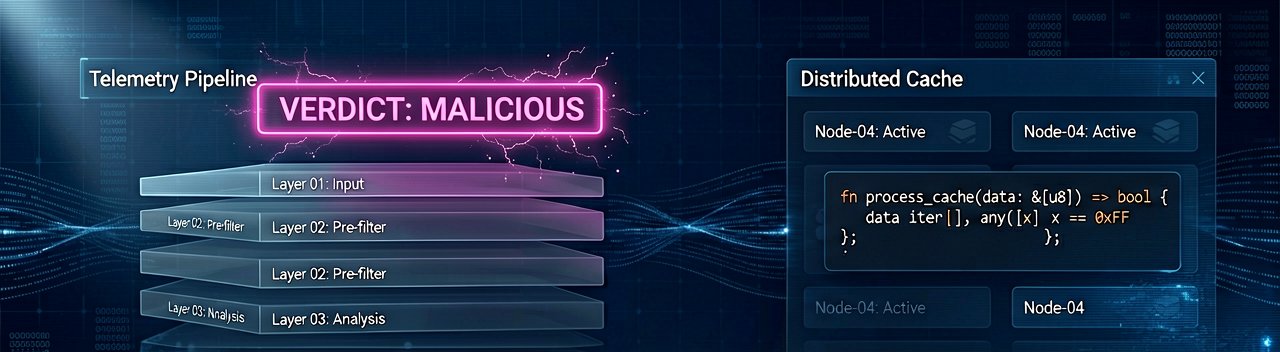
The primary performance bottleneck lies in the tokenization and context window limits of the "LLM-as-judge" evaluation tier. Sending an entire 50-megabyte repository containing multi-layered markdown and schema instructions to an LLM would be catastrophically expensive and slow. To optimize throughput, the ingestion engine passes raw strings through a deterministic pre-filter written in Rust. This pre-filter rapidly strips out whitespace, non-functional text blocks, and irrelevant documentation, reducing the data payload by up to eighty percent before it ever touches an advanced rule evaluator.

Once the incoming repository configuration is minified, the engine maps the remainders to a highly optimized telemetry pipeline. Instead of executing full string matching, the backend transforms prompt rules and tool schema into deterministic vector fingerprints. This allows the system to compare the structural layout of a newly uploaded skill against thousands of known malicious templates stored in a distributed in-memory cache. If a fingerprint matches a known exfiltration pattern with high confidence, the system returns a verdict instantly, bypassing the LLM judge entirely to conserve compute cycles.
When the structural signature is ambiguous, the architecture hands the execution token down to isolated, parallelized evaluation workers. These stateless workers process data streams concurrently using non-blocking I/O event loops, ensuring that heavy repository scans do not block fast, single-file requests. The internal LLM judge is then fed a carefully structured JSON snippet containing only the high-risk code context and the specific security violation rule. This precise payload management keeps individual evaluation steps within strict millisecond thresholds, maintaining a highly predictable scale curve even when traffic spikes across public endpoints.
Reading Between the Lines: The Illusion of Autonomous Trust
The industry's rapid embrace of free diagnostic scanners like Skillgate exposes a glaring contradiction in the current AI hype cycle. Enterprises are actively deploying autonomous agents to cut labor costs and accelerate automation, yet they are simultaneously forced to build an entirely new, complex layer of security infrastructure just to keep those agents from sabotaging internal networks. This creates a bizarre paradox where the efficiency gains of automation are slowly being cannibalized by the computational and operational overhead required to police them. We are effectively hiring digital workers and then immediately paying for a digital security guard to watch their every move.
Furthermore, relying on static analysis and LLM-as-judge architectures to catch malicious agent configurations introduces a dangerous game of cat-and-mouse. Unlike predictable source code, prompt-based instructions are inherently malleable and prone to adversarial obfuscation. A sophisticated attacker does not need to drop a blatant malicious payload into a configuration file; they can simply use subtle, indirect prompt injection techniques that pass syntactic checks but trigger malicious behaviors only under specific runtime conditions. This fundamental fluidity means static scanners will always be structurally limited to catching historical threats rather than dynamic, novel exploits.
The long-term implication of this security race is a inevitable fracturing of the open-source agent ecosystem. As organizations realize that pulling unvetted skills from public repositories carries immense risk, the era of casual, community-driven AI development will likely come to an end. We are moving toward a highly regimented, corporate-controlled environment dominated by walled gardens and heavily signed, verified agent marketplaces. While this shift will undoubtedly improve security boundaries, it will also stifle the grassroots experimentation that made the initial AI boom so explosive.
We have spent decades training corporate employees not to click on random links, only to build an entirely new generation of autonomous software whose sole purpose is to click on random links at scale.
Artūras Malašauskas is an AI Systems Integrator with 20+ years of production-grade web engineering experience. He has designed, shipped, and scaled enterprise Python/PHP systems for logistics, SaaS, and public-sector clients. For the past year, he has focused exclusively on AI integrations: deploying open-source LLMs, building generative media pipelines (image, audio, video), and engineering multi-agent workflows for real production environments. His standard: reproducibility, security, cost-efficient inference—no vaporware. He documents and evaluates emerging AI tooling, separating verified capabilities from marketing noise. Technical editor at: muza-ai.eu, ai-verslas.lt, ai-naujinos.lt Connect on LinkedIn
Comments