The Spatial AI Takeover: Stripping the Hype from NVIDIA's XR AI Beta
For years, extended reality has felt like a technology perpetually stuck five minutes in the future. We've been promised lightweight, stylish augmented reality glasses that can effortlessly overlay helpful context onto our daily lives, yet the reality usually involves bulky headsets or processors that run hot enough to cook an egg. NVIDIA is aiming to break that computational bottleneck with its public beta launch of the NVIDIA Blog XR AI platform. By shifting the crushing weight of spatial AI workloads away from the wearable device itself and distributed across a network of cloud, data center, and edge GPU resources, the chip giant is betting it can finally make truly smart glasses a practical reality for hands-on workers.
This isn't just about rendering prettier holograms; it's an ambitious play to introduce autonomous, multimodal AI agents into heavy-duty physical environments. Instead of relying on rigid, pre-programmed scripts, the platform utilizes real-time inputs—weaving together video, audio, depth, pose, and sensor telemetry—to help an on-device agent understand exactly what a human is looking at and doing. According to technical documentation on the NVIDIA Developer portal, developers can plug these complex streams directly into advanced vision-language models like NVIDIA Cosmos to give the agent a deep, physics-based understanding of the immediate spatial context. It's a pipeline built to transform standard AR hardware from a passive display into an active, thinking partner capable of automating frontline workflows, offering step-by-step guidance, and running quality verifications on the fly.
From Heavy Infrastructure to Zero-Latency Execution
The architecture succeeds or fails entirely on its ability to hide the latency of off-device processing. To bypass the strict thermal and architectural limits of untethered mobile hardware, NVIDIA relies on its RTX-powered server infrastructure to handle the foundational heavy lifting without forcing developers into aggressive model decimation. Crucially, the platform hooks into the NeMo Agent Toolkit to handle real-time reasoning and next-best-action logic, routing complex pipelines through optimized runtime frameworks to minimize the round-trip delay between a user's movement and the agent's response. Industry momentum is already building around this setup; major institutional research teams, such as those at the Stanford University School of Medicine and Princeton University, are deploying the framework via Rana's LabOS system to guide scientists through intricate laboratory experiments and gene-editing procedures in real time.
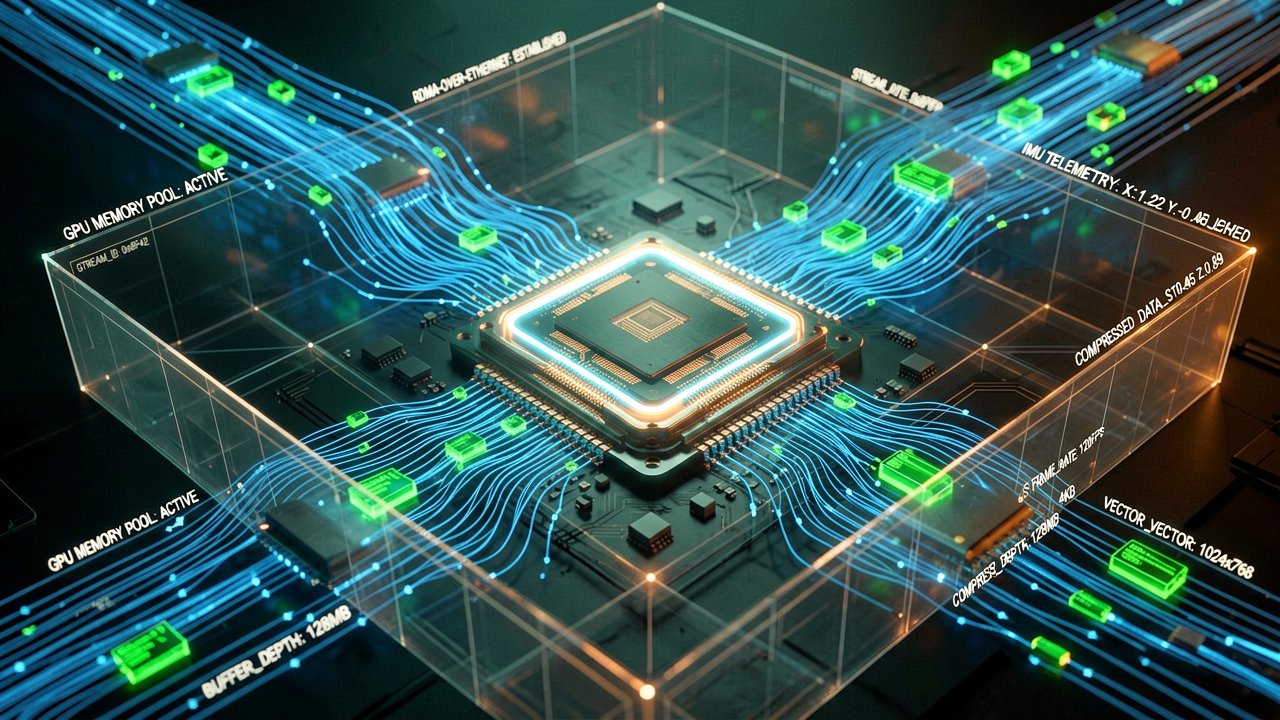
Behind the Scenes: Building a real-time spatial architecture means fighting a relentless war against photons, where every millisecond of transmission delay threatens to break user immersion or induce motion sickness. To keep the round-trip latency of off-device processing well under the human perception threshold, NVIDIA shifts away from monolithic execution structures. Systems engineers are looking at an architecture heavily dependent on highly optimized memory pipelines, where incoming sensor data from the wearable headset—including compressed video frames, inertial measurement unit telemetry, and high-frequency eye-tracking data—is directly streamed into high-bandwidth GPU memory pools via low-overhead networking primitives like RDMA over Converged Ethernet. This approach bypasses standard CPU host bottlenecks entirely, ensuring that raw environmental data hits the tensor cores almost instantaneously for immediate inference processing.
Optimizing the Distributed Inference Pipeline
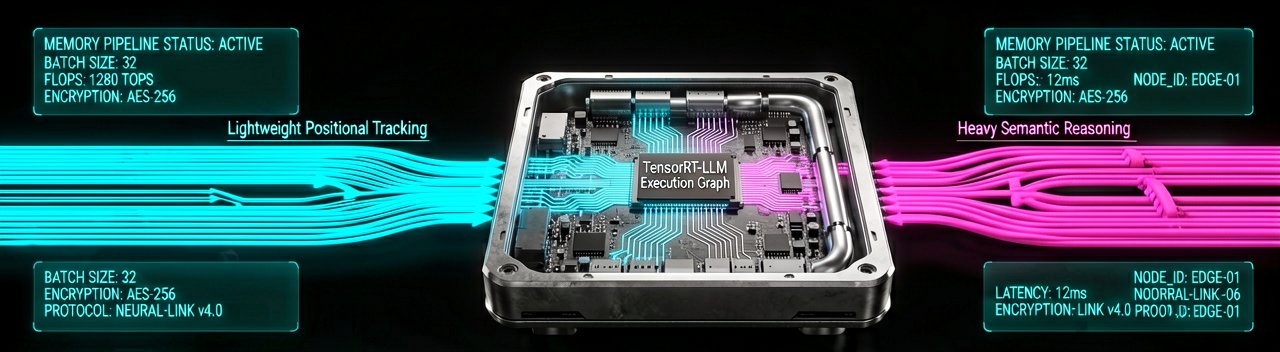
Once the data arrives at the edge cluster, the true computational magic happens within the spatial engine layer. Instead of running a generic, heavy vision-language model that would bottleneck the entire frame rate, the platform utilizes specialized execution graphs managed by NVIDIA TensorRT-LLM. The incoming data is split across parallel tracks; low-latency, deterministic tasks like positional tracking and surface meshing run on highly responsive, lightweight pipelines, while the heavy semantic reasoning—such as identifying a specific faulty valve in a complex industrial pipeline—is routed to larger, quantised models. By leveraging FP4 and INT8 quantization techniques natively supported by Blackwell and Hopper architectures, the system achieves a massive reduction in memory footprint and a major boost in throughput, enabling complex multi-modal models to run at interactive speeds without sacrificing the contextual precision required for high-stakes enterprise applications.
To further mitigate network jitter, the system implements advanced temporal reprojection algorithms directly inside the rendering loop. While the cloud-based AI agent generates semantic annotations and overlays, the local client device uses speculative rendering to adjust the position of those overlays based on the very latest IMU data from the headset. If a user quickly turns their head while a remote server is still processing the next AI frame, the local engine skews and repositions the existing overlay to match the new perspective perfectly. This distributed approach guarantees that the visual anchoring remains rock-solid at 90 or 120 frames per second locally, completely decoupled from the slightly slower update rate of the remote AI reasoning model.
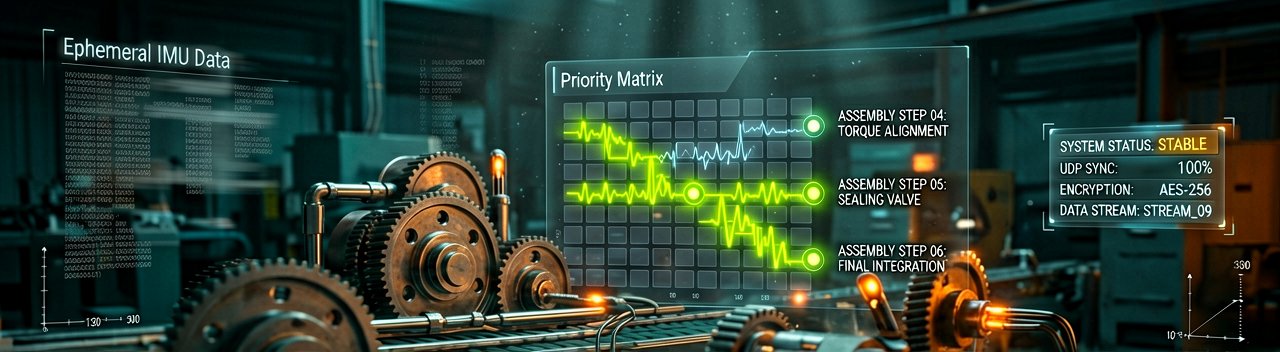
Managing the state synchronization between the physical user and the cloud-hosted agent requires a sophisticated orchestration layer that goes beyond traditional web sockets. The platform relies on a custom state-management protocol built on top of high-speed UDP streams, allowing the AI agent to continuously maintain a digital twin representation of the user’s immediate surroundings. When an engineer interacts with an object, the system uses a prioritization matrix to decide which data points need guaranteed delivery and which can tolerate packet loss. For instance, critical state changes like a completed assembly step are heavily verified, while routine head-movement coordinates are treated as ephemeral, ensuring that the network pipe remains clear for high-priority model updates.
Reading Between the Lines: The tech industry's sudden embrace of "Spatial AI" as the savior of extended reality smells remarkably like a rebranding exercise designed to mask a fundamental hardware stall. For nearly a decade, the narrative promised that Moore’s Law would eventually shrink desktop-class performance into a pair of sleek, all-day spectacles. Instead, NVIDIA's strategic pivot to the cloud effectively concedes that local silicon cannot win the thermal war required for truly intelligent, on-device spatial computing. By offloading the cognitive heavy lifting to the edge and the data center, we are not witnessing the triumph of miniaturization, but rather an elegant architectural compromise that trades device autonomy for raw computational muscle.
The Cloud Dependency Paradox
This off-device paradigm introduces an uncomfortable architectural contradiction regarding reliability and operating costs. While running quantized multi-modal models on enterprise server clusters sounds flawless in a presentation deck, it creates a fragile dependency on bulletproof, ultra-low-latency connectivity that simply does not exist in the messy reality of industrial field environments. A remote mining facility, a deep-sea oil rig, or even a shielded hospital basement frequently suffers from network dead zones and unpredictable jitter. Forcing an augmented reality headset to rely on a distant server cluster for basic semantic understanding means that when the connection drops, the device immediately loses its intelligence, reverting from a cutting-edge spatial agent into an incredibly expensive pair of safety goggles.
Furthermore, the economic math behind scaling these distributed XR AI workloads remains highly speculative for the average enterprise. Moving the processing loop to high-end infrastructure swaps a predictable, one-time hardware capital expenditure for an ongoing, highly volatile operational expense tied to server uptime and data egress fees. If every factory worker wearing a headset triggers continuous, multi-modal streaming pipelines into an edge cluster, the resulting infrastructure costs could easily eclipse the productivity gains the technology promises to deliver. Silicon Valley loves a recurring subscription model, but corporate accountants may look askance at a line item that charges them by the gigabyte just to keep their workers' digital overlays from stuttering.
Ultimately, this beta launch positions NVIDIA to establish a formidable moat at the infrastructure layer, ensuring that no matter who wins the hardware headset war, their back-end servers will power the ecosystem. By binding the spatial rendering loop tightly to their proprietary optimization runtimes and network protocols, they are quietly setting the stage for platform lock-in. Enterprise developers who build deeply integrated workflows around these specific cloud-edge pipelines will find it incredibly painful to migrate to alternative architectures later, effectively cementing a dependency on a single vendor's ecosystem before the spatial industry has even reached maturity.
We are told the future of computing is an invisible, omnipresent layer of intelligence floating gracefully in our field of view, though for now, that weightless illusion still requires a multi-billion-dollar data center humming loudly in the background just to remind us which way to turn a bolt.
Artūras Malašauskas is an AI Systems Integrator with 20+ years of production-grade web engineering experience. He has designed, shipped, and scaled enterprise Python/PHP systems for logistics, SaaS, and public-sector clients. For the past year, he has focused exclusively on AI integrations: deploying open-source LLMs, building generative media pipelines (image, audio, video), and engineering multi-agent workflows for real production environments. His standard: reproducibility, security, cost-efficient inference—no vaporware. He documents and evaluates emerging AI tooling, separating verified capabilities from marketing noise. Technical editor at: muza-ai.eu, ai-verslas.lt, ai-naujinos.lt Connect on LinkedIn
Comments