Code Maestro's Unity AI Integration Offers Granular, Project-Specific Development Assistance

Generic AI coding assistants have a habit of fracturing game development pipelines because they treat code as isolated text files. When a generic chatbot writes a script that accidentally breaks your game’s physics engine or ignores asset dependencies, developers spend more time fixing bugs than they would have writing the code by hand. Code Maestro solves this fundamental frustration by introducing project-aware AI tools tailored specifically for Unity developers and playable ad creators. By parsing the entire project ecosystem—including scenes, prefabs, UI hierarchies, and script architecture—this engine integration bridges the gap between raw code completion and systemic spatial awareness.
The magic behind this contextual awareness lies in an advanced Model Context Protocol (MCP) integration bridge built explicitly for game environments. This architecture connects deep development environments directly to the editor, granting the AI model full real-time visibility into active project states. Instead of forcing developers to copy-paste scripts into an external prompt window, the tool indexes your entire local directory and reads game-world relationships automatically. It understands what an Animator controller is, tracks prefab overrides, and knows precisely which objects are responsible for physical triggers or event systems. Through simple natural language, developers can command the editor to build assets, modify platforms, or configure active cameras without clicking through nested engine menus.
Intelligent Automation from Code to Canvas
This structural understanding translates directly into measurable workflow speedups. In practical testing scenarios, engineering teams have successfully utilized the tool to construct fully functional game mechanics from scratch in fractions of the traditional development time. For example, during a community deployment, developers built a reactive bot behavior system, resolved resulting console errors via automated debugging, and achieved a production-ready build in under twenty-five minutes. This level of granular assistance shrinks the standard onboarding time for new engineers by 70% to 90%, allowing fresh hires to comprehend deeply interconnected legacy codebases without tying up senior staff resources.
Beyond traditional desktop and console workflows, the integration redefines interactive advertising by embedding a specialized authoring suite for playable ads. Creating mobile marketing variants has historically required separate codebases or tedious hand-coding in HTML5 frameworks. Code Maestro sidesteps this hurdle by translating Unity canvas layouts directly into optimized ad assets. Creators can lay out gameplay grids visually, define matching mechanics or swiping rules via the AI assistant, and rely on validation agents to cross-check asset placement against real gameplay rules. The system completes the pipeline by automating the build distribution, generating highly compressed outputs tailored for various ad networks, and yielding a documented twofold increase in developer productivity.
Architectural Deep-Dive: Memory Mapping and AST Integration
Behind the Scenes: Traditional Large Language Models fail in game environments because they view code strictly as linear text strings rather than a multi-dimensional graph of dependencies. Code Maestro circumvents this limitation by implementing a lightweight, local abstract syntax tree (AST) parser that works concurrently with the Unity Editor’s compilation pipeline. Instead of flooding an external context window with thousands of lines of boilerplate code, the system generates an in-memory graph database of the entire project topology. This graph maps class inheritances, serialized fields, and explicit asset references, allowing the AI to understand exactly how a modified Monobehaviour script will impact an uncompiled prefab sitting inside an asset folder.
To prevent massive Unity projects from bottlenecking system memory or triggering extensive editor lag, the architecture relies on differential indexing. When a developer modifies a script or changes a scene hierarchy, the integration updates only the specific branches of the local dependency graph affected by that mutation. This incremental parsing engine processes project state shifts in under 50 milliseconds, running entirely on a background thread to preserve the editor's main thread performance. By maintaining this persistent, low-overhead semantic index locally, the tool provides the LLM bridge with targeted, highly compressed context packets that dramatically reduce token consumption while maximizing code generation accuracy.
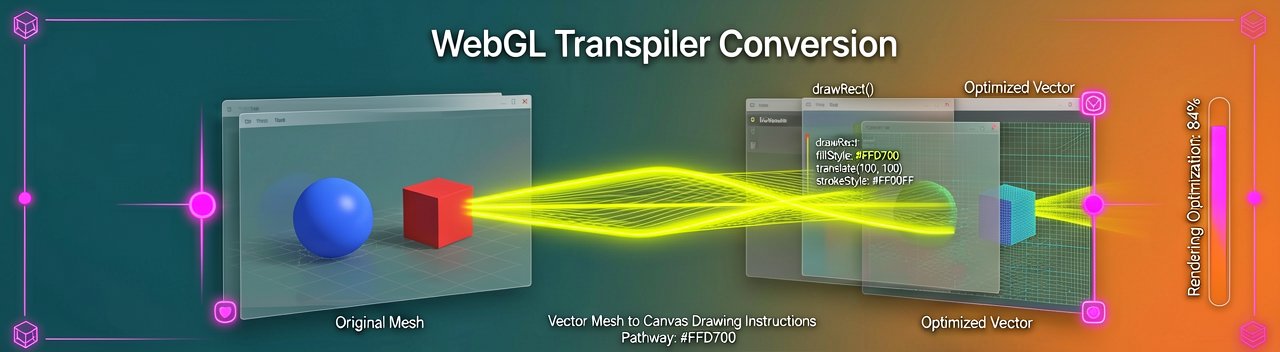
The translation from visual canvas layouts to interactive ad assets leverages a specialized WebGL transpiler pipeline designed to bypass traditional Unity build bottlenecks. Standard Unity WebGL exports often yield bloated file sizes that fail the strict memory limits imposed by mobile ad networks. To solve this, the integration analyzes the Unity UI canvas and strips away the heavy core engine runtime, replacing it with a highly optimized, custom JavaScript rendering engine. The AI identifies explicit gameplay hooks, converts C# event handlers into highly compressed, native browser execution loops, and packages the entire experience into a single self-contained HTML5 file under 5 megabytes.
Memory management during this conversion process is strictly prioritized via automated code splitting and vector asset optimization. The compilation engine automatically compresses audio clips and textures using modern web formats like WebP and WebM, while transforming complex vector meshes into lightweight 2D canvas drawing instructions. This drastic asset reduction guarantees rapid load times on low-end mobile devices, matching the performance profiles of hand-coded HTML5 marketing campaigns. Consequently, developers benefit from the rapid prototyping speed of the Unity editor while deployment pipelines receive a production-ready, ultra-optimized web deliverable.

The Hidden Cost of Automated Engines
Reading Between the Lines: The promise of turning complex game architecture into a series of conversational prompts sounds like an engineer's dream, but it glosses over a fundamental contradiction in software development. AI models are trained on historical data, meaning they excel at spitting out standardized, highly predictable design patterns. Game development, however, thrives on exploitation of edge cases, custom physics workarounds, and highly unorthodox code structures designed to squeeze performance out of limited hardware. By encouraging developers to rely on project-aware automation, the industry risks homogenizing gameplay mechanics into whatever structural patterns the model deems most mathematically probable.
Furthermore, local dependency mapping presents a significant security and computing overhead that few studios have adequately factored into their workflows. While updating a local dependency graph in 50 milliseconds sounds seamless on paper, scaling that architecture across a team of fifty developers working on a multi-gigabyte repository introduces massive version-control friction. When two developers use AI agents to refactor interconnected systems simultaneously, the potential for silent, logically valid but mechanically catastrophic merge conflicts skyrockets. The editor might compile the code without throwing a syntax error, but the systemic interplay between a modified script and a detached prefab could easily break downstream assets without triggering a standard compiler flag.
The highly compressed playable ad pipeline also invites healthy skepticism regarding long-term platform dependency. Stripping out the core Unity runtime to generate ultra-lightweight HTML5 wrappers is a clever engineering trick, but it essentially traps developers between two fragmented development pipelines. When Apple or Google alters mobile browser security protocols, developers will be entirely dependent on Code Maestro updating its proprietary JavaScript translation layers rather than relying on standard web development documentation. This shifts the bottleneck from manual web coding to platform-specific vendor lock-in, where a single breaking API change on the ad network's side could render automated builds instantly obsolete.
"We are rapidly approaching a future where an engineer will spend ten minutes writing a prompt, five minutes watching a stunning prototype compile, and three days trying to figure out why a stray piece of automatically generated JavaScript has caused a virtual button to permanently break the laws of physics on an older model smartphone."
Artūras Malašauskas is an AI Systems Integrator with 20+ years of production-grade web engineering experience. He has designed, shipped, and scaled enterprise Python/PHP systems for logistics, SaaS, and public-sector clients. For the past year, he has focused exclusively on AI integrations: deploying open-source LLMs, building generative media pipelines (image, audio, video), and engineering multi-agent workflows for real production environments. His standard: reproducibility, security, cost-efficient inference—no vaporware. He documents and evaluates emerging AI tooling, separating verified capabilities from marketing noise. Technical editor at: muza-ai.eu, ai-verslas.lt, ai-naujinos.lt Connect on LinkedIn
Comments