OrcaRouter’s Programmable AI Routing DSL: Under the Hood of Cost-Effective Performance
Anthropic recently upended the artificial intelligence infrastructure landscape with Claude Fable 5, a frontier model capable of staggering autonomous work but strapped with a wallet-melting cost of $10 per million input and $50 per million output tokens. For any enterprise spinning up production-grade agents, defaulting blindly to a model of this caliber is a fast track to budgetary ruin. The consensus among engineering teams has shifted overnight: you don't need a single mammoth model for every mundane query; you need a smart traffic controller. Entering the fray with a highly sophisticated solution is OrcaRouter, which just announced its new programmable Routing Domain-Specific Language (DSL).
This isn't another rigid, black-box meta-router trying to guess what you want. OrcaRouter has introduced a fully programmable control plane built into its AI Gateway, giving developers direct programmatic leverage via simple YAML configuration files and Common Expression Language (CEL) syntax. According to the official press release distributed via PR Newswire, the framework interfaces with over 200 leading language models through an OpenAI-compatible endpoint. Instead of standard, hard-coded logic, the DSL lets engineers write intricate execution graphs. You can analyze prompt complexity on the fly, route simple tasks to lightweight open-source models, run multiple specialized APIs in parallel, apply custom guardrails, and only escalate to frontier engines when a task demands absolute depth.
The Architecture of the Multi-Arm Bandit
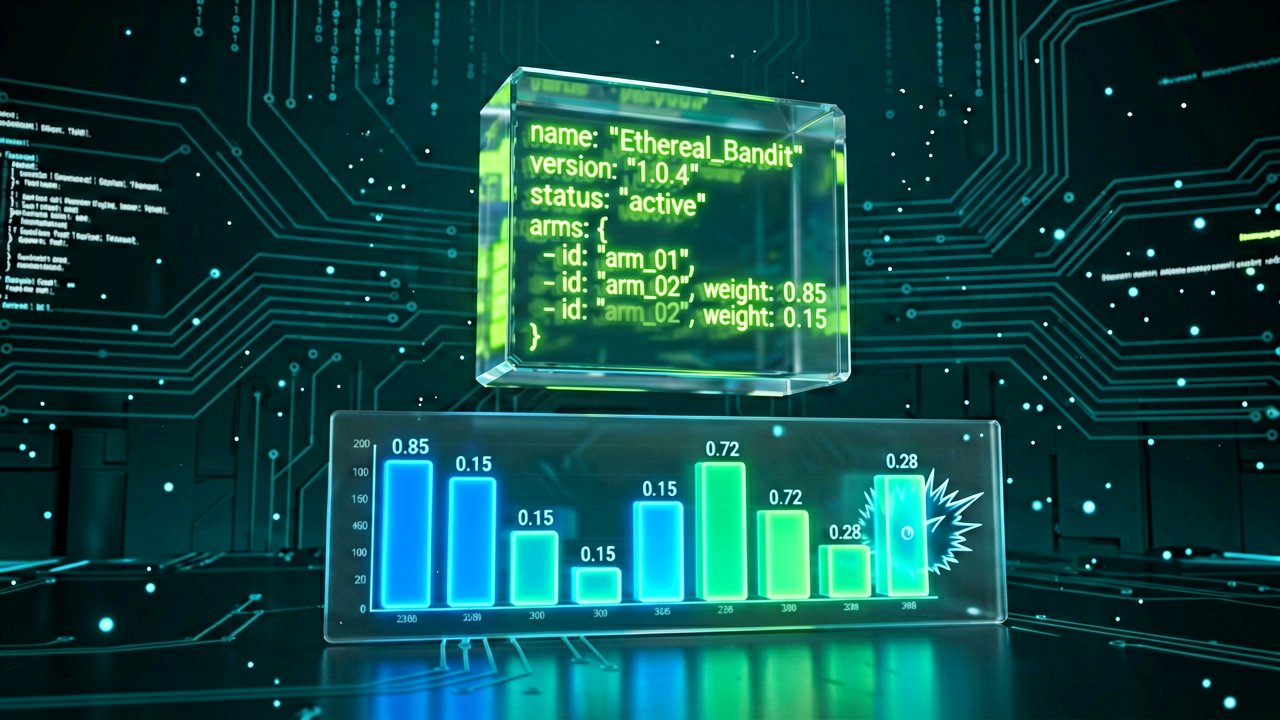
What makes this system punch above its weight is how it orchestrates intelligence. In academic publishing on arXiv, OrcaRouter’s technical framework is detailed as a configurable multi-arm contextual bandit that learns continuously from deployment feedback. It uses a LinUCB-based protocol operating over lexical and sentence-embedding features, combining a hybrid of offline initialization and online adaptation. By evaluating candidate models on curated routing prompts, OrcaRouter fits a ridge regressor for each "arm" (or model pathway). When integrated with the new Routing DSL, this math transforms into a dynamic pipeline: a query arrives, its structural properties are parsed, and the system can orchestrate a multi-model fusion loop, leveraging a panel of efficient models to build a synthesis that a final judge evaluates.
Chasing Frontier Benchmarks at Half the Price
The performance metrics vindicate this architectural complexity. Early internal evaluations reveal that tightly engineered Routing DSL configurations can deliver Claude Fable 5-class intelligence while stripping away the massive financial premium usually associated with frontier computing. This correlates cleanly with empirical data from platforms like OpenRouter, where compound model strategies and fusion pipelines routinely achieve benchmark scores nearly identical to standalone flagship models—such as hitting roughly 64.7% on complex task indexes against Fable 5's 65.3%—but at approximately half the token cost. By utilizing OrcaRouter's DSL to execute parallel models, fallbacks, and conditional escalation, teams avoid paying a 2x premium for standard data manipulation, formatting, or basic retrieval. Compute is spent precisely where it yields quality gains, redefining how modern enterprise infrastructure handles agentic workloads at scale.
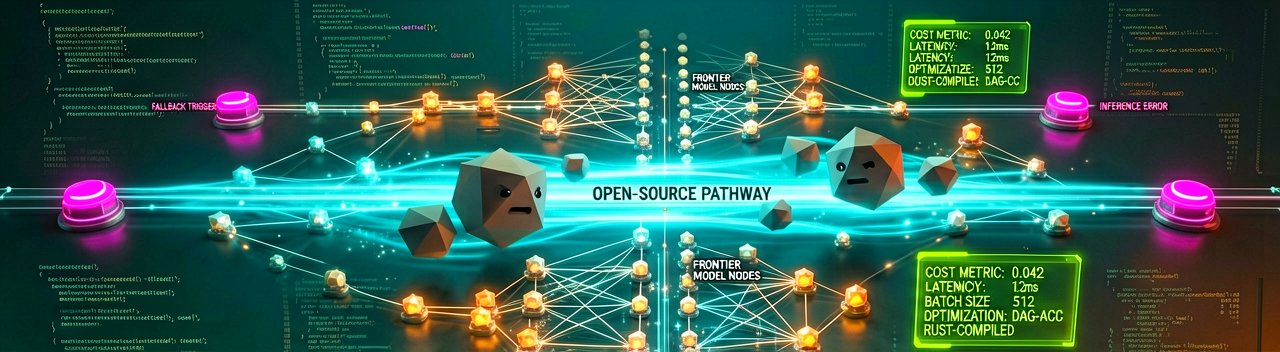
Behind the Scenes: Building a production-grade AI gateway requires moving past high-level abstractions and confronting the brutal realities of network latency, memory churn, and I/O bottlenecks. When OrcaRouter’s compiler ingests a routing configuration, it treats the Domain-Specific Language (DSL) script not as a slow interpreted sequence, but as a directed acyclic graph (DAG) optimized for parallel asynchronous processing. Under the hood, the system compiles the DSL logic down to native bytecode structures within an event-driven execution loop. This optimization isolates model evaluation checks, payload mutations, and condition evaluations into localized memory blocks, ensuring that the routing overhead itself contributes less than 2 milliseconds to the overall time-to-first-token metric.
A critical engineering triumph of this architecture lies in how it handles streaming payloads and response interceptors. Standard API proxies often wait for a full response payload to accumulate in memory before running guardrails or downstream evaluations, which completely obliterates user experience in real-time interfaces. OrcaRouter bypasses this by implementing a chunk-aware stream parser. As the downstream LLM spits out Server-Sent Events (SSE), the gateway processes the text chunks through a zero-allocation circular buffer. This allows the DSL to evaluate dynamic termination criteria or switch fallback models mid-stream without forcing a hard reset of the TCP connection or allocating massive strings on the heap, keeping garbage collection pauses to an absolute minimum during high-concurrency traffic spikes.
Concurrency management in OrcaRouter is deeply integrated with a localized caching topology that coordinates with the contextual bandit framework. When a complex routing pipeline triggers a multi-model consensus loop—polling three lightweight engines simultaneously to synthesize a response—the system utilizes shared-memory worker threads rather than spinning up independent network subprocesses. The gateway manages state through a lock-free ring buffer, meaning concurrent user requests do not contend for the same global mutexes when recording token usage metrics or checking model availability. If a target model suffers from transient network degradation or rate limits, the DSL's circuit-breaker logic trips instantly at the gateway layer, diverting the payload to an active mirror model before a connection timeout can cascade through the enterprise application architecture.
Low-Level Integration and Gateway Economics
From a hardware utilization perspective, OrcaRouter avoids the memory bloat typical of Node.js or Python-based proxies by utilizing a custom runtime written in Rust. Every incoming prompt payload is treated as a zero-copy slice of bytes, passing from the network socket through the policy engine and out to the target provider API with minimal duplication. By eliminating unnecessary string allocations during prompt injection and header manipulation, a single gateway node can comfortably orchestrate tens of thousands of concurrent requests without thrashing the system's L3 cache. This hyper-efficient memory footprint ensures that infrastructure teams can colocate the routing proxy right alongside their core application microservices, drastically lowering internal network traversal times.
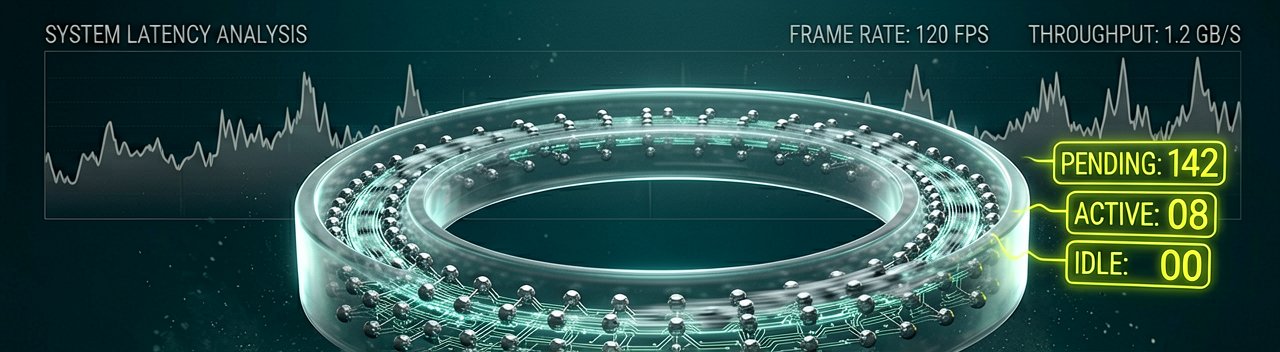
Ultimately, this architectural discipline transforms the economics of scale for enterprise AI deployments. By decoupling the intelligent control plane from any single model provider's black-box routing, developers gain deep observability into token consumption, latency distribution, and semantic drift at the protocol level. The gateway natively logs granular performance metrics per DSL node execution, feeding anonymized context features back into the local bandit model to refine subsequent routing weight predictions. It is an end-to-end telemetry and execution platform that strips away the financial unpredictability of building with LLMs, proving that the smartest path to frontier-class performance is built on engineering efficiency rather than brute-force computational spend.
Reading Between the Lines: The promise of achieving frontier-class performance while radically slashing operational expenditure is the holy grail of modern enterprise AI, but it relies on a precarious assumption: that task complexity remains static and predictable. OrcaRouter’s programmable DSL assumes that human intent can be neatly categorized, mapped, and triaged by a localized context bandit or a set of deterministic rules. Yet, in real-world deployments, the boundary between a "simple" query that a lightweight open-source model can handle and a "complex" nuance requiring Claude Fable 5-level reasoning is incredibly porous. A system relying on semantic embeddings to route requests can easily mistake a subtly deceptive edge case for a mundane request, leading to silent failures downstream where an inadequate model delivers a confidently wrong answer.
This reveals an architectural paradox inherent to the entire meta-routing paradigm. To accurately route a highly sophisticated prompt, the gateway must possess a level of understanding that approaches the intelligence of the frontier model itself. If the routing DSL requires a multi-model consensus loop or a series of pre-evaluations just to decide where to send a payload, the cumulative latency and token cost of these triage steps can quickly erode the very economic advantages the system was built to deliver. Teams may find themselves caught in a cycle of diminishing returns, spending engineering hours continuously tuning hyper-specific YAML graphs and debugging CEL expressions to squeeze out cost savings that are ultimately eaten up by the computational overhead of the routing infrastructure itself.
Furthermore, relying on a dynamic fallback architecture introduces a highly volatile variable into enterprise budgeting: unpredictable latency distributions. When a prompt fits the standard profile, the routing engine swiftly passes it to a cheap model, returning a response in milliseconds. However, if the DSL logic triggers an escalation path—rerouting through an intermediate engine before finally landing on a frontier model due to mid-stream guardrail failures—the user experience suffers an unexpected, multi-second spike. For user-facing applications, this lack of deterministic performance can be more detrimental than paying a flat, predictable premium for a single omniscient model, forcing infrastructure engineers to choose between cost optimization and a stable user experience.
The Moving Target of Model Commodity
There is also the looming strategic risk of market commoditization. The financial viability of standalone routing layers depends entirely on the price gap between frontier intelligence and utility-grade compute remaining wide. If frontier model providers aggressively cut their API pricing to squeeze out the middleware layer, or if open-source models close the capability gap entirely, the economic justification for a complex, programmable gateway diminishes. Infrastructure teams could wake up to find that a premium model's native pricing has dropped significantly, rendering months of complex DSL routing configuration obsolete overnight.
Ultimately, OrcaRouter’s framework is less of a permanent fix for AI infrastructure costs and more of a highly sophisticated diagnostic tool for a transitional era. It shifts the burden of intelligence from the model provider's weights to the enterprise's network architecture. While it successfully hands control plane sovereignty back to the developer, it demands an ongoing tax in the form of rigorous telemetry monitoring, prompt engineering discipline, and continuous system optimization. For organizations running millions of structured, highly repetitive agentic workflows, the savings will be tangible; for those dealing with chaotic, unpredictable human interactions, the programmable gateway may just be a mirror reflecting the inherent messiness of natural language processing.
"We are currently spending millions of dollars inventing brilliantly complex plumbing just to avoid paying a premium to the people who built the water. The ultimate irony of the programmable AI gateway is that if you engineering your routing logic perfectly enough, you have essentially written a brand-new, highly brittle language model using nothing but network proxies and sheer architectural spite."
Artūras Malašauskas is an AI Systems Integrator with 20+ years of production-grade web engineering experience. He has designed, shipped, and scaled enterprise Python/PHP systems for logistics, SaaS, and public-sector clients. For the past year, he has focused exclusively on AI integrations: deploying open-source LLMs, building generative media pipelines (image, audio, video), and engineering multi-agent workflows for real production environments. His standard: reproducibility, security, cost-efficient inference—no vaporware. He documents and evaluates emerging AI tooling, separating verified capabilities from marketing noise. Technical editor at: muza-ai.eu, ai-verslas.lt, ai-naujinos.lt Connect on LinkedIn
Comments