Douglas Enlists Google Cloud to Bring Generative AI to the Beauty Counter

The retail industry's obsession with generative artificial intelligence just found its next major canvas. European beauty giant Douglas, known as Nocibé in France, is preparing to launch a new generative AI chatbot powered by Google Cloud infrastructure to overhaul its digital customer support and accelerate online sales conversion rates. According to strategic reporting from Mind Retail, the upcoming deployment signals a definitive shift from isolated technology experiments toward deep, operational integration within premium retail commerce.
This initiative builds upon a foundation laid when the retailer initially began testing an early proof-of-concept AI Beauty Advisor, developed using DOUGLAS Group's proprietary data alongside Google Cloud's LLM capabilities. By shifting from a closed testing environment to an active customer-facing asset, Douglas aims to replace rigid, rule-based legacy systems with fluid conversational experiences that accurately parse intricate user inquiries about ingredients, personalized skincare routines, and price-point matching.
The Friction in Digital Beauty Advice
Replicating the nuance of an in-store beauty consultation online has historically been a persistent bottleneck for digital commerce. Human beauty advisors naturally interpret ambiguous requests, balancing customer preferences against product data sheets, brand catalogs, and dynamic pricing metrics. Traditional automated retail chat apps failed at this scale, frustrating users with mechanical dead-ends and generic search results that failed to drive sales.
By leveraging conversational agent frameworks, Douglas plans to bridge this gap through highly contextualized interactions. If a user asks for a specific moisturizing serum suited for dry skin, the system does not simply match keywords; it sifts through multi-brand inventory specifications to deliver customized advice. This shift towards hyper-personalized curation addresses a dual need for the brand: reducing the administrative load on traditional contact centers while simultaneously driving up cart values through targeted, conversational product discovery.
Enterprise Cloud Infrastructure Becomes the Standard
The collaboration highlights a wider pattern of retailers abandoning basic chatbot plugins in favor of industrial-grade cloud ecosystems. Operating these complex machine learning workflows requires enterprise scaling that safeguards internal catalog data while ensuring sub-second response latencies. Deep infrastructure integration enables the retailer to continuously train its model against real-time inventory levels, promotional calendars, and global product updates without risking proprietary operational insights.
As competition intensifies across the premium beauty market, the barrier to entry for customer retention is shifting toward digital utility. Douglas's adoption of cloud-native AI reflects a strategic reality where maintaining market leadership requires turning transactional web portals into intelligent, adaptive commerce environments.
Beneath the Conversational Surface: The Data Architecture Challenge
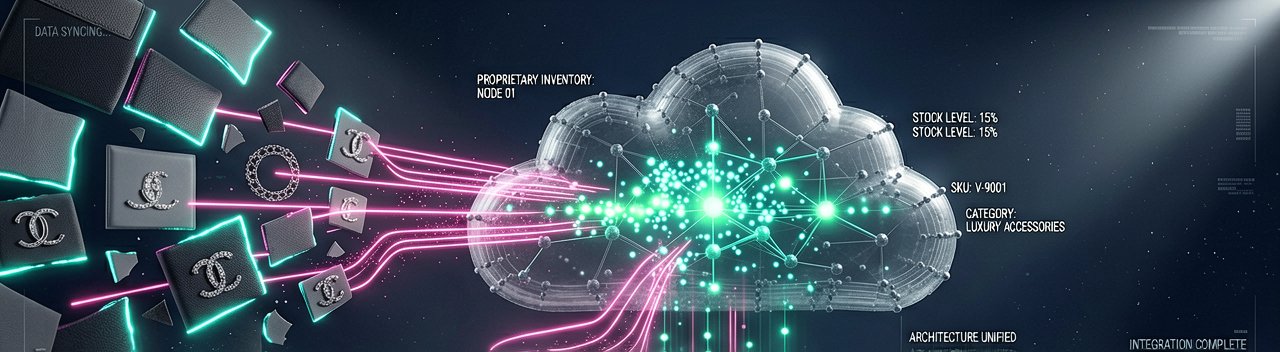
Behind the Corporate Press Release: The real battleground for Douglas isn't the user interface—it's the sprawling, fragmented web of legacy database architecture sitting beneath it. For an AI beauty advisor to truly mimic a human consultant, it cannot simply rely on generalized public training data. It requires real-time access to highly proprietary information, including fluctuating inventory levels across thousands of European brick-and-mortar storefronts, shifting ingredient regulations, and the deeply nuanced nomenclature of luxury cosmetics. Merging these disparate data streams into a single, cohesive cloud repository represents the invisible heavy lifting that determines whether a chatbot feels like a trusted advisor or a broken search engine.
Historically, the beauty sector has struggled with digital personalization due to the sheer subjectivity of its products. A formulation that works for one skin type might trigger irritation in another, creating a compliance and brand-safety minefield for automated systems. By anchoring this deployment within enterprise cloud infrastructure, Douglas data engineers are establishing strict guardrails around the model's outputs. This architecture ensures that the generative engine remains firmly tethered to verified brand documentation and clinical safety sheets, mitigating the hallucination risks that have notoriously plagued less regulated retail AI rollouts.

From a stakeholder perspective, this transition represents a fundamental realignment of how retail performance is measured. Traditional customer service automation was viewed strictly through a lens of cost reduction—specifically, how many incoming support tickets could be deflected away from human agents. However, internal strategists are now shifting the benchmarks toward direct commercial KPIs, focusing on metrics like average order value, cart abandonment mitigation, and digital-to-offline customer retention. The chatbot is no longer structured as an administrative firewall; it is positioned as an active, revenue-generating digital storefront manager.
This strategic shift also signals a changing dynamic in the relationship between multi-brand retailers and luxury cosmetics manufacturers. Prestige beauty houses have long been fiercely protective of their brand presentation, often resisting automated platforms that risk cheapening their image or misrepresenting their products. By demonstrating a highly controlled, sophisticated conversational ecosystem, Douglas aims to reassure its high-end brand partners that digital automation can preserve the premium experience of a physical beauty counter. Ultimately, this rollout is a high-stakes proof of concept for the wider retail landscape, proving that complex, sensory-driven consumer categories can be successfully navigated by cloud-powered intelligence.
Reading Between the Lines: The Cost of Algorithmic Beauty
Reading Between the Lines: While the promise of an automated, hyper-personalized beauty consultant makes for compelling shareholder presentations, the operational reality of generative AI in retail often clashes with the fundamental nature of prestige commerce. The beauty industry has built its multi-billion-dollar foundations on an emotional, intensely tactile allure—the physical sampling of a fragrance, the texture of a cream against skin, and the charisma of an in-store makeup artist. Replacing this deeply human friction with a sanitized, cloud-hosted text prompt assumes that consumers view beauty shopping as a purely transactional problem to be optimized by data science, rather than a sensory ritual of self-discovery.
Furthermore, an inherent contradiction lies at the heart of multi-brand retail chatbots. Douglas operates as a marketplace for competing luxury brands, each paying for premium visibility and distinct positioning. When a machine learning model is tasked with recommendng the "best" night cream for a user, the impartiality of the algorithm immediately comes into question. Will the cloud-native advisor prioritize the product backed by the most robust dataset, the one with the highest profit margin for the retailer, or the brand that paid a premium to top the algorithmic recommendation queue? This introduces a friction point where consumer trust could easily be compromised by opaque backend commercial agreements.
There is also the matter of long-term infrastructure dependency to consider. By anchoring its digital transformation so deeply within a single hyperscaler's ecosystem, Douglas trades traditional technical debt for total platform lock-in. The costs of maintaining, fine-tuning, and running continuous queries on specialized large language models are notoriously volatile. If computing expenses rise or licensing terms change, the financial efficiency of deflecting customer service tickets quickly degrades. Retailers risk finding themselves on a costly technological treadmill, constantly upgrading models just to maintain a baseline of customer interaction that consumers will rapidly come to expect as standard.
Finally, this deployment tests the limits of consumer data privacy in an era of heightened regulation. Skincare recommendations inherently require users to disclose sensitive personal information, from chronic skin conditions to aging anxieties. Entrusting this highly intimate data to an automated system requires an unprecedented level of consumer compliance. Should a data leak occur, or should users grow uncomfortable with the idea of their aesthetic vulnerabilities being processed by an enterprise cloud network, the brand backlash could easily overshadow any marginal gains in online checkout conversion rates.
"We have officially reached the era where buying a simple moisturizer requires a complex conversation with a cloud-hosted supercomputer. One can only hope the algorithm understands that when a customer asks to look ten years younger, they are seeking a miracle, not a system error report."
Artūras Malašauskas is an AI Systems Integrator with 20+ years of production-grade web engineering experience. He has designed, shipped, and scaled enterprise Python/PHP systems for logistics, SaaS, and public-sector clients. For the past year, he has focused exclusively on AI integrations: deploying open-source LLMs, building generative media pipelines (image, audio, video), and engineering multi-agent workflows for real production environments. His standard: reproducibility, security, cost-efficient inference—no vaporware. He documents and evaluates emerging AI tooling, separating verified capabilities from marketing noise. Technical editor at: muza-ai.eu, ai-verslas.lt, ai-naujinos.lt Connect on LinkedIn
Comments