Human Marketers in the AI Age: Navigating Strategy and Creativity Amidst Automation
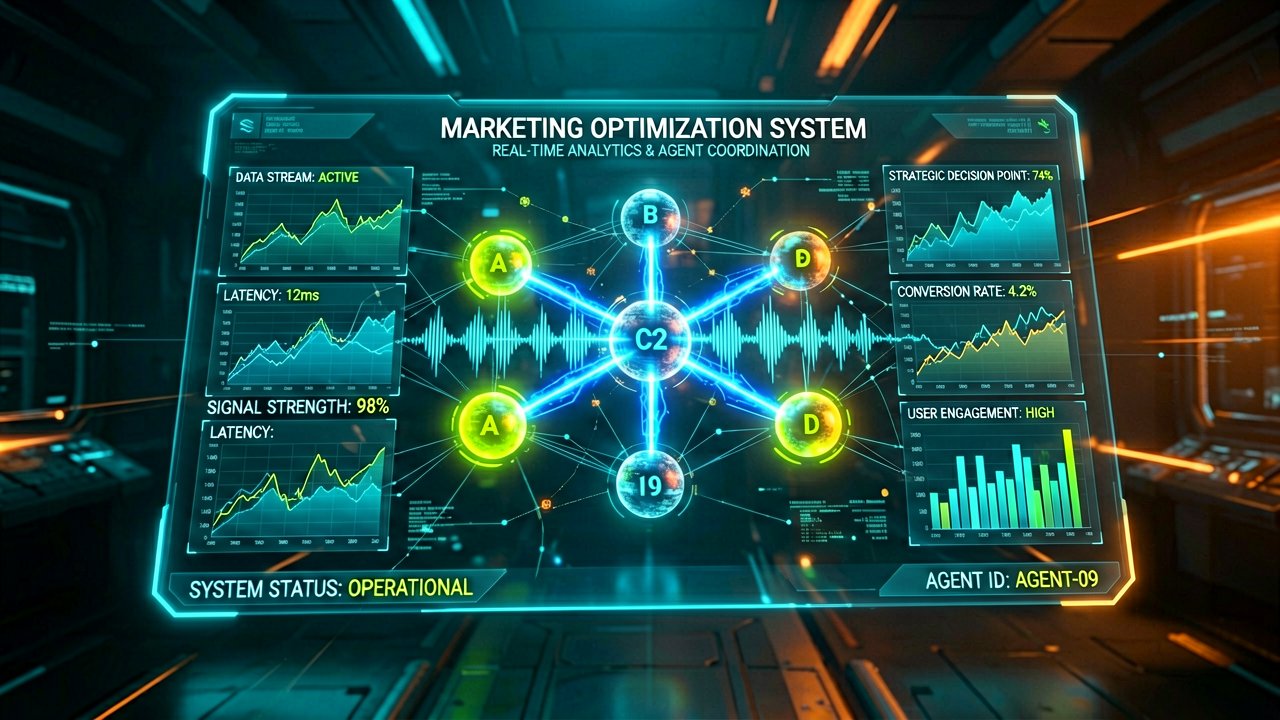
The contemporary marketing ecosystem is approaching a major structural inflection point as teams face a growing discrepancy between manual workflows and rapid digital signals. Enterprise marketing strategies are shifting from basic reactive prompting to self-directing systems capable of autonomous execution. According to a research whitepaper released by Appier, embedding autonomy into decision loops allows enterprise teams to narrow this structural gap and respond to complex market changes with greater agility. This operational shift does not eliminate the human element but rather redefines the collaboration between machine efficiency and human talent.
By delegating high-volume operational tasks to specialized digital agents, human marketers are liberated from manual orchestration and multi-step test setups. This collaborative system functions as a closed-loop growth engine where real-time signals translate directly into coordinated execution. Industry analysis shows that when autonomous architectures handle backend data intelligence, human professionals can shift focus toward high-value responsibilities. This new landscape restores strategic oversight and creative storytelling to the forefront of brand campaign management.
Bridging the Autonomy Gap
Modern customer journeys are increasingly non-linear and cross-channel environments grow more complex by the day. Traditional automation relies on rigid rules that fail to scale alongside real-time data fluctuations. Advanced marketing engines close this execution gap through continuous data iteration and autonomous decision cycles. Case data published via PR Newswire demonstrates that moving from manual orchestration to autonomous workflows can reduce campaign activation timelines from three days down to under an hour.
Elevating Human Strategy Over Operations
While large language models offer raw reasoning power and content generation capabilities, they function primarily as a reactive engine. Integrating autonomous system workflows introduces a digital pilot that independently executes multi-stage processes toward specific enterprise business goals. This division of labor allows marketing technology platforms to handle audience discovery, real-time campaign adjustments, and personalized customer journeys. Human teams retain final governance, focusing exclusively on emotional brand resonance, creative strategy, and cross-functional business alignment.

The Shift from Automation to True Autonomy
Beyond the Algorithmic Horizon: The evolution of marketing technology has quietly crossed a critical threshold, transitioning from deterministic automation to true digital autonomy. Early programmatic platforms operated on rigid, if-then logic loops that required constant human intervention to tweak parameters whenever market conditions shifted. Today, agentic artificial intelligence functions with a level of situational awareness that allows it to self-correct in real time. Experienced enterprise strategists note that this shift fundamentally alters the standard operating rhythm within marketing departments, transforming the daily workflow from proactive orchestration into strategic oversight.
This operational pivot changes how organizations measure institutional efficiency. Instead of tracking the time spent building manual audience segments, analytics leads now focus on how quickly machine intelligence interprets multi-channel data anomalies. The practical result is an environment where micro-conversions and predictive modeling happen instantly at the edge of the consumer experience. For human professionals, this means the operational burden of setting up multivariate tests is entirely gone, leaving behind a blank canvas that demands deeper analytical and creative skills.
However, the rapid adoption of independent system loops introduces distinct challenges regarding brand safety and narrative continuity. Industry veterans frequently warn that fully autonomous execution engines risk flattening a brand's unique identity if left unguided. Algorithms prioritize mathematical efficiency and statistical performance, which can unintentionally favor conversion metrics over long-term customer equity. Consequently, enterprise marketing leads find themselves stepping into the critical role of brand guardians, setting the ethical guardrails and emotional parameters within which the software operates.
The relationship between creative teams and software architectures is also redefining product development and narrative pacing. Rather than relying on rigid quarterly campaign cycles, modern marketing teams use continuous feedback loops to adapt assets based on shifting audience sentiment. This fluid model allows organizations to adjust their creative focus instantly without restarting the traditional agency briefing process. The resulting workflows require creative professionals to understand algorithmic capabilities deeply, ensuring that initial creative inputs are structured to scale effectively across various digital environments.
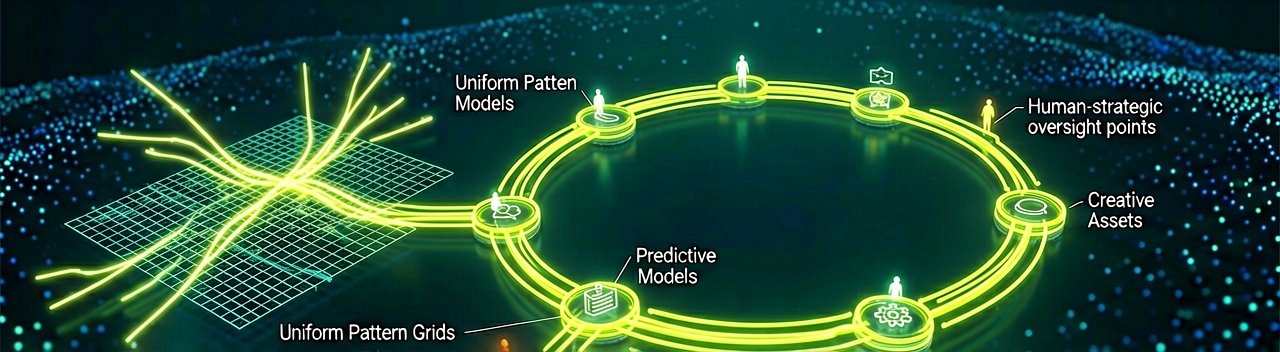
Ultimately, this technological shift elevates the strategic value of human intuition within corporate structures. While machines process data at an unattainable scale, they cannot synthesize cultural nuances, subtle social shifts, or the complex emotional triggers that drive brand loyalty. Human marketers who successfully navigate this transition use machine intelligence to handle data processing, freeing up their own time to focus on authentic human experiences. This balance ensures that corporate strategies remain deeply relevant in an increasingly automated marketplace.
The Paradox of Algorithmic Homogenization
Reading Between the Lines: The prevailing narrative among enterprise software providers suggests that autonomous marketing engines will effortlessly liberate human creativity, yet this promise overlooks a glaring structural contradiction. When multiple competing brands deploy the same underlying large language models and autonomous optimization loops, their strategic outputs naturally begin to converge. The mathematical pursuit of the exact same optimized audience segments and predictable conversion peaks risks creating a sea of creative sameness. By outsourcing distinct execution paths to standardized digital agents, enterprises may inadvertently strip away the very creative friction that makes a brand memorable in the first place.
This reality exposes a deep irony in the current marketing landscape: the tools designed to maximize hyper-personalization often result in highly predictable brand behavior. Algorithms are inherently backward-looking, trained to predict future consumer actions based entirely on historical data patterns. They excel at optimizing what already works but struggle to conceptualize the radical, irrational creative leaps that historically define breakthrough marketing campaigns. Relying too heavily on these autonomous frameworks turns the marketing department into a reactive management function, where data validation overrides bold, calculated creative risks.
Furthermore, the industry’s shift toward real-time, automated campaign adjustments introduces hidden operational risks. While deploying autonomous pilots reduces campaign activation timelines from days to minutes, it also removes critical human reflection points from the workflow. In the rush to achieve pure statistical efficiency, brands risk deploying tone-deaf messaging during sudden cultural or global crises because an automated system cannot process real-world context outside its immediate data feed. The speed of execution becomes a vulnerability rather than an advantage if the software lacks situational awareness.
The financial implications of this automation loop also warrant a degree of skepticism. As agencies and internal teams reallocate budgets from human content creators to enterprise AI licensing, the cost of distribution will likely skyrocket. When content creation becomes essentially free and instantaneous, digital channels will face an unprecedented influx of synthetic media, forcing platforms to charge steep premiums for authentic consumer attention. Consequently, the efficiency gains realized by cutting human operational costs will simply be transferred to ad networks and distribution channels to cut through the noise.
Ultimately, the true competitive edge in an AI-saturated market will not belong to the brand with the most sophisticated autonomous stack, but to the one that knows precisely when to override it. Maintaining a unique market position requires human executives to treat algorithmic recommendations as a baseline rather than an absolute directive. True marketing innovation lives in the anomalies that data models routinely dismiss as statistical noise, waiting for human intuition to turn them into cultural moments.
“Automation is an incredible tool for finding out exactly what your customers wanted yesterday, leaving marketers with the uniquely human, and slightly terrifying, task of guessing what they might actually tolerate tomorrow.”
Artūras Malašauskas is an AI Systems Integrator with 20+ years of production-grade web engineering experience. He has designed, shipped, and scaled enterprise Python/PHP systems for logistics, SaaS, and public-sector clients. For the past year, he has focused exclusively on AI integrations: deploying open-source LLMs, building generative media pipelines (image, audio, video), and engineering multi-agent workflows for real production environments. His standard: reproducibility, security, cost-efficient inference—no vaporware. He documents and evaluates emerging AI tooling, separating verified capabilities from marketing noise. Technical editor at: muza-ai.eu, ai-verslas.lt, ai-naujinos.lt Connect on LinkedIn
Comments