The Latent Engine: Video Diffusion Models and the Rise of Unprogrammed Game Physics

The traditional video game architecture relies on deterministic physics engines that dictate interactions through explicit, hard-coded code. However, a major structural paradigm shift is occurring as generative video diffusion models prove capable of rendering complex real-world dynamics without formal instruction. Recent scholarly research published on demonstrates that models like GameNGen can run real-time interactive software environments entirely within neural architectures, bypassing standard rendering pipelines. By learning the visual and spatial language of existing game trajectories, these frameworks predict subsequent frames conditioned strictly on player input and historical states.
This technological leap has revealed that deep generative structures are doing more than just approximating pixels; they are embedding structural principles of physical environments. A technical study on GameDev.net reveals that physical plausibility is linearly decodable from internal diffusion transformer states with an accuracy rate of 81.27%. This discovery implies that generative video platforms naturally organize abstract representations of space, momentum, and continuity. Consequently, the game development industry is preparing to transition from computationally rigid physics engines to responsive world models that compute complex environmental interactions simultaneously with visual output.
Decoding the Hidden Physics of Diffusion Transformers
Traditional computer graphics require manual programming for bounding boxes, collision detection, and mass distribution vectors. Generative frameworks eliminate this bottleneck by learning representations of physics directly from video data libraries. When an object breaks or fluids deform in models like OpenAI's Sora, the system does not solve a set of differential formulas. Instead, it relies on its internal spatial-temporal transformer blocks to predict the most plausible continuity vector. Probing experiments demonstrate that while the final variational autoencoder latent space does not explicitly emphasize physical constraints, the intermediate denoising layers hold a highly structured understanding of physical consistency.
Market Displacement and the Hybrid Engine Pipeline
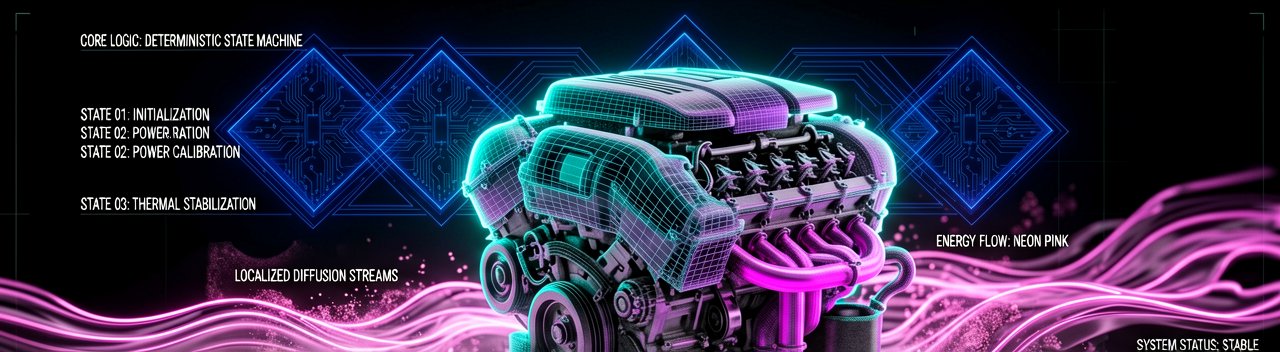
The immediate commercial implications for the interactive entertainment market center on rapid prototyping and limitless environment generation. Standard production timelines often stall during the implementation of asset interactions, but diffusion models allow designers to establish functional interactive environments from basic text instructions or reference imagery. Major studio systems are exploring hybrid architectures that combine traditional logic loops with neural generation. In this model, core logic commands like player inventory and health points are tracked via deterministic state machines, while complex visual feedback, destruction, and fluid dynamics are processed by localized, low-latency neural video streams.
Overcoming the Temporal Drift and Compute Bottlenecks
Despite these emerging breakthroughs, generative physics models face considerable technical constraints before achieving widespread integration in commercial software. The primary architectural hurdle is auto-regressive drift, where minor computational errors accumulate over long execution sequences, causing the simulated environment to eventually lose structural stability. Furthermore, executing high-frame-rate diffusion processing in real time demands significant hardware resources, historically requiring dedicated tensor processing infrastructure. For widespread market adoption, developers are focusing on noise augmentation training techniques alongside specialized hardware inference engines to stabilize long trajectories and compress the compute footprint down to consumer-tier hardware.
The Hidden Dynamics of Neural Simulations
Beyond the Surface Pixels: The traditional reliance on rigid, explicit equations for gravity and collision detection has long restricted the creative boundaries of game designers. While standard physics engines like PhysX excel at managing predictable, rigid-body interactions, they fail when tasked with complex multi-variable phenomena, such as accurate structural crumbling or hyper-realistic mud degradation. Video diffusion architectures bypass this barrier entirely by treating physical reactions as a unified predictive challenge rather than a collection of separate mathematical code lines. This structural shift allows developers to construct interactive environments that react fluidly to unpredictable player behaviors, moving past the constraints of pre-baked animations.
Industry engineers are increasingly recognizing that this technique addresses the long-standing challenge of environmental scale. In high-budget game development, configuring interactive assets across vast virtual landscapes requires hundreds of development hours spent on manual testing and collision adjustments. Neural world models can alleviate this workload by inferring how objects must behave based on contextual patterns in training data. A stone wall shattering from an explosion does not require unique programming for every fragment; the model understands the visual and behavioral laws of fragmentation, significantly reducing the engineering overhead required for highly interactive, destructible environments.
However, studio executives and technical directors remain cautious about the unpredictable nature of neural rendering systems. Unlike traditional software pipelines where output is predictable and testable, generative networks can produce visual anomalies or break structural logic over extended play sessions. This unpredictability presents a challenge for competitive multiplayer design, where fairness relies on completely consistent physical behavior across different player perspectives. Consequently, early enterprise adoption is focusing on non-competitive single-player experiences, simulation tools, and real-time concept design pipelines where visual flexibility is valued over absolute mathematical predictability.

From a historical view, this transition mirrors the industry's previous leap from simple 2D sprites to sophisticated 3D polygonal rendering. Each technological shift initially faced skepticism due to the high computational costs and the steep learning curve of new production tools. The current movement toward generative physics demands entirely new hardware optimization strategies, as consumer graphics cards must adapt to process continuous neural network inferences simultaneously with traditional gameplay logic. As specialized hardware cells become standard in home consoles and gaming PCs, the boundary between programmed mechanics and generative simulations will continue to blur, changing the fundamental nature of virtual world design.
The Reality Check for Neural Realism
Reading Between the Lines: The enthusiasm surrounding diffusion-driven physics often overlooks a fundamental contradiction in how video games actually function. Proponents celebrate the fact that these models can simulate complex interactions without explicit programming, yet predictability remains the cornerstone of game design. If a player shoots a wall, the resulting debris must not only look convincing, but it must also consistently alter line-of-sight and navigation paths. Diffusion models, by their very nature, calculate probabilities rather than certainties. Relying on a system that merely guesses the most likely visual outcome introduces an element of systemic instability that could render traditional, goal-oriented game mechanics entirely unplayable.
This reliance on probability exposes a deep technical rift between visual plausibility and functional mechanics. A video diffusion model might flawlessly render the chaotic splashing of water or the complex tearing of fabric, but it lacks an underlying logical database to track the state of those objects. In a traditional engine, a object's velocity, weight, and elemental state are variables that other gameplay systems can easily read and react to. In a pure neural simulation, those variables are trapped within inaccessible latent layers. A game cannot easily trigger an audio effect based on a collision speed, nor can it calculate precise damage vectors if the collision itself exists only as a shifting pattern of pixels.
Furthermore, the environmental cost and hardware realities of this shift reveal a stark disconnect between tech demonstrations and consumer market viability. Running multi-billion-parameter video transformers in real time requires server-grade tensor processing hardware, a far cry from the consumer silicon found in standard home consoles or mid-tier gaming rigs. While optimization and model compression will inevitably improve, the computational overhead required to generate high-fidelity physical responses frame-by-frame remains vastly inefficient compared to classic formulas. Until neural inference achieves near-zero latency on consumer hardware, this technology will likely remain a specialized tool for cloud-based rendering or offline development pipelines, rather than the immediate replacement for standard physics engines.
Ultimately, the push for unprogrammed physics threatens to strip away the deliberate abstraction that makes games compelling in the first place. Game design is rarely about recreating perfect real-world data; it is about crafting exaggerated, highly tuned feedback loops that feel satisfying to control. A perfectly simulated physical world, governed by the averaged probabilities of internet video data, risks erasing the unique, stylized, and finely tuned mechanics that give distinct game genres their identity. By offloading world-building logic to autonomous neural networks, the industry risks trading precise creative control for a generic, automated approximation of reality.
"We spent forty years teaching computers exactly how a bouncing ball works, only to decide that it’s much more innovative to let a neural network guess where the floor is—even if it occasionally decides the ball is actually a very fast tomato."
Artūras Malašauskas is an AI Systems Integrator with 20+ years of production-grade web engineering experience. He has designed, shipped, and scaled enterprise Python/PHP systems for logistics, SaaS, and public-sector clients. For the past year, he has focused exclusively on AI integrations: deploying open-source LLMs, building generative media pipelines (image, audio, video), and engineering multi-agent workflows for real production environments. His standard: reproducibility, security, cost-efficient inference—no vaporware. He documents and evaluates emerging AI tooling, separating verified capabilities from marketing noise. Technical editor at: muza-ai.eu, ai-verslas.lt, ai-naujinos.lt Connect on LinkedIn
Comments