AI Shift in Spatial Design: Function2Scene Paradigms Reframe 3D Indoor Generation Around Human Use
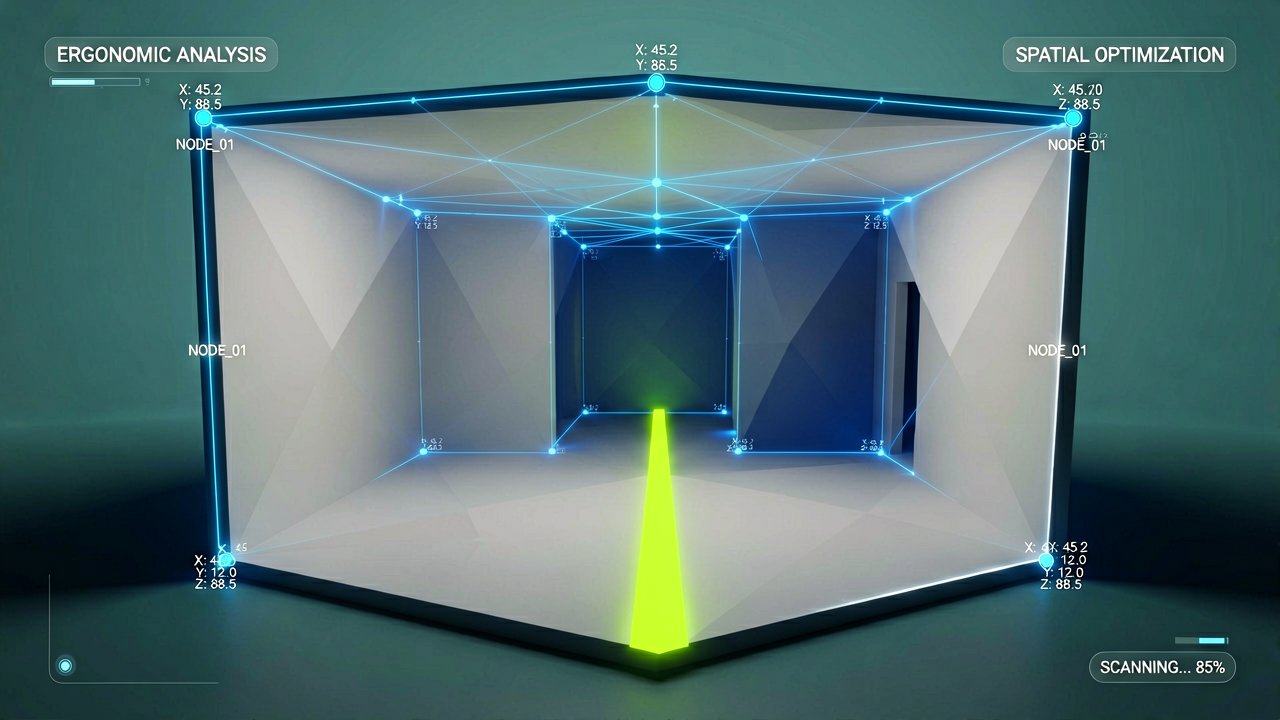
The traditional workflow for AI-driven 3D layout synthesis is undergoing a critical evolution from object-centric prompts to functional design execution. Historically, generative tools relied on basic furniture lists or structural bounding boxes, often producing scenes with high aesthetic polish but impractical spatial arrangements. According to a research preprint published on , a new framework named Function2Scene is successfully shifting this paradigm by translating human-centric functional specifications—detailed natural-language briefs about who will occupy a room and what tasks they must complete—into comprehensive, ergonomically valid 3D environments.
This structural change addresses a major bottleneck in automated architecture and game development, where procedurally generated spaces frequently suffer from overlapping geometry or poor workflow navigation. As highlighted by GameDev.net , Function2Scene breaks away from the standard practice of demanding that a Large Language Model (LLM) generate an entire 3D scene in a single output. Instead, the framework maps user behaviors against an interior design taxonomy of 17 distinct criteria spanning spatial, ergonomic, environmental, and activity considerations, demonstrating that operational utility is now just as critical as visual realism in generative design.
The Iterative Tool-Augmented Pipeline
Function2Scene secures its technical advantage through a continuous check-and-repair loop rather than relying entirely on deterministic generation. The architecture balances geometric measurements with LLM-based contextual reasoning and Vision-Language Model (VLM) visual checks. When a design brief is provided, the framework decomposes it into exact behavioral constraints, continually evaluating object interactions to ensure furniture placement matches human movement patterns. This multi-layered validation prevents typical generative failures like blocked doorways or inaccessible work surfaces.
Market Impact on Spatial Industries
The practical application of functional layout synthesis signals a substantial shift for game developers and architectural planners aiming to scale production without sacrificing environmental logic. In comparative tests across dozens of professionally authored interior design scenarios, the authors of the paper reported a 94.3% human preference rate over conventional LLM baselines. By automating the tedious early stages of spatial layout planning through verifiable human-use constraints, studios and design firms can pivot human effort toward fine-tuning asset details and bespoke artistic composition.

The Convergence of Ergonomic Code and Algorithmic Realism
Behind the Design Engine: The introduction of Function2Scene highlights a long-standing tension between algorithmic automation and human spatial intuition. For decades, procedural generation in software relied heavily on rigid constraint-based systems or randomized placement algorithms that required engineers to manually program exact distance rules between objects. When early generative AI models entered the spatial design market, they traded this programmatic control for visual diversity, creating layouts that looked impressive from isolated camera angles but completely failed basic safety and functional requirements. Industry veterans have noted that a beautiful virtual room becomes a liability the moment an avatar or a real-world client cannot navigate between a bed and a wardrobe.
To overcome this limitation, the engineering behind this new approach leverages an interconnected triad of evaluation techniques that mirror human peer reviews. The primary engine coordinates structural metrics, contextual reasoning, and visual inspection into a unified feedback loop. This integration prevents the structural hallucination common in generic AI models, where chairs might be merged into walls or desks placed facing away from natural light sources. By establishing a rigid taxonomy of seventeen design criteria, the platform codifies rules that human architects traditionally spend years mastering, effectively teaching machine learning models how physical space alters human behavior.
From a software development perspective, the framework addresses the high computational cost of manual scene correction. In massive multiplayer environments or sprawling architectural visualization projects, fixing clipping geometries and broken navigation meshes often devours hundreds of developer hours. The framework's ability to self-correct during the layout phase reduces the reliance on manual QA testing, allowing studios to redirect constrained budgets toward unique hero assets and narrative worldbuilding. Studio leads are recognizing that automating the foundational layout step allows smaller teams to compete with the sheer environmental scale traditionally reserved for AAA productions.
This technical evolution also carries profound implications for the future of interactive simulation and digital twins. Real-world logistics firms, manufacturing plants, and smart-home designers require virtual environments that behave exactly like physical spaces to train autonomous robots or optimize factory floor operations. By anchoring 3D generation to functional specifications rather than aesthetic prompts, the underlying technology transitions from a speculative creative tool into a dependable simulator for real-world interactions. The ultimate value of this shift lies not just in making scene generation faster, but in ensuring that the generated digital environments are immediately ready for practical, human-centric deployment.

The Friction Between Automated Logic and Creative Defiance
Reading Between the Lines: The industry’s enthusiasm for functional layout automation ignores a fundamental paradox of human design: great spaces frequently succeed by breaking the exact rules that AI pipelines seek to codify. By reducing interior environments to an idealized taxonomy of seventeen ergonomic and behavioral criteria, systems like Function2Scene assume that human spatial needs are entirely rational, predictable, and quantifiable. However, both architectural history and game design history demonstrate that memorable environments often rely on deliberate friction, subverted expectations, and eccentric spatial arrangements. An algorithm optimized to maximize navigational efficiency and logical object proximity risks mass-producing sterile, hyper-rationalized spaces that fulfill every mechanical requirement while draining the environment of its artistic identity.
Furthermore, the reliance on Vision-Language Models and Large Language Models to validate these layouts introduces a layer of systemic homogenization. Because these foundational models are trained on existing repositories of internet text and conventional design imagery, their concept of a functional space is inherently derivative. The continuous check-and-repair loop might prevent blatant geometry errors, but it also acts as a creative filter, smoothing out any avant-garde layout choice that fails to conform to standard dataset distributions. For architectural firms looking to establish a distinct brand or game developers trying to craft surreal, unsettling digital worlds, a tool that aggressively enforces conventional ergonomics becomes a structural constraint rather than a creative catalyst.
The financial promise of slashing production pipelines also merits skepticism from a project management perspective. While automating early-stage spatial planning undoubtedly reduces the initial hours spent dragging virtual furniture across a screen, it shifts the labor bottleneck further down the development pipeline. Human designers will inevitably spend substantial time auditing AI-generated frameworks to fix subtle contextual errors that automated checkers miss, such as an optimized layout that technically functions but completely ruins the intended dramatic lighting or narrative pacing of a scene. The industry must reckon with whether it is genuinely saving resources, or simply trading upfront drafting hours for protracted, tedious debugging cycles.
Ultimately, the widespread adoption of behavioral-driven layout generation will force a redefinition of what it means to be a 3D artist. As technical layout creation becomes a commoditized commodity managed by intelligent agents, human professionals will need to pivot from spatial arrangement to high-level systemic oversight. The competitive edge in design will no longer belong to those who can efficiently layout a room according to code, but to those who know exactly when to violate the rules to evoke a specific emotional response. If the industry becomes over-reliant on automated functionality, the market may soon face a surplus of perfectly navigable, entirely uninspiring digital worlds.
"We are rapidly approaching a future where an AI can generate a flawlessly optimized, perfectly ergonomic three-bedroom home in under ten seconds, leaving human architects with the distinct and deeply humbling responsibility of explaining why anyone would actually want to live in it."
Artūras Malašauskas is an AI Systems Integrator with 20+ years of production-grade web engineering experience. He has designed, shipped, and scaled enterprise Python/PHP systems for logistics, SaaS, and public-sector clients. For the past year, he has focused exclusively on AI integrations: deploying open-source LLMs, building generative media pipelines (image, audio, video), and engineering multi-agent workflows for real production environments. His standard: reproducibility, security, cost-efficient inference—no vaporware. He documents and evaluates emerging AI tooling, separating verified capabilities from marketing noise. Technical editor at: muza-ai.eu, ai-verslas.lt, ai-naujinos.lt Connect on LinkedIn
Comments