Navigating Transparency: AI Scrutiny Intensifies as Tomb Raider Discloses Tool Usage
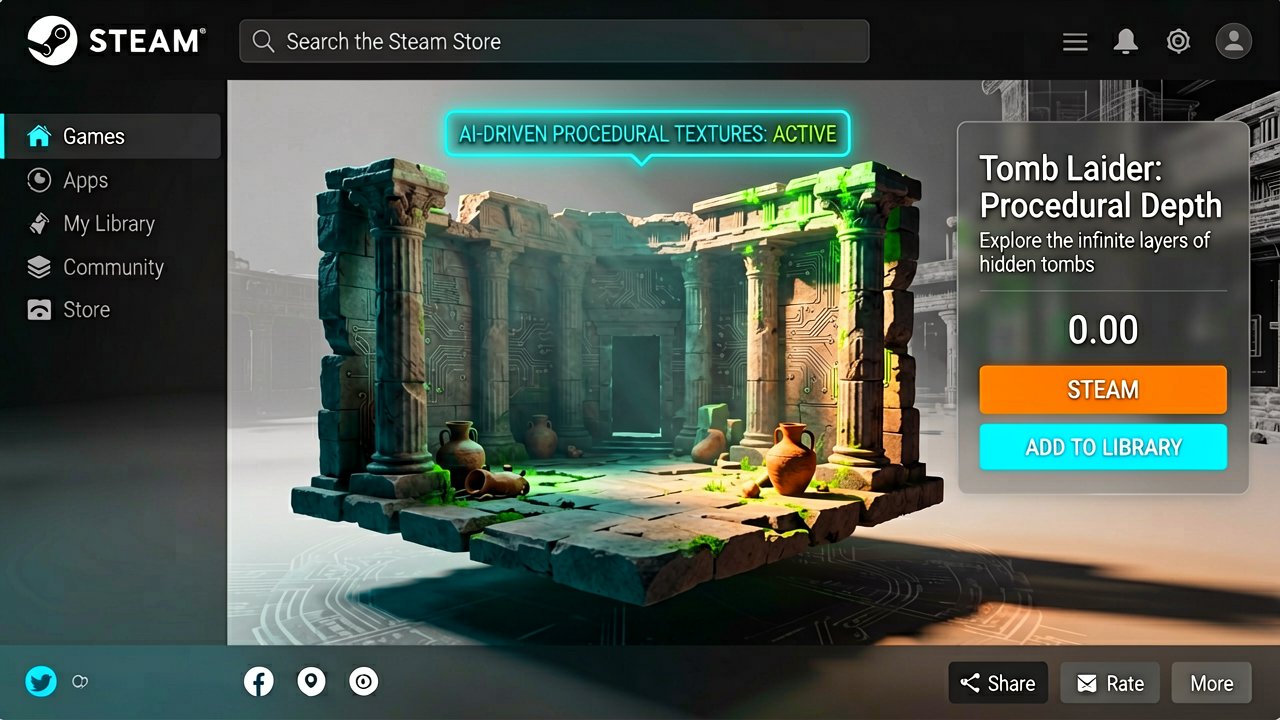
The upcoming release of Tomb Raider: Legacy of Atlantis has sparked an industry-wide conversation regarding transparency in video game development. Developer Crystal Dynamics and publisher Amazon Games recently added a mandatory generative artificial intelligence disclosure to the title’s storefront page, as documented on Steam. The disclosure states that AI-assisted tools were utilized to support early exploration and temporary development content. However, the studio explicitly clarified that any AI-assisted assets were ultimately replaced or refined by human developers to maintain the creative and artistic integrity of the project.
This public acknowledgment arrives at a critical juncture for the interactive entertainment market. As major publishers seek operational efficiency to combat ballooning production budgets, the integration of automation tools has faced steep resistance from labor unions, creative professionals, and consumer communities. The decision to explicitly label a high-profile intellectual property like Tomb Raider highlights a broader strategic shift. AAA studios are moving away from treating generative tools as unmentionable trade secrets and are instead adopting proactive compliance to mitigate consumer backlash and regulatory penalties.
From a market analysis perspective, this disclosure underlines the shifting enforcement landscape of digital distribution platforms. Platforms have adjusted their operational policies to cope with the influx of machine-assisted assets, balancing developer flexibility against market demands for consumer awareness. By explicitly framing the final product as human-crafted, Crystal Dynamics attempts to reassure players that machine intervention was restricted to back-end prototyping rather than displacing core creative labor.
The Evolution of Platform Regulation and Compliance Standards
The necessity for this disclosure stems directly from structural updates implemented by digital storefronts. Market leader Valve adjusted its developer mandates, establishing a clearer framework for how pre-generated and live-generated machine assets must be cataloged, as reported by GamesIndustry.biz . Under the revised guidelines, storefronts enforce strict reporting for customer-facing content like promotional imagery and localized text, while offering exemptions for internal efficiency gains such as code optimization or automated data scanning.

This nuanced regulatory approach directly influences developer behaviors across the industry. Game creators must carefully map asset lifecycles, separating internal procedural workflows from visible consumer content to satisfy corporate auditing teams. Failure to properly document these technical pipelines introduces severe platform risks, including potential product delisting or localized distribution bans in jurisdictions with strict digital consumer protection laws.
Creative Integrity, Labor Dynamics, and the Intellectual Property Gap
Beyond distribution logistics, the integration of automation platforms introduces significant legal vulnerabilities regarding copyright ownership. Legal precedents established by regulatory bodies confirm that purely machine-generated outputs lack traditional intellectual property protections unless substantial human authorship can be verified. For an enterprise handling multi-million dollar intellectual properties, deploying unedited generative assets creates a legal vacuum where competitors could potentially duplicate core visual elements without facing statutory infringement penalties.
Consequently, the corporate strategy utilized for Tomb Raider: Legacy of Atlantis acts as a blueprint for modern AAA asset management. By enforcing a strict policy where human artists refine, alter, or completely replace initial machine-assisted drafts, the studio secures the legal parameters required for standard copyright protection. This methodology transforms generative tools into a more sophisticated version of traditional conceptual software, maintaining human creative control as the central pillar of production.
Consumer Sentiment and the Commercial Value of Transparency
Public reaction to these technical disclosures remains deeply polarized, indicating that transparency functions as both a compliance tool and a commercial risk. While some consumer segments view any inclusion of automation as a reduction in artistic value, others accept its application provided it remains confined to back-end development tasks. As these disclosure badges become a standardized feature across digital marketplaces, the absence of an automation tag is rapidly transforming into a distinct marketing advantage, allowing specialized studios to command premium pricing by guaranteeing entirely human-made products.

Ultimately, the industry is entering an era where technical transparency is mandatory rather than optional. Publishers can no longer rely on obscurity to shield their engineering choices from highly analytical player bases capable of auditing asset files. Proactive labeling, backed by ironclad human-in-the-loop production workflows, represents the current standard for navigating the complex crossover between modern software engineering and traditional artistic development.
The Hidden Architecture of Human-Machine Collaboration
Behind the Digital Curtain: The decision to disclose tool usage on Steam for a flagship franchise like Tomb Raider exposes a deeply transactional compromise occurring within modern game development. While casual observers often view generative tools as automated generation engines that output completed characters or levels with a single button press, the reality inside AAA studios resembles a highly fragmented manufacturing pipeline. Engineers utilize these platforms primarily to bypass the tedious, non-creative bottlenecks that traditionally drain months from production schedules. For instance, generating vast sets of varied background textures, organizing thousands of lines of unvoiced dialogue for temporary placeholder testing, or running millions of automated quality assurance simulations to detect environment collision errors are all hidden tasks increasingly delegated to specialized software.
This division of labor introduces a complex paradox for veteran creators who pride themselves on artisan craftsmanship. Industry insiders note that using automated tools for early prototyping allows small pre-production teams to quickly test design concepts that previously required an entire department to build. However, this shift alters the nature of entry-level industry roles. Traditionally, junior artists and junior programmers built their portfolios by handling the repetitive, labor-intensive tasks—such as modeling minor background assets or writing basic asset-loading scripts—that are now the primary targets for automation. By automating these developmental stepping stones, the industry risks disrupting the traditional mentorship pipeline, leaving a widening experiential gap between senior directors and the next generation of creative talent.
Furthermore, the legal architecture governing these projects forces developers to treat automated output with extreme caution. Under prevailing global intellectual property frameworks, pure machine output cannot be copyrighted, creating an unprecedented vulnerability for corporations investing hundreds of millions of dollars into recognizable intellectual properties. If a studio permits an unedited, machine-generated texture or musical motif to remain in a commercial build, that specific asset technically enters the public domain, leaving the publisher powerless to prevent competitors from copying it directly. To insulate themselves from this legal gray zone, major publishers now mandate rigorous internal logging systems where every asset must be tracked from its digital inception to its final state, proving that human artists applied enough transformative labor to guarantee copyright eligibility.
This rigorous vetting process highlights why transparency disclosures are becoming standard corporate policy rather than a voluntary ethical choice. As labor organizations continue to negotiate strict protections regarding the use of voice, likeness, and artistic styles, studios must maintain transparent production histories to avoid costly union disputes or breach-of-contract lawsuits. By documenting exactly how tools are integrated into the creative workflow, publishers can simultaneously satisfy platform compliance requirements, pacify highly critical player communities, and maintain legal ownership over their commercial products in a rapidly changing digital marketplace.
The Paradox of Technical Efficiency and Consumer Trust
Reading Between the Lines: The industry’s sudden pivot toward mandatory transparency disclosures masks a more cynical commercial reality. Publishers routinely present these disclosures as voluntary steps toward ethical compliance and consumer respect, yet this transparency is largely forced by the threat of platform delisting and public relations disasters. There is a inherent contradiction in celebrating a studio's commitment to "human-crafted" final products when the underlying production pipeline relies heavily on machine learning to compress development timelines and reduce headcount. Labeling automated tools as mere prototyping assistants downplays how deeply integrated these algorithmic systems have become in day-to-day operations, setting up an unsustainable standard where studios must constantly minimize the true scope of their technical dependency to protect their brand reputation.
This calculated transparency also exposes a profound disconnect between corporate strategy and consumer perception. Game publishers operate under the assumption that explicitly marking machine-assisted content will appease a skeptical audience, but historical evidence suggests that disclosures often inflame rather than soothe community anxieties. By creating a distinct, legally mandated category for automated assets, the industry inadvertently validates the consumer perception that machine-assisted development is an inferior, cost-cutting alternative to traditional craftsmanship. This dynamic forces marketing departments into an awkward defensive position, where they must aggressively over-emphasize the organic, human labor involved in every asset to counteract the perceived stigma of the mandatory platform badge.
Looking forward, this push for disclosure will inevitably trigger an administrative arms race within major studios, ultimately driving up the very overhead costs that automation was supposed to reduce. To confidently sign off on platform compliance forms, multinational publishers will have to establish specialized legal and technical auditing departments dedicated entirely to reviewing asset code, verifying human modification percentages, and managing intellectual property risks. This emerging bureaucracy threatens to neutralize the efficiency gains promised by generative software, transforming a technology once heralded as a frictionless production accelerator into a complex legal liability that complicates the creative process from pre-production to launch.
"The future of AAA game development looks remarkably like an expensive corporate audit, where we will spend millions on advanced automation tools just to spend millions more on human lawyers to prove that the machines didn't actually do anything important."
Artūras Malašauskas is an AI Systems Integrator with 20+ years of production-grade web engineering experience. He has designed, shipped, and scaled enterprise Python/PHP systems for logistics, SaaS, and public-sector clients. For the past year, he has focused exclusively on AI integrations: deploying open-source LLMs, building generative media pipelines (image, audio, video), and engineering multi-agent workflows for real production environments. His standard: reproducibility, security, cost-efficient inference—no vaporware. He documents and evaluates emerging AI tooling, separating verified capabilities from marketing noise. Technical editor at: muza-ai.eu, ai-verslas.lt, ai-naujinos.lt Connect on LinkedIn
Comments