Fortifying the Digital Concierge: Inside the Cybersecurity Architecture of Next-Gen Hospitality AI

The modern luxury resort isn't just selling a oceanfront view or a Michelin-starred dinner anymore; it's managing an intricate web of autonomous agents, predictive analytics engines, and Internet of Things (IoT) integrations. As hotels rush to deploy everything from multilingual voice AI receptionists to predictive personalization suites, the hospitality industry has inadvertently transformed itself into an incredibly wide, high-value cyberattack surface. In fact, what used to be a pure IT concern has escalated into a national security priority, punctuated by the White House's June 2026 Executive Order on Advanced AI Innovation and Security, which firmly repositions frontier-model infrastructure as a matter of state defense. With hospitality data breaches having already averaged a staggering $3.86 million according to industry analyses tracked by Nomadix, hoteliers are realizing that an unprotected AI model is the ultimate liability.
Securing these systems requires moving past legacy firewalls and fragmented network perimeters. Next-generation hospitality AI architecture relies heavily on zero-trust architectures designed to enforce continuous evaluation. Because these modern platforms connect directly to critical Operational Technology (OT) and core Property Management Systems (PMS), an unverified connection could allow a compromised smart thermostat or guestroom TV to serve as a literal gateway to the hotel's central payment database. To mitigate this, enterprise hospitality frameworks are rapidly adopting the structured parameters of the National Institute of Standards and Technology (NIST) Cyber AI Profile, a framework detailed by Stinson LLP that focuses on securing components, conducting AI-enabled cyber defense, and thwarting adversarial threats like AI-driven social engineering.
The Architecture of Isolation and Interoperability
At the center of a resilient hospitality AI blueprint sits the strict segmentation between guest-facing applications and back-of-house operations. Take an AI-powered conversational chatbot handling instant messaging concierge requests. In a modern architecture, that system is completely isolated from the primary database via secure API gateways. When a guest requests a late checkout through an automated WhatsApp channel, the AI agent doesn't directly read the guest's profile. Instead, it utilizes specialized protocols, aligning with the principles highlighted in the WorkOS breakdown of NIST's AI Agent Standards Initiative, ensuring that autonomous software entities validate their identities and maintain rigid authorization scopes before interacting with other enterprise systems. This means that even if an attacker tricks a frontend chatbot using prompt injection, the model lacks the structural access required to dump regional payment logs or manipulate electronic door locks.
Data privacy presents another major architectural hurdle, especially given the global patchwork of regulations like Europe's NIS2 directive and the General Data Protection Regulation (GDPR). To avoid massive non-compliance penalties, the technology stack must embed privacy-by-design principles right into the data ingestion layer. Advanced systems utilize tokenization and dynamic data masking, stripping out personally identifiable information (PII) before feeding transactional data into machine learning models for predictive housekeeping or resource scheduling. This strict data minimization satisfies strict global mandates while still giving the AI engine enough anonymized operational context to optimize room cleaning schedules and reduce labor inefficiencies effectively.

The Performance Cost of Ultimate Security
Deploying such a heavily fortified architecture isn't without its real-world performance tradeoffs. Every layer of encryption, every multi-factor authentication check, and every zero-trust handshake adds computational overhead. When evaluating operational efficiency, engineers track the latency metrics of conversational AI agents very closely. A standard cloud-hosted Large Language Model (LLM) might take 400 milliseconds to formulate a response, but routing that query through data-masking pipelines, an adversarial prompt filter, and an identity verification broker can push total round-trip latency past 1.2 seconds. In a voice assistant scenario, that delay causes awkward pauses that quickly degrade the guest experience. Finding the sweet spot between bulletproof safety and seamless real-time interaction is the definitive engineering challenge of modern hospitality deployment.
Despite the latency penalties of deep security vetting, the defensive gains remain undeniably clear. AI-driven security operations centers (SOCs) leverage behavioral anomaly detection to scan the hotel's entire digital ecosystem in microseconds, identifying malicious traffic patterns long before a human analyst could spot them. For example, if a smart room's IoT environmental sensor suddenly attempts to establish an external connection or access a PMS reservation database, the system isolates the compromised hardware immediately. This continuous threat hunting ensures that hotels achieve an adaptive cybersecurity posture, shutting down complex ransomware vectors silently and allowing the property to protect its margins, secure guest trust, and keep its operations running entirely uninterrupted.
Behind the Scenes: Building a production-grade hospitality AI system means grappling with the realities of distributed data pipelines and the unforgiving latency constraints of guest-facing applications. While high-level architecture diagrams often present a neat abstraction of API calls, systems engineers must design for the chaotic edge environments of multi-property hotels. This requires building a robust, hybrid infrastructure where local edge gateways manage low-latency IoT tasks like smart room telemetry, while highly secured cloud clusters process heavy computational workloads such as large language model inference. The primary challenge is not just processing the data, but orchestrating this pipeline so securely that a vulnerability at a remote property cannot propagate backward into the central corporate network.
Optimizing the Pipeline for Low-Latency Security
To prevent the 1.2-second latency bottleneck from ruining the guest experience, engineers rely heavily on streaming tokenization and asynchronous, parallel processing blocks. Instead of waiting for a guest's full voice command to be transcribed, sanitized, and processed sequentially, the data ingestion layer splits the inbound payload. The audio stream passes through a lightweight, localized adversarial prompt-detection filter that runs concurrently with a token-masking engine. By using compiled WebAssembly modules at the edge network layer, the system strips out sensitive items like credit card numbers or passport data in under 5 milliseconds. The sanitized text tokens are then streamed to the LLM orchestrator while a parallel thread asynchronously validates the session's JSON Web Token (JWT) against the central authorization database.
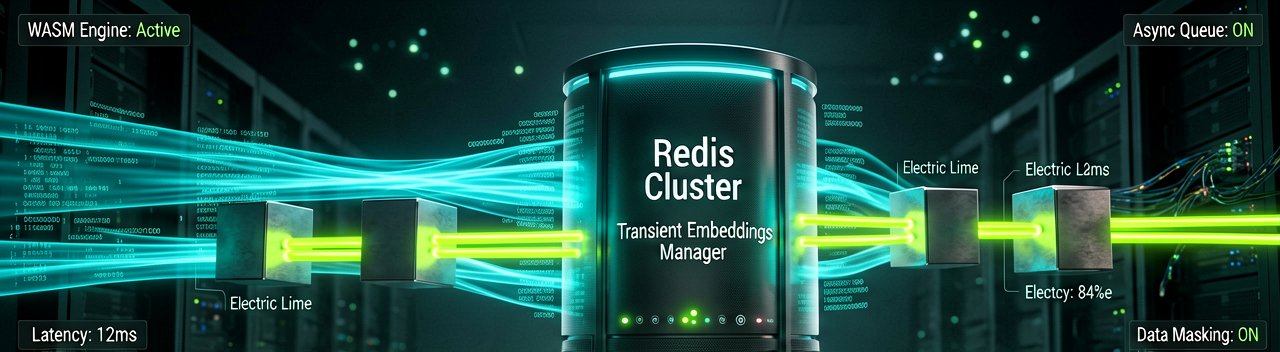
Memory management within these AI pipelines represents another critical point of failure under heavy load. When thousands of guests are simultaneously interacting with room assistants and digital concierges, standard relational databases can choke on the concurrency. High-performance hospitality engines deploy in-memory Redis clusters specifically to manage transient session states and contextual embeddings. These embeddings represent a guest's current interaction context but are completely scrubbed of persistent PII. By storing these mathematical vectors in a temporary, highly available state, the AI engine can maintain a natural, multi-turn conversation without needing to query the slower, heavily encrypted relational database for every single response cycle, cutting database overhead by up to 60 percent.
Mitigating Model Poisoning and Prompt Injection
The threat model changes dramatically when an AI system is exposed to the public. Hackers frequently attempt indirect prompt injection, hiding malicious instructions inside seemingly normal requests to force the AI to reveal underlying system prompts or execute unauthorized database commands. To defend against this, engineers implement a dual-LLM validation topology. A highly restricted, deterministic guardrail model sits in front of the primary generative model. This guardrail engine evaluates the semantic intent of the input against a strict whitelist of hospitality tasks. If the vector distance of the incoming request strays too close to known jailbreak patterns or system command structures, the request is immediately dropped before it ever touches the main inference engine, triggering an automated alert to the security operations team.
Continuous model alignment and fine-tuning must also be protected against data poisoning attacks. Hospitality systems constantly learn from guest feedback and regional operational shifts, but feeding untrusted user input directly back into training loops is a recipe for disaster. To secure the learning lifecycle, engineering teams isolate the feedback data inside an air-gapped staging environment. Here, automated sanitization scripts scan for anomalies, and differential privacy algorithms inject controlled mathematical noise into the datasets. This ensures that while the core model can still learn macro-level trends, such as shifting booking preferences or seasonal room temperature patterns, it remains completely incapable of memorizing or exposing specific, malicious inputs injected by bad actors during the previous operational cycle.
Reading Between the Lines: The tech industry’s current rush to wrap every single hospitality interface in a layer of defensive artificial intelligence ignores a glaring, uncomfortable contradiction. While marketing brochures promise that zero-trust architectures and dual-LLM topologies will transform hotels into digital fortresses, the hospitality sector remains fundamentally dependent on a fractured, fragile supply chain of third-party vendors. A hotel can build a flawless, air-gapped internal network, but that security means very little if it must constantly sync data with legacy local tour operators, external laundry services, and regional point-of-sale systems. These external entities rarely operate under the same strict national security frameworks, meaning that the multi-million-dollar AI security apparatus is often just a heavy iron gate swinging on a wooden fence post.
The Real-World Friction of Automated Defense
There is also a profound disconnect between the sterile assumptions of systems engineers and the chaotic realities of front-desk operations. Security models assume that when a behavioral anomaly detection system flags a suspicious transaction or an isolated IoT device, an automated quarantine is the safest course of action. However, in a five-star resort, a false positive that suddenly deactivates a digital room key or mistakenly declines a VIP guest's credit card during a high-stakes check-in is treated as an absolute catastrophe. Operational managers will almost always favor frictionless guest service over strict technical compliance, frequently demanding overrides or bypassing automated security prompts just to keep the lobby moving, creating a massive human-shaped hole in the most sophisticated zero-trust defense layers.
Furthermore, the financial math behind these heavily fortified next-gen systems simply does not compute for the vast majority of the industry. The computational overhead of running continuous token-masking engines, WebAssembly edge modules, and adversarial prompt filters forces a massive spike in cloud hosting and token-inference costs. While mega-chains and elite luxury brands might possess the deep capital reserves required to absorb these ongoing infrastructure fees, mid-market properties and independent boutiques are left with an impossible choice. They must either settle for stripped-down, dangerously vulnerable off-the-shelf AI plugins, or bleed their margins dry attempting to maintain a defense system that costs more than the data it is designed to protect.
Looking ahead, this economic divide will likely spark a wave of regulatory and operational consolidation across the travel sector. As national security frameworks become more litigious and compliance penalties under directives like NIS2 tighten, smaller operators will find themselves completely priced out of the legal market. The ultimate irony of the hospitality AI revolution is that an initiative meant to democratize hyper-personalized guest service will instead entrench a rigid corporate monopoly, where only a handful of massive tech-driven hotel conglomerates can actually afford to guarantee both a seamless check-in and an uncompromised identity.
"We have spent millions of dollars building autonomous, zero-trust digital concierges capable of thwarting state-sponsored cyber espionage, only to realize that the entire multi-layered defense matrix can still be brought down by a front-desk manager who just wants the lobby printer to work."
Artūras Malašauskas is an AI Systems Integrator with 20+ years of production-grade web engineering experience. He has designed, shipped, and scaled enterprise Python/PHP systems for logistics, SaaS, and public-sector clients. For the past year, he has focused exclusively on AI integrations: deploying open-source LLMs, building generative media pipelines (image, audio, video), and engineering multi-agent workflows for real production environments. His standard: reproducibility, security, cost-efficient inference—no vaporware. He documents and evaluates emerging AI tooling, separating verified capabilities from marketing noise. Technical editor at: muza-ai.eu, ai-verslas.lt, ai-naujinos.lt Connect on LinkedIn
Comments