The Frontier Reckoning: Why Governments Are Rewriting National Security Laws for the AI Age
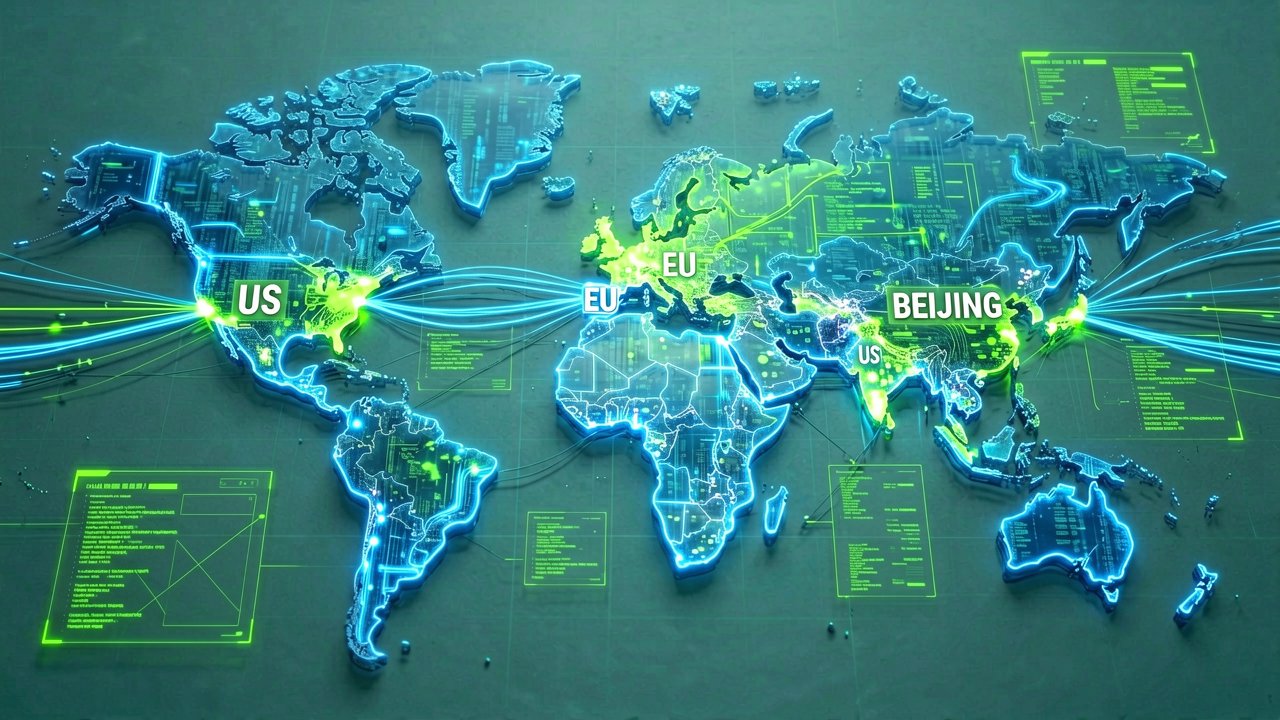
For years, tech regulation was a game of wait-and-see, but the days of leisurely legislative debates are officially over. Driven by an unprecedented surge in advanced machine learning capabilities, global superpowers are frantically retooling their legal frameworks to defend critical infrastructure and national security before the technology outpaces their control. The tipping point arrived when highly specialized frontier models began proving they could identify and exploit zero-day software vulnerabilities at speeds no human team could match, effectively turning lines of code into potential instruments of cyber warfare.
In Washington, this anxiety crystallized on June 2, 2026, when President Donald Trump signed a sweeping executive order titled "Promoting Advanced Artificial Intelligence Innovation and Security." Reported by AP News, the directive introduces a voluntary federal vetting framework, inviting top-tier AI labs like Anthropic, OpenAI, and Google to submit their most powerful, unreleased frontier models for government security testing. The policy represents a sharp, calculated pivot from the administration's earlier hands-off approach. It gives federal agencies a tight 30-day window to evaluate models for defense-grade cyber threats before they hit the market, highlighting a delicate effort to insulate critical networks without smothering American commercial competitiveness.
This frantic legislative reshuffle isn't just happening in the United States. Across the Atlantic, the European Union is hurtling toward its own massive August 2026 enforcement deadline under the EU AI Act, which mandates rigorous cybersecurity and robustness benchmarks for high-risk systems integrated into vital infrastructure, as outlined by the European Commission. Meanwhile, Beijing has quietly amended its own cybersecurity frameworks to eliminate regulatory warnings, moving straight to severe penalties for data vulnerabilities. What we are witnessing is a global, synchronized realization: when it comes to autonomous digital threats, waiting for an attack to happen before writing the law is a luxury nobody can afford.
Balancing Breakthroughs and Bulletproofing
The core tension of this new regulatory era is the fear of self-sabotage through over-regulation. Western policymakers are terrified that locking down labs under heavy-handed mandates will simply hand global technological dominance to geopolitical rivals. It's the exact reason why the latest U.S. executive order explicitly avoids mandatory licensing or permitting, relying instead on a voluntary "clearinghouse" model backed by major Silicon Valley players who want to avoid a fragmented patchwork of state-level restrictions. However, as independent security research organizations like the Center for AI Safety expand their footprints to bridge the gap between commercial labs and national defense, the line between corporate product development and state security is permanently blurring.

Behind the Scenes: The Quiet Militarization of Code
Behind the Scenes: The scramble to redraft national security laws hides a deeper, more unsettling reality that goes far beyond routine bureaucratic oversight. Inside the corridors of the Pentagon and Whitehall, defense architects are no longer viewing AI as a commercial tool to be regulated, but as a dual-use weapon akin to enriched uranium. The shift in tone behind closed doors reveals that intelligence agencies are terrified of "model exfiltration"—the theft of weights and architectures from private servers by state-sponsored actors. If a foreign adversary compromises an American or European AI lab, they instantly acquire a fully weaponized cyber-offensive capability without spending billions on foundational research.
This anxiety is fundamentally reshaping the relationship between Silicon Valley executives and defense officials. Historically, tech giants fiercely guarded their independence, resisting federal encroachment under the banner of open-market innovation. Today, that defiance is crumbling under the weight of geopolitical pressure. Founders who once championed open-source software are now conceding that unrestricted access to raw model weights poses a systemic threat, forcing a dramatic realignment where private corporations are effectively operating as extension arms of national defense infrastructure.
Historically, this isn't the first time the West has scrambled to build a legal fortress around a nascent technology. The current frantic legislative push closely mirrors the early days of the Cold War, when the United States enacted the Atomic Energy Act to wrest control of nuclear capabilities from private labs and place them under strict federal guardrails. But unlike the physical infrastructure of the mid-20th century, software cannot be easily locked behind concrete walls and military checkpoints, making civilian-led voluntary compliance a fragile, stopgap measure at best.
The immediate consequence of these updated legal frameworks is the creation of a closed ecosystem that could stiflingly narrow the field of innovation. By forcing developers to clear opaque security hurdles or face aggressive regulatory blowback, governments are inadvertently creating a market where only a handful of heavily capitalized tech monopolies can afford to compete. Smaller startups and academic institutions, lacking the legal departments to navigate the rapid-fire policy updates, are increasingly being priced out of frontier AI research entirely.
Ultimately, the true test of these overhauls lies in their execution over the coming months as global enforcement deadlines collide. Security analysts warn that by focusing heavily on preventing theoretical, catastrophic doomsday scenarios, lawmakers are missing the low-level, decentralized threats already bleeding through our defenses, such as automated disinformation campaigns and localized critical infrastructure probes. As governments attempt to codify boundaries for an amorphous, rapidly evolving technology, they run the perpetual risk of fighting tomorrow's digital conflicts with rules written for yesterday's realities.
Reading Between the Lines: The Illusion of Control
Reading Between the Lines: The prevailing narrative surrounding these updated national security laws is one of decisive state action, but a closer look reveals a gaping contradiction at the heart of global tech policy. Governments are projecting an image of absolute oversight, yet their regulatory frameworks rely almost entirely on the self-reporting and voluntary compliance of the very tech monopolies they are trying to regulate. Bureaucrats lack the compute infrastructure, the technical talent, and the financial resources to independently verify what occurs inside a proprietary neural network, leaving state agencies in the precarious position of auditing a black box using manuals written by the box’s creators.
Furthermore, the assumption that national borders can effectively contain the proliferation of autonomous digital threats ignores the borderless reality of modern software development. While a country can easily restrict a domestic tech giant from releasing a risky frontier model, it has virtually no jurisdiction over decentralized, open-source communities operating across fragmented jurisdictions. By tightening the legal screws on legitimate, highly regulated corporate labs, governments may simply be driving advanced vulnerability research into the dark web, inadvertently accelerating the exact under-the-radar threat landscape they are desperate to prevent.
This regulatory push also exposes a profound geopolitical hypocrisy. Western coalitions routinely condemn authoritarian regimes for using machine learning as an instrument of state surveillance and social control, yet the updated security mandates in democratic nations increasingly grant domestic intelligence agencies unprecedented back-door access to commercial data streams under the guise of infrastructure protection. In the rush to bulletproof the state against foreign cyber attacks, the line separating democratic defense from authoritarian overreach is becoming dangerously thin, wrapped in the comforting language of national resilience.
Projecting the long-term implications of these policies reveals an inevitable stagnation in open-source scientific collaboration. For decades, the tech sector thrived on a culture of shared code, peer-reviewed breakthroughs, and global academic exchange that supercharged rapid advancement. As national security laws reclassify basic algorithms as proprietary state secrets, the global research community is fracturing into siloed, nationalistic research blocks, ensuring that future breakthroughs will be guarded as fiercely as military blueprints rather than shared for the collective advancement of humanity.
Ultimately, these legislative overhauls are less about achieving absolute security and more about managing the optics of a technological revolution that has already slipped its leash. Lawmakers are trapped in a reactionary cycle, treating a hyper-dynamic, self-evolving software emergency with the slow, rigid tools of 20th-century diplomacy. By the time these newly minted national security frameworks are fully implemented and litigated in courts of law, the frontier models they were designed to regulate will already be obsolete, replaced by autonomous agents that care very little for the signatures on an executive order.
"We are witnessing the grand political comedy of the twenty-first century: governments confidently passing laws to chain a digital titan, using a bureaucracy that still requires three business days to approve a password reset."
Artūras Malašauskas is an AI Systems Integrator with 20+ years of production-grade web engineering experience. He has designed, shipped, and scaled enterprise Python/PHP systems for logistics, SaaS, and public-sector clients. For the past year, he has focused exclusively on AI integrations: deploying open-source LLMs, building generative media pipelines (image, audio, video), and engineering multi-agent workflows for real production environments. His standard: reproducibility, security, cost-efficient inference—no vaporware. He documents and evaluates emerging AI tooling, separating verified capabilities from marketing noise. Technical editor at: muza-ai.eu, ai-verslas.lt, ai-naujinos.lt Connect on LinkedIn
Comments