The AI Job Paradox: Why Companies Claim Innovation While Workers Fear Obsolescence
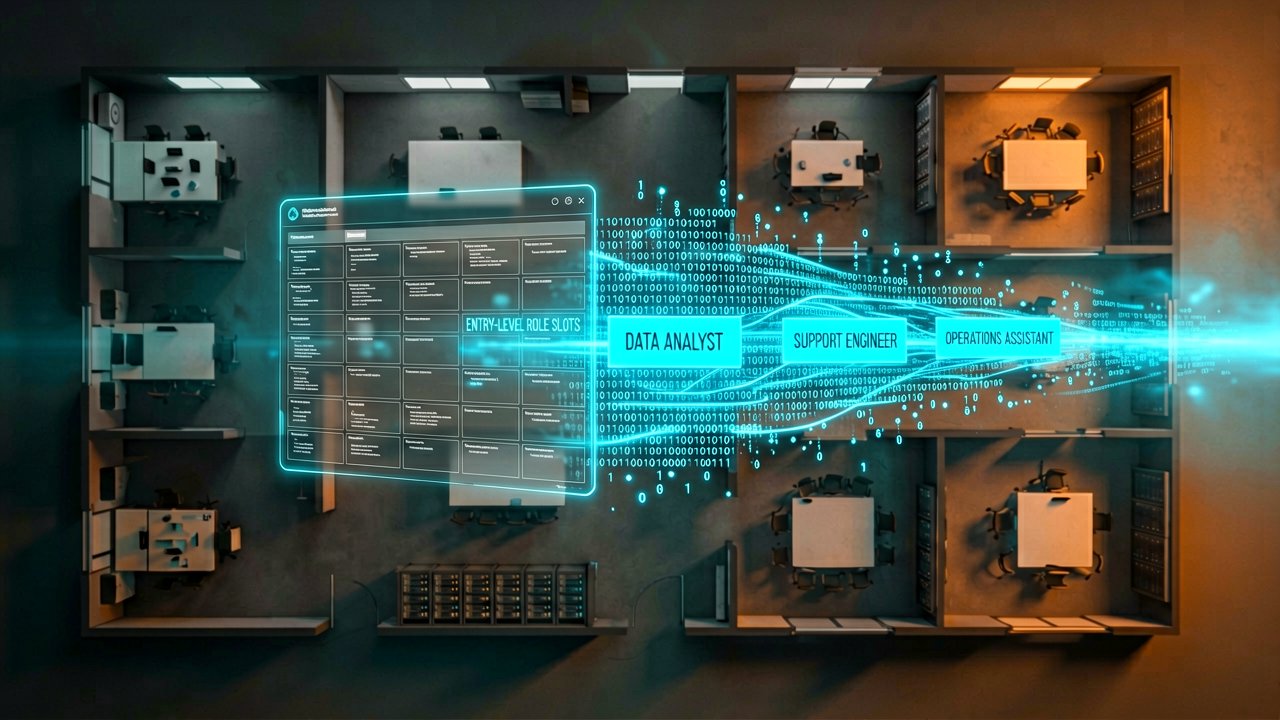
Corporate executives increasingly champion artificial intelligence as the ultimate engine for business transformation, arguing that automation unlocks unprecedented creative potential and higher-value work. However, this corporate optimism sits in stark contrast with widespread worker anxiety regarding rapid job obsolescence. Market indicators reveal a growing structural disconnect, as enterprise buyers rapidly substitute human operations with algorithms to cut costs while framing the operational changes to Wall Street as strategic modernizations.
According to research published by Yahoo Finance, an overwhelming 99% of CEOs plan to execute AI-driven layoffs within the coming years, primarily targeting entry-level talent and repetitive administrative workflows. This shift alters the standard tech career path, making it increasingly difficult for younger professionals to find initial placement. While the broader economic narrative pushes the concept of job augmentation, front-line workforce data points toward structural displacement in specific white-collar sectors.
The core of the paradox lies in the speed of enterprise adoption versus the slow pace of worker reskilling initiatives. Businesses frequently use corporate restructuring cycles to phase out traditional support roles, quietly introducing automated platforms under the banner of innovation. This tension reveals that while the long-term economic outcome may yield a net positive in specialized technical positions, the immediate labor transition introduces severe disruption for vulnerable operational teams.
The Disconnection Between Corporate PR and Labor Realities
Corporate communications heavily emphasize that AI serves to empower employees rather than replace them, yet internal spending tells a completely different story. Budgets are actively shifting from human payroll allocations directly into machine learning infrastructure and cloud computing licenses. Enterprises frequently point to macro productivity statistics to justify these changes, leaving labor unions and workforce advocates to navigate immediate, unmitigated layoffs.
Entry-Level Contraction and the Erasure of the Career Ladder
Junior professionals bear the brunt of early corporate automation strategies. Standard back-office positions, basic data management, and introductory analytical tasks are now easily handled by specialized software models. By automating these baseline roles, organizations inadvertently dismantle the foundational learning environments where young workers traditionally acquired necessary corporate experience.
The Widening Reskilling Mismatch
The emerging positions created by this technological shift require highly specific expertise in data architecture, prompt engineering, and advanced systems management. Displaced operational personnel rarely possess these niche capabilities, creating a labor market mismatch where job openings and unemployment rise concurrently. Without massive, structured retraining frameworks, the divide between corporate efficiency gains and worker security will continue to widen.
An Unforgiving Shift in the Corporate Engine
Behind the Corporate Veil: The friction defining the current technological transition stems from a profound change in how public markets value corporate efficiency. Historically, business expansion required a proportional increase in human headcount, creating a predictable relationship between economic growth and job creation. Today, institutional investors actively penalize companies with high overhead, rewarding organizations that demonstrate a high ratio of revenue per employee. This Wall Street pressure creates an environment where corporate leaders must publicly celebrate artificial intelligence as an innovative creative tool, while privately leveraging it as a mechanism for permanent workforce reduction.
This dynamic creates an intense cultural divide inside modern enterprises, splitting staff into two distinct classes. On one side are the technical architects who manage the infrastructure, and on the other are the operational workers whose daily tasks are being systematically cataloged to train the next generation of software models. Mid-level managers find themselves in the difficult position of supervising employees while simultaneously auditing those same roles for automated replacement. This structural shift erodes workplace trust, as workers realize that their daily contributions are actively used to optimize the systems designed to replace them.

The current disruption closely mirrors historical automation cycles, such as the introduction of computerized bookkeeping in the late twentieth century or the arrival of robotic assembly lines in manufacturing. However, the current transition is moving at an unprecedented pace, compressing a process that traditionally took decades into just a few quarters. In past technological shifts, workers displaced from one sector could transition into adjacent service or administrative roles. In the current landscape, because generative software simultaneously targets cognitive, creative, and administrative tasks, those traditional safety valves are rapidly disappearing.
This rapid displacement creates an environment where the economic gains of automation flow almost exclusively to capital owners and high-level executives, while the transition costs are borne entirely by the displaced workforce. While corporate balance sheets reflect higher margins and lower operational risks, local economies face the challenge of supporting a growing class of underemployed professionals. The long-term stability of the broader corporate ecosystem remains uncertain if the consumer base, which relies on steady white-collar employment, sees its purchasing power systematically diminished by automation.
The Mirage of the Frictionless Transition
Reading Between the Lines: The prevailing enterprise narrative assumes that labor freed from routine tasks will automatically pivot toward high-level strategy and creative innovation. This optimistic projection fundamentally ignores the realities of corporate cost management, where saved labor hours are rarely reinvested into human experimentation. Instead, when an automated tool reduces a workflow from forty hours to four, corporations predictably reduce headcounts rather than funding thirty-six hours of unquantifiable creative exploration. The assumption that every displaced administrative worker can seamlessly transform into a strategic visionary misjudges both corporate behavior and human capital limitations.
A glaring contradiction lies in the tech sector's own hiring patterns, which serve as a leading indicator for the broader economy. While technology executives enthusiastically evangelize an AI-driven economic boom to the public, their internal operations tell a story of aggressive downsizing and restricted entry-level hiring. This reveals a troubling double standard where the creators of these tools are hesitant to absorb the human displacement they cause, choosing instead to run their own operations with highly lean, hyper-specialized teams. The broader market is being urged to adopt a labor model that its own architects are actively using to shrink their workforces.
Furthermore, the long-term reliability of an entirely automated corporate memory remains highly questionable. By automating entry-level and mid-tier roles, organizations eliminate the traditional training grounds where future senior leadership develops institutional knowledge and contextual judgment. If the foundational layers of an industry are outsourced to algorithmic models, the pipeline for human expertise effectively dries up. Over-reliance on automation risks creating a top-heavy corporate ecosystem managed by executives who lack the fundamental, hands-on operational experience required to navigate unprecedented systemic crises.
Ultimately, the corporate rush toward total automation may trigger an unexpected backlash in consumer value and brand differentiation. As enterprises adopt identical, standardized machine learning models to handle customer service, content creation, and market analysis, corporate outputs risk becoming entirely homogenized. When every competitor uses the same algorithmic foundation to optimize its business, true innovation stalls, leaving companies with highly efficient but entirely uninspired operations. The quest for absolute efficiency threatens to eliminate the chaotic, human variables that historically sparked genuine market disruption.
The modern corporate ideal appears to be an enterprise that generates billions in revenue managed entirely by a single executive, an advanced algorithm, and a very expensive coffee machine—though it remains entirely unclear who will actually have the money to buy the products being manufactured.
Artūras Malašauskas is an AI Systems Integrator with 20+ years of production-grade web engineering experience. He has designed, shipped, and scaled enterprise Python/PHP systems for logistics, SaaS, and public-sector clients. For the past year, he has focused exclusively on AI integrations: deploying open-source LLMs, building generative media pipelines (image, audio, video), and engineering multi-agent workflows for real production environments. His standard: reproducibility, security, cost-efficient inference—no vaporware. He documents and evaluates emerging AI tooling, separating verified capabilities from marketing noise. Technical editor at: muza-ai.eu, ai-verslas.lt, ai-naujinos.lt Connect on LinkedIn
Comments