The Sovereign Sandbox: How Free, Always-Compliant AI Models Are Re-Centering Global Tech Infrastructure
The global artificial intelligence market is undergoing a structural realignment as proprietary, multi-billion-dollar foundation models face an existential squeeze from a new class of free, structurally compliant, open-weights alternatives. As strict frameworks take teeth—notably with the European Union commencing full financial enforcement of its regulatory codes—the enterprise sector is rapidly abandoning the "move fast and break things" deployment ethos. Instead, organizations are prioritizing systemic risk mitigation, verifiable training transparency, and localized data sovereignty over raw, unaligned computing power. This strategic shift is turning compliance into a core product requirement rather than a post-development afterthought.
At the center of this movement is a fundamental redesign of how open software interacts with international legal statutes. Landmark exemptions established under global frameworks incentivize developers to publish deep model architectures, tokenizations, and weights under highly permissive public licenses. By meeting these rigorous transparency baselines, free models bypass the most suffocating documentation overheads reserved for opaque, closed-source monopolies, provided they remain under critical computing thresholds. Enterprise architects are leveraging this regulatory asymmetry to build highly specialized, local deployments that are natively immune to shifting compliance liabilities and costly vendor lock-in.
The Economics of Structural Compliance and Open-Weights Disruption
The migration toward open, pre-aligned architectures is rewriting the financial playbook for enterprise software deployment. The traditional software-as-a-service (SaaS) model for generative tools introduces volatile per-token pricing alongside severe vulnerabilities regarding extraterritorial data transfers and intellectual property exposure. By embedding compliance parameters directly into the pre-training and filtering phases, open-weight developers deliver foundational systems that can be inspected, audited, and fine-tuned on private infrastructure without risking regulatory friction.
According to comprehensive policy deep-dives provided by the EU Artificial Intelligence Act platform, general-purpose AI models that distribute parameters, architecture, and usage metrics freely are granted explicit operational paths to minimize administrative burdens. This regulatory design allows small and medium-sized enterprises to deploy high-tier automation without the crushing overhead of independent multi-million-euro validation audits. Consequently, venture capital and corporate budgets are rotating away from paying recurring proprietary API premiums and moving toward localized infrastructure tuning, hardware acceleration, and internal data engineering.

Navigating the Systemic Risk Threshold and Market Fragmentation
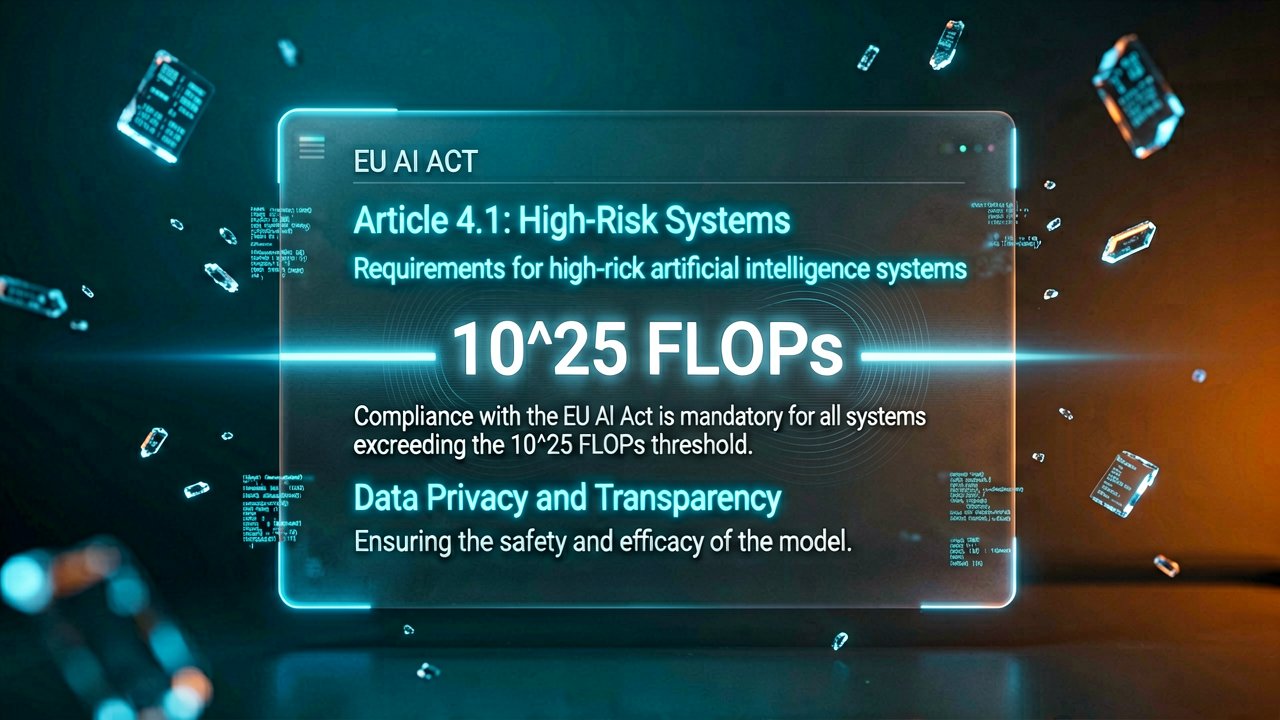
A stark technical boundary remains regarding computational scale and the legal definition of systemic risk. Regulators globally utilize strict mathematical limits—typically tracking training compute thresholds around 10^25 floating-point operations (FLOPs)—to categorize hyper-capable frontier models. Once a free or open-source model crosses this computational threshold, it loses its standard open-source exemptions and becomes subject to aggressive adversarial testing, mandatory incident tracking, and centralized oversight.
This reality forces an architectural bifurcation in corporate strategy. Forward-looking tech providers are deliberately designing highly efficient, sub-threshold models that maximize token-processing efficiency while remaining comfortably beneath high-risk regulatory classifications. This tactical optimization ensures that software systems remain globally agile, fully customizable, and protected against catastrophic enforcement penalties. The future of equitable, accessible artificial intelligence belongs to these highly targeted, mathematically optimized, and permanently compliant open ecosystems.
The Hidden Dynamics of Open-Weights Decentralization
Behind the Corporate Veil: The rapid proliferation of open, pre-aligned AI models is less an act of altruism by big tech and more a calculated defensive maneuver designed to commoditize the proprietary advantages of early market leaders. Historically, tech monopolies were maintained through closed ecosystems and high capital barriers to entry. By funding and open-sourcing highly capable, compliant model weights, secondary market competitors are effectively collapsing the pricing power of closed-source API providers, shifting the field of competition from foundational model access to proprietary data curation and specialized runtime integration.
This structural shift has triggered an intense, quiet ideological civil war among enterprise software architects and chief information security officers. While executive leadership teams are drawn to the zero-dollar licensing costs and the elimination of vendor lock-in, engineering teams are grappling with the operational realities of hosting and fine-tuning these models locally. Maintaining continuous regulatory alignment requires ongoing engineering overhead, including the development of custom input-output guardrails, synthetic data generation pipelines, and localized bias-mitigation frameworks that match the scale of cloud-native alternatives.

Furthermore, the reliance on public, open-source compliance models creates an architectural monoculture that introduces unique systemic risks across the tech sector. When dozens of major financial institutions or healthcare providers fine-tune the exact same base model weights, they inadvertently inherit identical blind spots, vulnerabilities, and alignment anomalies. A singular, undiscovered vulnerability in a widely adopted, legally compliant foundation model could theoretically compromise hundreds of down-stream corporate applications simultaneously, shifting the regulatory burden from individual data privacy compliance to systemic cybersecurity resilience.
Geopolitical strategies are further complicating this paradigm as nation-states recognize that AI accessibility is a crucial tool for soft power and economic autonomy. Developing nations are actively leveraging these free, unencumbered models to bypass the strict digital colonialist patterns of the past, establishing localized compute centers that do not rely on transatlantic fiber pipelines or foreign cloud sovereignty. Consequently, the true value of compliant, accessible AI is not found in the code itself, but in how effectively it democratizes institutional agility and breaks the geographical monopoly on advanced cognitive automation.
The Compliance Paradox and the Illusion of Permanent Autonomy
Reading Between the Lines: The corporate rush toward structurally compliant, open-weights AI models relies on a deeply flawed assumption that regulatory landscapes will remain static or predictable. Tech executives are treating current open-weights legal exemptions as a permanent safe harbor, ignoring the historical reality that regulators routinely close loopholes once decentralized technologies achieve mass scale. The current system creates a glaring contradiction where a model can be legally classified as free and low-risk during its release phase, only to transform into an un-auditable corporate liability the moment it is fine-tuned on proprietary enterprise datasets.
This dynamic introduces a severe operational bottleneck regarding liability and accountability. When a closed-source API provider suffers a model collapse or outputs a legally damaging hallucination, enterprise clients have a clear vendor to sue or hold contractually accountable. With free, open-weights models, that legal buffer completely evaporates, leaving the deploying enterprise entirely exposed to the legal consequences of the model's outputs. Organizations are effectively trading predictable monthly API subscription fees for unpredictable, long-term legal defense funds, masking a massive shifting of corporate risk under the banner of technological independence.
Furthermore, the technical premise of maintaining models comfortably underneath compute-based regulatory thresholds is a short-sighted strategy that ignores algorithmic efficiency gains. As training methodologies optimize, sub-threshold models will inevitably achieve performance characteristics that match or exceed older frontier systems, forcing regulators to abandon raw computing metrics in favor of tracking actual deployment capabilities. This shift will trigger a massive retroactive compliance burden for thousands of businesses that believed their specialized, locally hosted systems were permanently immune to centralized state oversight.
"We are witnessing a classic corporate shell game where tech firms eagerly swap the golden handcuffs of proprietary vendor lock-in for the invisible, legally binding ankles-shackles of decentralized regulatory compliance—all while congratulating themselves on achieving absolute digital freedom."
Artūras Malašauskas is an AI Systems Integrator with 20+ years of production-grade web engineering experience. He has designed, shipped, and scaled enterprise Python/PHP systems for logistics, SaaS, and public-sector clients. For the past year, he has focused exclusively on AI integrations: deploying open-source LLMs, building generative media pipelines (image, audio, video), and engineering multi-agent workflows for real production environments. His standard: reproducibility, security, cost-efficient inference—no vaporware. He documents and evaluates emerging AI tooling, separating verified capabilities from marketing noise. Technical editor at: muza-ai.eu, ai-verslas.lt, ai-naujinos.lt Connect on LinkedIn
Comments