The Ghost in the Machine: Why Prompt Injection Remains AI’s Unsolved Security Paradox

We have spent decades teaching computers to treat code as sacred execution commands and data as passive text. Then came Large Language Models, which smashed those two concepts together into a single, fluid conversational stream. By design, an LLM processes your system instructions and an untrusted user's input within the exact same context window. It makes for an incredibly intuitive interface, but it also creates a massive structural vulnerability. This mixing of control and data channels means that any rogue text can easily hijack the model's logic, turning a helpful AI assistant into an open gateway for malicious exploitation.
When looking at the mechanics of these exploits, security teams usually divide them into direct and indirect variants. Direct attacks are what we traditionally call jailbreaking, where a user actively tries to trick the model into breaking its core rules. However, the real threat to enterprise applications lies in indirect prompt injection, an exploit highlighted as a critical vulnerability in the OWASP Gen AI Security Project guidelines. In this scenario, an attacker hides malicious instructions inside an external source, such as a PDF file, a web page, or an email repository. When an autonomous AI agent naturally pulls that content using tools like Retrieval-Augmented Generation, it unknowingly ingests a payload that overrides its original programming, steering the system toward unauthorized actions.
From Architecture to Performance Metrics
This architectural blind spot gets significantly worse as we transition from simple chatbots to fully autonomous agentic workflows. When an LLM is granted tool-calling capabilities, an indirect prompt injection attack ceases to be a mere text manipulation trick. Instead, it becomes a method for remote code execution or unauthorized data exfiltration. If an agent reads an infected document that instructs it to delete data or send private API keys to an external server, the underlying model simply lacks the native awareness to separate the information it is reading from the commands it is supposed to follow.
Faced with this vulnerability, engineering teams have started deploying multi-agent pipelines and dual-LLM architectures to separate untrusted data processing from core decision-making. In these setups, a highly restricted supervisor model evaluates inputs before passing them along, a strategy that has shown highly promising results in recent security benchmarks. According to recent research on , specialized multi-agent defense pipelines can successfully drive the Attack Success Rate down to near-zero levels across common exploit categories. This structural isolation effectively creates a firewall out of text, forcing a secondary model to validate the safety of incoming data before any downstream tools can be triggered.
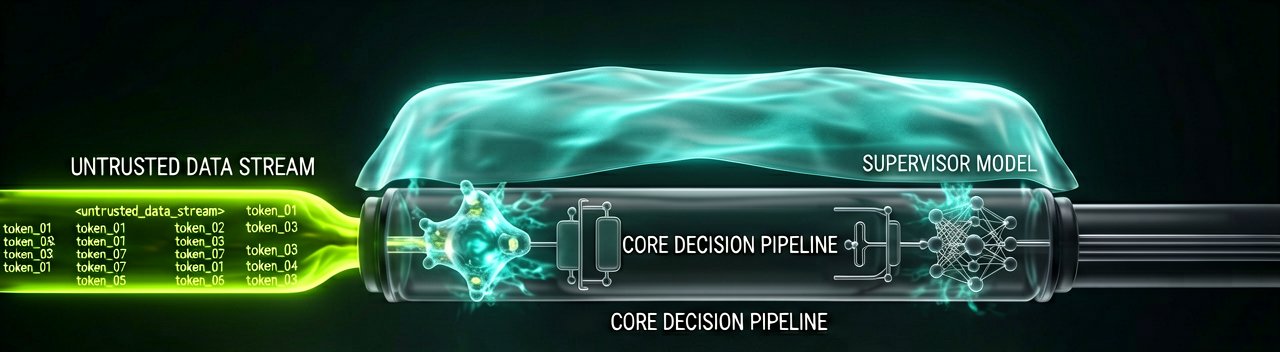
Unfortunately, adding these defensive layers introduces a challenging trade-off between absolute system security and operational efficiency. Running input validation through secondary evaluation models or complex semantic firewalls adds significant latency to every interaction, often doubling the time-to-first-token for the end user. Furthermore, the operational cost scales linearly with token volume, which can heavily strain corporate infrastructure budgets when processing massive datasets. To maintain a smooth user experience, developers are forced to rely on a layered approach, combining fast, deterministic token-filtering guardrails with strict, least-privilege access controls on all connected APIs.
Behind the Scenes: Building truly resilient LLM systems requires engineers to treat prompt injection not as a simple input-validation bug, but as a fundamental compiler security flaw. Because LLM context windows function as execution environments where code and data are unified, traditional string sanitization completely fails. Systems engineers are instead forced to implement architectural isolation at the inference and decoding levels. This means moving away from single-stage prompt templates and shifting toward strictly segregated data processing pipelines that treat all untrusted strings as isolated variable payloads.
Isolating the Execution Context
One primary method for enforcing this isolation at the infrastructure layer involves the use of specialized structural formatting protocols, such as ChatML, combined with rigid token-level access controls. By strictly defining roles like system, user, and assistant through immutable, hardware-enforced token boundaries, developers can prevent a model from misinterpreting text inputs as high-priority configuration commands. When the inference engine parses incoming requests, these structural markers ensure that data injected into a user prompt cannot prematurely close its own container or spoof a system-level directive. This design mirrors how parameterized queries in traditional SQL databases prevent injection attacks by stripping raw data strings of any executable privileges.
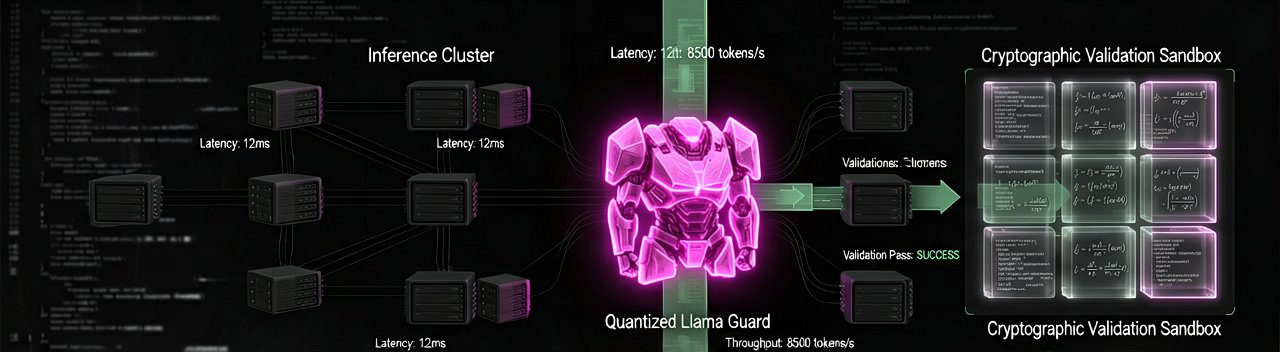
At scale, however, relying solely on static token boundaries proves insufficient when autonomous agents are given tool-calling capabilities. Advanced architectures solve this by introducing an intermediary parsing layer between the LLM output and the internal API gateway. Instead of allowing the model to generate raw, unvalidated function calls directly, the system passes the generated payload through an isolated, deterministic execution sandbox. This engine validates the schema, checks the requested arguments against a strict whitelist, and uses cryptographic signing to verify that the tool request originated from an authorized system sequence rather than an injected user payload.
Quantifying Defense Overhead and Latency
Implementing these strict parsing boundaries and validation steps inevitably impacts system throughput and operational efficiency. In high-performance enterprise applications, routing every LLM response through secondary semantic checking models can cause response times to skyrocket. To mitigate this latency bottleneck, engineering teams are increasingly relying on localized, highly optimized guardrail models like Llama Guard, which are deployed as sidecars directly within the inference cluster. By utilizing quantized weights and keeping these evaluation models small, systems can perform asynchronous safety checks with an overhead of less than 10 to 15 milliseconds per request, preserving a fast user experience while maintaining robust defensive coverage.
Ultimately, the most secure setups combine these low-latency guardrails with a Zero Trust access architecture for all downstream integrations. By giving connected APIs the absolute minimum privileges required to function, an organization ensures that even if an attacker successfully executes an indirect prompt injection attack, the blast radius is strictly limited. The compromised agent simply lacks the systemic permissions to perform destructive operations or read sensitive databases, transforming a potentially catastrophic system-wide breach into a contained, easily auditable parsing anomaly.
Reading Between the Lines: The tech industry’s current rush to fix prompt injection with software guardrails ignores a deeply uncomfortable reality: we are trying to force deterministic security onto inherently non-deterministic systems. Security vendors pitch advanced firewalls and validation models as absolute cures, yet these solutions are fundamentally flawed. They rely on the premise that an AI can reliably outsmart another AI's malicious creativity. This creates a circular dependency where we deploy complex, unpredictable models simply to police other unpredictable models, multiplying our system dependencies while failing to eliminate the core architectural vulnerability.
The Illusion of Total Control
This paradox becomes obvious when looking at the industry's push for autonomous enterprise agents. Companies want models to be incredibly flexible, understanding subtle human nuances and executing complex, multi-step workflows. At the same time, they expect these systems to show rigid, absolute obedience to security rules. These two goals are fundamentally incompatible. An LLM’s power comes from its ability to treat all words in its context window as interconnected concepts. If you completely lock down a model's cognitive flexibility to prevent injection, you strip away the exact intelligence that makes it useful in the first place, turning an advanced AI agent into an expensive, glorified script.
Furthermore, relying on secondary evaluation models creates a false sense of security that can backfire on system administrators. When an organization sees a security dashboard showing high detection rates, they often feel safe granting the AI direct access to internal databases and sensitive APIs. This trust overlooks the fact that prompt injection is an infinite game of cat-and-mouse. An attacker does not need to bypass a defense pipeline a thousand times to do damage; they only need a single, clever piece of text to slip through. Believing that a system is bulletproof because it passes standard benchmarks ignores how easily creative adversaries can bypass static evaluation tools.
The Real Path Forward
Accepting that text-based systems cannot be perfectly patched forces a shift in how we approach enterprise security. Instead of wasting resources trying to build a flawless prompt filter, engineers must focus on limiting the damage an exploit can cause. This means treating the output of any LLM as untrusted user input, regardless of how many guardrails it has passed. True security will not come from clever prompt engineering or multi-agent validation loops, but from traditional, rigid software engineering practices like hardcoded API limitations, strict user confirmation prompts for sensitive actions, and isolated data environments.
Designing a secure system around a modern Large Language Model is a bit like hiring a brilliantly creative but chaotic intern, and then leaving them alone with the master keys to the company vault. No matter how many polite warning signs you tape to the wall, or how many other interns you hire to watch them, you probably shouldn't be surprised when the vault door ends up wide open anyway.
Artūras Malašauskas is an AI Systems Integrator with 20+ years of production-grade web engineering experience. He has designed, shipped, and scaled enterprise Python/PHP systems for logistics, SaaS, and public-sector clients. For the past year, he has focused exclusively on AI integrations: deploying open-source LLMs, building generative media pipelines (image, audio, video), and engineering multi-agent workflows for real production environments. His standard: reproducibility, security, cost-efficient inference—no vaporware. He documents and evaluates emerging AI tooling, separating verified capabilities from marketing noise. Technical editor at: muza-ai.eu, ai-verslas.lt, ai-naujinos.lt Connect on LinkedIn
Comments