Adapting CyberCorps SFS to AI Threats: A Strategic Imperative for Cybersecurity's Future

For over two decades, the federal government relied on a predictable playbook to protect its digital borders. It minted fresh security talent through the CyberCorps Scholarship for Service (SFS) program, trading full tuition and healthy stipends for a commitment to defend public sector networks. But the old playbook does not work anymore. The sudden, violent shift toward artificial intelligence has turned basic coding skills into historical artifacts, forcing a massive, top-down rewrite of how Uncle Sam recruits its digital defenders.
We are watching a classic institutional pivot happen in real time. The National Science Foundation completely reinvented the legacy pipeline by launching the U.S. National Science Foundation CyberAICorps program. It is an aggressive, overdue recognition that traditional network defenses are wholly inadequate against autonomous, machine-learning-driven exploits. By fundamentally altering curriculum requirements, Washington is quietly admitting that the baseline definition of technical literacy has changed forever.
The Realignment of Defense Priorities
This is not just a cosmetic rebranding; it is an entirely new operational directive. Under the updated framework, universities seeking multi-million dollar grants must split their focus into two rigorous, distinct academic pathways. The first prepares traditional cyber experts to leverage automated threat hunting, while the second trains artificial intelligence engineers to harden foundational machine learning models against adversarial tampering. It is an acknowledgment that the code protecting our infrastructure is just as vulnerable as the data feeding it.
The financial mechanics backing this shift show exactly how high the stakes have become. The program actively funnels millions into higher education institutions to completely restructure their computer science departments. Students receive massive incentive packages, including substantial cost-of-living stipends alongside tailored professional allowances, to ensure the public sector can aggressively compete with big tech's deep pockets.

Friction in the Pipeline
However, forcing an academic pivot of this scale creates immediate friction on the ground. Reports indicate that the sudden policy shift has caused noticeable tension among current scholars, many of whom feel caught in an ideological tug-of-war regarding post-graduation placement. While the administration views the mandate as a matter of immediate national security, the federal hiring mechanism remains notoriously sluggish, sometimes leaving highly specialized graduates trapped in bureaucratic bottlenecks while private sector giants circle with open checkbooks.
Bridging this gap requires more than just updated textbooks. If the state expects these newly minted specialists to honor their service commitments, the actual agency infrastructure must evolve at the exact same speed as the academic requirements. Training an elite class of machine learning defenders means absolutely nothing if they spend their government service hours trapped behind outdated firewalls or filling out paper procurement forms.
Inside the Academic Trenches: The real friction of this transition is playing out across university campuses, where computer science departments are scrambling to rewrite curricula overnight. For decades, academic institutions built stable, predictable cybersecurity tracks centered around cryptography, network architecture, and penetration testing. Injecting complex artificial intelligence into this mix requires an entirely different pedagogical foundation, forcing schools to merge disparate departments that historically operated in silos. Professors who spent their careers mastering legacy operating systems now find themselves teaching adversarial machine learning and the mechanics of large language model poisoning.
This rapid curricular evolution has exposed a widening generational and technical divide among university faculty. Younger researchers are pushing for rapid experimentation with automated defense tools, while tenured traditionalists argue that abandoning foundational security principles for the latest tech trend is a dangerous gamble. This internal debate slows down the approval process for new course materials, directly impacting the very students the government is trying to fast-track into the workforce. The result is an uneven educational landscape where some CyberCorps institutions are lightyears ahead of others.
The Private Sector Gravity Well
Compounding this academic scramble is the relentless gravitational pull of private sector compensation. While the federal government has increased stipends and professional allowances to make public service more appealing, it still cannot compete with the astronomical signing bonuses and equity packages offered by Silicon Valley AI startups. A student trained in hardening machine learning models is a hot commodity in the commercial sector, where corporate espionage and data privacy concerns drive massive security budgets. This stark financial disparity tests the ideological commitment of even the most patriotic scholars.
Federal agencies are attempting to counter this talent drain by offering unprecedented access to massive, classified datasets that private corporations simply do not possess. For a data scientist or AI engineer, the opportunity to work with unique, state-level intelligence can be a stronger career catalyst than a high corporate salary. Security officials are heavily leaning into this narrative, pitching public service not as a financial sacrifice, but as the ultimate playground for cutting-edge technical problem-solving.
Bureaucracy Versus Automation
Even when highly trained graduates choose to honor their service commitments, they often crash directly into the rigid wall of federal hiring timelines. The traditional security clearance process remains notoriously slow, sometimes taking upwards of a year to fully vet a candidate for a sensitive role. In the fast-moving world of artificial intelligence, where models evolve and threats mutate in a matter of weeks, a twelve-month delay means a graduate's cutting-edge skills can become partially obsolete before they even log into their first government workstation.
To prevent this specialized talent from languishing in administrative limbo, defense and intelligence agencies are experimenting with provisional clearance frameworks and accelerated onboarding tracks specifically designed for AI scholars. The goal is to get these digital defenders into active operational roles immediately upon graduation. Success hinges entirely on the government's ability to modernize its own human resources infrastructure to match the blazing speed of the machine-driven threats it is trying to defeat.
Reading Between the Lines: The prevailing narrative paints this AI-focused overhaul as a masterstroke of forward-thinking strategy, but it rests on a remarkably fragile assumption. Washington is operating under the belief that academia can accurately predict the exact flavor of AI threats the nation will face five years from now. In reality, the weaponization of machine learning changes at a pace that makes standard federal procurement and curriculum-approval cycles look glacial. By the time a university codifies a course on combating specific adversarial attacks, the threat landscape has migrated entirely, leaving graduates highly trained to fight the last war rather than the current one.
This creates an institutional paradox where the government is throwing money at a rigid, formalized structure to solve a fluid, unpredictable problem. The very nature of the CyberCorps SFS program relies on a multi-year commitment, tying a student's education to a specific bureaucratic outcome. Yet, the most potent AI threats today are characterized by their agility and lack of structure, developed by decentralized actors who do not wait for semester boundaries or budget cycles. Forcing an inherently chaotic technology into a strictly regulated civic pipeline feels less like a modern defense strategy and more like trying to trap lightning in a wooden bucket.
The Illusion of the Tech-Savvy Bureaucracy
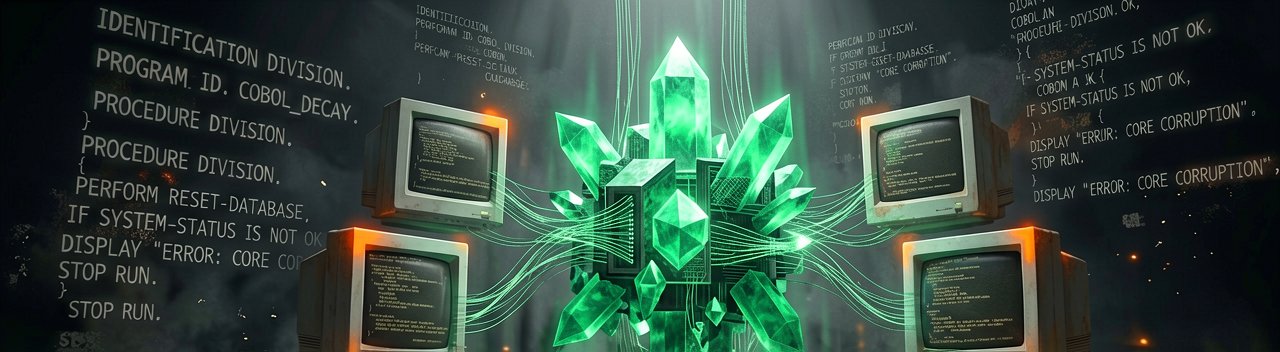
Furthermore, there is a fundamental disconnect between the sophisticated training these scholars receive and the actual technological environment they inherit upon graduation. The federal government remains a massive patchwork of legacy databases, ancient COBOL code, and slow-moving administrative systems. Introducing a hyper-specialized AI security expert into an agency that still struggles with basic multi-factor authentication creates a jarring operational mismatch. There is a distinct risk that these advanced defenders will find themselves bogged down by routine IT maintenance rather than engineering automated counter-measures.
This systemic inertia suggests that the bottleneck was never a lack of technical talent, but an inability to deploy that talent effectively. If an agency's leadership does not understand the difference between a basic algorithm and a neural network, the most brilliantly designed scholarship program in the world will not save it. True systemic resilience requires an overhaul of the managerial class just as much as the entry-level workforce, a reality that current funding injections conveniently ignore in favor of flashier educational grants.
We have essentially designed a pristine, state-of-the-art sports car, fueled it with the brightest young minds in the country, and parked it directly in the middle of a five-mile-long traffic jam on the morning commute.
Artūras Malašauskas is an AI Systems Integrator with 20+ years of production-grade web engineering experience. He has designed, shipped, and scaled enterprise Python/PHP systems for logistics, SaaS, and public-sector clients. For the past year, he has focused exclusively on AI integrations: deploying open-source LLMs, building generative media pipelines (image, audio, video), and engineering multi-agent workflows for real production environments. His standard: reproducibility, security, cost-efficient inference—no vaporware. He documents and evaluates emerging AI tooling, separating verified capabilities from marketing noise. Technical editor at: muza-ai.eu, ai-verslas.lt, ai-naujinos.lt Connect on LinkedIn
Comments