The Overtime Illusion: Why Hard Work Won’t Save Your Job in the AI Revolution
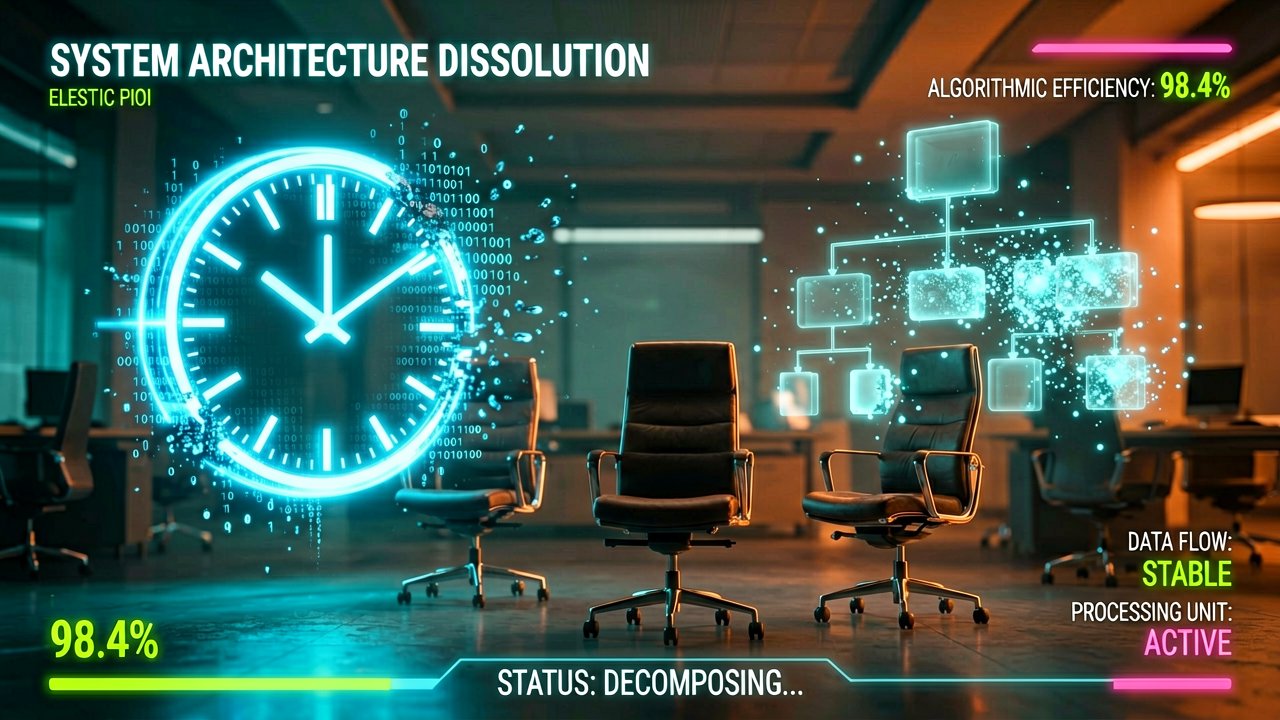
For decades, the corporate playbook for surviving a layoff was simple: be the first to arrive, the last to leave, and make your indispensable presence known. But as generative artificial intelligence sweeps through white-collar industries, that classic survival strategy is breaking down. Burning the midnight oil no longer provides the job security it once did because the metric of value has fundamentally shifted overnight.
Tech executives and market analysts are quietly acknowledging a uncomfortable truth. AI tools do not get tired, they do not demand overtime pay, and they can replicate routine cognitive tasks in seconds. When a company decides to restructure, an employee's 60-hour workweek looks less like dedication and more like an inefficient use of legacy processes that automation can easily optimize.
What Most Reports Miss: The current wave of corporate restructuring is not a typical response to a temporary economic downturn, but a permanent structural realignment. Silicon Valley leaders are aggressively pivoting capital away from massive human teams and channeling it directly into computational power. According to ongoing industry tracking by Crunchbase, venture capital and enterprise budgets alike are heavily favoring lean organizations that maximize output per human head through deep LLM integration. In this new ecosystem, traditional productivity metrics—like the sheer volume of emails sent or hours logged at a desk—are rendered obsolete by algorithmic efficiency.
The Fallacy of Computational Brute Force
Mid-level professionals often respond to automation anxieties by doubling down on their current output. They write more code, generate more reports, or schedule more meetings to prove their worth. This approach fails to recognize that AI thrives on precisely this type of linear, volume-based production. A seasoned software engineer churning out boilerplate code during a weekend sprint is competing directly with a tool that can generate the same architecture in under a minute for fractions of a cent.
Labor economists note that this creates a dangerous paradox for the modern workforce. The harder an employee works within a rigid, rules-based framework, the clearer the roadmap becomes for automating that exact role. Enterprise software suites are continuously learning from user behavior, turning today's manual workarounds into tomorrow's automated native features.
Where Strategic Capital is Moving
The corporate shift is visible in recent earnings reports and organizational charts across the tech and financial sectors. Companies are actively flatlining their middle management tiers, not because those managers underperformed, but because data routing and project tracking are now handled by specialized AI agents. This corporate triage prioritizes individuals who possess deep domain expertise and the ability to steer these algorithmic tools, rather than those who simply execute the labor.
The premium has shifted entirely to systemic oversight, creative problem-solving, and emotional intelligence—areas where AI still faces significant bottlenecks. Employees who survive the ongoing transitions are those who stop trying to out-work the machine and instead focus on defining what the machine should build next.
The Counter-Intuitive Trap of Employee Compliance
Reading Between the Lines: There is a profound irony in how corporations are managing this transition. For years, human resource departments incentivized standard operating procedures and predictable, repeatable workflows. Employees who mastered these rigid frameworks were rewarded with promotions and glowing performance reviews. Now, those exact workers are discovering that their flawless adherence to predictable patterns has essentially served as a high-quality training dataset for the systems designed to replace them.

This reality exposes a glaring contradiction in modern management philosophy. Executives publicly champion "human-centric innovation" while privately tying managerial bonuses to headcount reduction and algorithmic efficiency. The worker who stays late to meticulously format spreadsheets is operating under the assumption that meticulousness equals safety. In reality, that level of predictability makes the role a prime target for a script that can execute the same task without human error.
Looking ahead, the long-term economic implications point to a highly polarized labor market. We are likely to see a tiny class of highly compensated "AI shepherds" who direct enterprise strategy, contrasted against a vast, gig-economy workforce relegated to physical or unpredictable tasks that robots cannot yet handle. The traditional corporate ladder, once climbed through sheer endurance and incremental skill accumulation, is missing its middle rungs.
"The ultimate corporate irony of the twenty-first century will be watching an exhausted middle manager drink their third cup of midnight coffee, desperately trying to outwork an algorithm that doesn't sleep, doesn't drink coffee, and frankly, doesn't even know it's competing."
Artūras Malašauskas is an AI Systems Integrator with 20+ years of production-grade web engineering experience. He has designed, shipped, and scaled enterprise Python/PHP systems for logistics, SaaS, and public-sector clients. For the past year, he has focused exclusively on AI integrations: deploying open-source LLMs, building generative media pipelines (image, audio, video), and engineering multi-agent workflows for real production environments. His standard: reproducibility, security, cost-efficient inference—no vaporware. He documents and evaluates emerging AI tooling, separating verified capabilities from marketing noise. Technical editor at: muza-ai.eu, ai-verslas.lt, ai-naujinos.lt Connect on LinkedIn
Comments