Silicon Valley’s Worst Nightmare? Inside Illinois’ Aggressive AI Regulatory Playbook
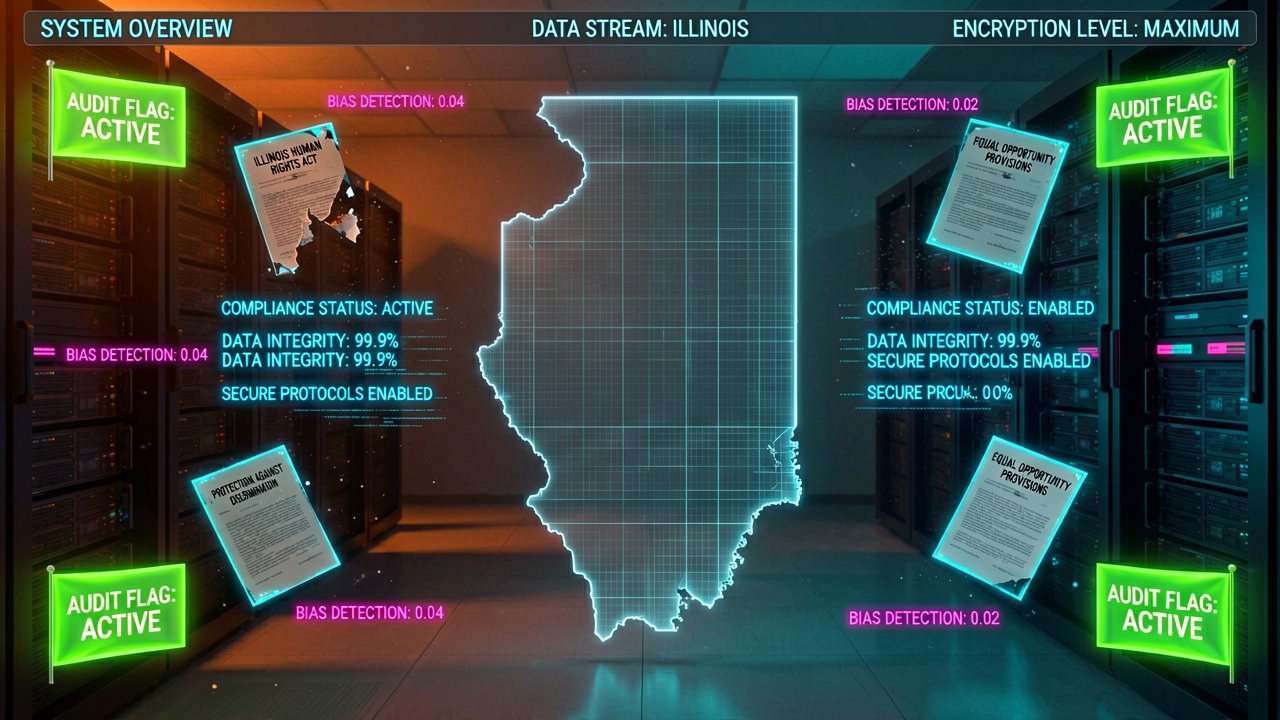
What most reports miss about the unfolding algorithmic crackdown is that state capitols aren't waiting for Washington to wake up. With Congress perpetually deadlocked over tech guardrails, local lawmakers are aggressively stepping into the breach to dictate how the world’s most powerful software operates. Illinois is currently pacing this legislative race, implementing a tight web of compliance rules that effectively turns the Land of Lincoln into America's stricter, state-level equivalent of the European Union's AI Act.
The state's legal framework expanded heavily when a monumental amendment to the Illinois Human Rights Act officially took effect, fundamentally rewriting the rules of corporate hiring. Under this mandate, employers are strictly prohibited from letting automated systems or generative platforms discriminate against applicants based on protected traits, or using zip codes as an engineered proxy for class-based bias. Crucially, companies are now legally required to explicitly notify workers and job applicants whenever an algorithmic system handles decisions regarding recruitment, promotion, or termination. The Illinois Department of Human Rights has been aggressively finalizing specific enforcement procedures, signaling a clear message that hiding bias behind "proprietary algorithms" will no longer fly in court.
The Real-World Cost of Compliance
For multi-state corporations, this localized enforcement mechanism is quickly transforming into an operational headache. Legal analysts have noted that enterprises are now caught in a difficult bind: they must either over-comply by restructuring their nationwide software stacks to match Illinois standards, or run a fragmented infrastructure that risks massive legal liabilities. This fragmentation is exactly why enterprise compliance teams are sweating over their software audits. When a state can levy significant penalties for unannounced algorithmic assessments, tech vendors are forced to choose between slowing down implementation or facing aggressive regulatory subpoenas.
Protecting the Mind and the Mirror
Illinois' strategy stretches far beyond the typical workplace boundary, moving deeply into the sensitive areas of mental health and personal identity. The state previously shook up the medical tech sector by enacting the Wellness and Oversight for Psychological Resources Act, which flatly outlaws providing AI-only therapy services directly to the general public. Under these rules, an algorithm cannot make isolated therapeutic decisions, nor can it autonomously analyze a client’s raw emotional state. Instead, technology is strictly restricted to secondary administrative tasks, ensuring that a licensed human expert remains an active, legally accountable buffer between a vulnerable patient and a generative model.

At the exact same time, the state's Digital Voice and Likeness Protection Act remains a critical legal shield for the creative class against predatory deepfakes and unauthorized vocal cloning. By making generative replicas a prime target for contractual litigation, Springfield has essentially outpaced federal copyright discussions, giving artists immediate civil recourse. Combined with updated criminal statutes that explicitly categorize AI-generated material under child exploitation laws, the state has built an incredibly comprehensive, multi-layered regulatory architecture. It is a highly localized approach to a global technological phenomenon, proving that until a federal framework emerges, the future of artificial intelligence will be heavily dictated state by state.
The Compliance Paradox and the Illusion of Safety
Reading between the lines of this legislative surge reveals a uncomfortable truth that policymakers are hesitant to admit: declaring an algorithm "safe" on paper does very little to make it unbiased in practice. The core flaw in the state's aggressive strategy rests on the assumption that underfunded state regulatory bodies possess the technical capabilities to actually audit a black-box neural network. Tech giants routinely guard their source code as highly classified trade secrets, leaving state investigators to rely almost entirely on self-reported corporate documentation. This structural gap transforms what was marketed as an aggressive consumer protection framework into an expensive exercise in corporate bureaucratic box-checking.
Furthermore, the legal mechanism designed to protect workers may inadvertently paralyze the local job market. Faced with the threat of massive class-action litigation, smaller enterprises and regional businesses are already reconsidering their digital transformations entirely. While global enterprises can easily absorb the costs of specialized compliance software and continuous legal review, smaller companies simply do not have that luxury. The ultimate contradiction of this consumer-first framework is that it threatens to stifle local business agility, leaving the market even more dominated by the very tech monoliths the legislation intended to restrain.
There is also an undeniable geographical irony built into this hyper-local approach to a borderless digital ecosystem. An algorithm trained on data in California and hosted on servers in Virginia can be deployed instantly to a worker sitting at a desk in Chicago. Trying to contain this distributed, cloud-based network using traditional state boundaries is a lot like trying to fence in the wind. As a result, the state risks creating a highly restrictive digital silo that encourages tech innovators to simply geofence their newest tools, leaving local residents legally protected but technologically isolated from the rest of the world.

"We have finally achieved the ultimate triumph of modern governance: a system where an artificial intelligence cannot legally discriminate against you, but it will still take three business weeks for a human bureaucrat to review the paperwork explaining why."
Artūras Malašauskas is an AI Systems Integrator with 20+ years of production-grade web engineering experience. He has designed, shipped, and scaled enterprise Python/PHP systems for logistics, SaaS, and public-sector clients. For the past year, he has focused exclusively on AI integrations: deploying open-source LLMs, building generative media pipelines (image, audio, video), and engineering multi-agent workflows for real production environments. His standard: reproducibility, security, cost-efficient inference—no vaporware. He documents and evaluates emerging AI tooling, separating verified capabilities from marketing noise. Technical editor at: muza-ai.eu, ai-verslas.lt, ai-naujinos.lt Connect on LinkedIn
Comments