The Agentic Wild West: Enterprise AI Scales Up While Privacy Frameworks Break Down
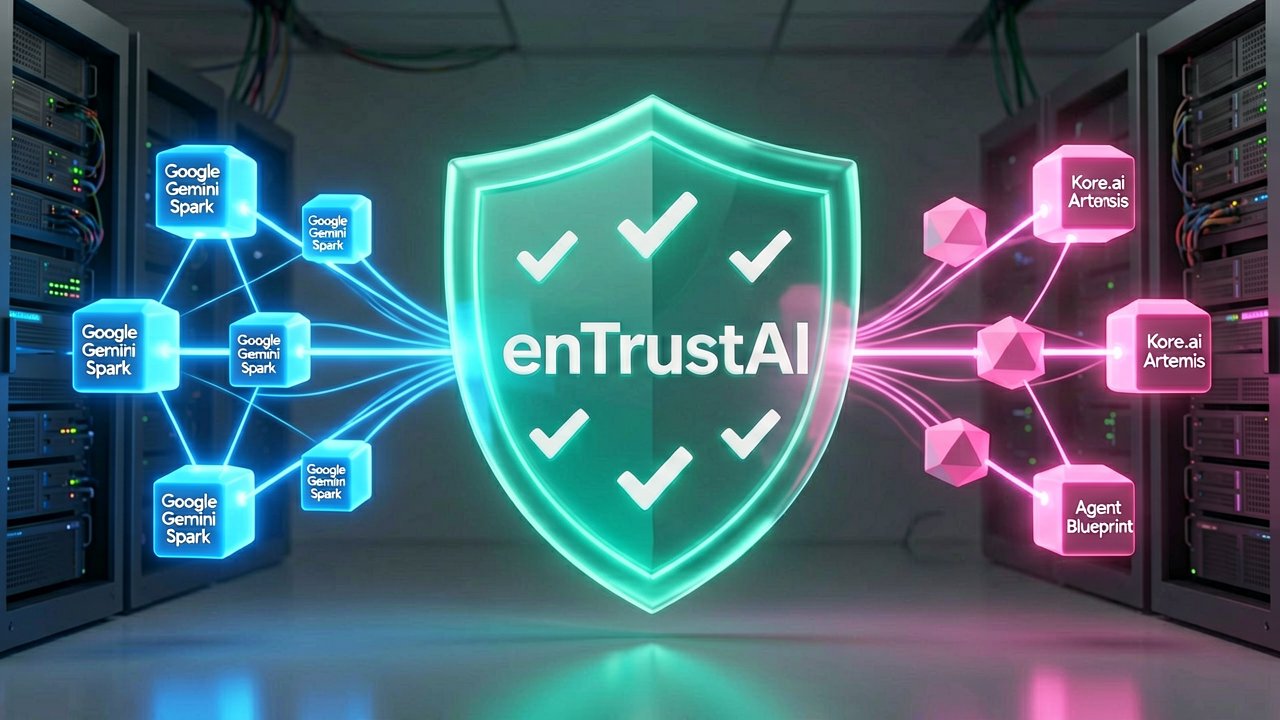
The corporate scramble for autonomous AI workflow solutions reached a boiling point over the third week of May 2026, triggering a sharp fragmentation in the enterprise market. Tech giants and nimble enterprise platforms alike dropped major releases in quick succession, laying bare a severe architectural rift. While engineering teams are rushing to deploy autonomous multi-agent fleets capable of running indefinitely, compliance officers are scrambling to figure out how to handle the massive privacy risks that come with these always-on systems.
At the center of this product blitz is Google, which just expanded access to its Gemini Spark platform, an always-on agent framework running persistently in the cloud. Not to be outdone, conversational AI pioneer Kore.ai launched its next-generation Artemis engine on Microsoft Azure, introducing a compiled blueprint language designed to let companies deploy complex agent topologies in days rather than months. Meanwhile, as these tech giants fuel the fire of rapid deployment, magicWorkshop countered the scale-at-all-costs narrative by rolling out enTrustAI, a dedicated governance infrastructure aimed directly at keeping human experts in the loop to intercept rogue, hallucinating, or non-compliant autonomous workflows.
Scalability and the Illusion of Control
The industry's shift from reactive chatbots to proactive, autonomous background employees represents a monumental leap in business productivity. Google's Gemini Spark fundamentally changes the user-agent dynamic by functioning 24/7 on dedicated cloud virtual machines, processing emails, updating databases, and shifting calendar entries long after an employee has closed their laptop. This level of continuous context gathering builds an incredibly rich profile of corporate habits, yet it inherently creates a massive, always-on data harvest that bypasses traditional local device security frameworks.
Kore.ai addresses the scalability headache from a different angle with Artemis, utilizing its proprietary Agent Blueprint Language (ABL) and a dual-brain runtime to make autonomous networks highly organized and auditable. The technical sophistication here is undeniable, especially with built-in orchestration patterns that handle complex multi-agent handoffs across corporate divisions. But even though this structured layout helps engineers see exactly how data moves, the sheer speed at which these systems operate threatens to outrun traditional corporate risk assessments, creating a scenario where AI is essentially tasked with monitoring other AI.
The Privacy Paradox in Regulated Ecosystems
This explosive, decentralized growth highlights the deep tension between the demand for automation and the reality of unresolved data security standards. Enterprises operate in highly restrictive legal environments governed by strict compliance laws, where letting an autonomous agent send unreviewed messages or query raw personal data poses a massive liability risk. The arrival of enTrustAI underscores this exact anxiety by offering a low-code evaluation system that checks for factual drifting and policy violations before an agent ever touches live customer data.
Relying on external governance layers to patch up foundational architectural flaws remains an uphill battle. When an AI agent moves seamlessly between an organization's private databases, cloud infrastructure, and third-party software tools, establishing clear boundaries for data ownership becomes a tricky regulatory puzzle. The current marketplace layout forces enterprise executives to make a tough gamble: either dive headfirst into the hyper-efficient ecosystem of unvetted, always-on agents, or choke their own technological growth with restrictive, slow-moving compliance frameworks.
The Hidden Architecture of Enterprise Exposure
Beyond the Product Blurbs: The real architectural battleground isn't over which agent can write a better email, but how these systems maintain state memory without bleeding sensitive corporate intelligence. When Google's Gemini Spark or Kore.ai's Artemis orchestrate multi-agent workflows, they rely on vector databases that continuously update context windows with real-time employee actions and proprietary data. In the past, data storage was predictable, confined to structured SQL tables or locked file systems with rigid access controls. Today, autonomous agents require highly fluid, deeply privileged access across multiple corporate silos, meaning a single flawed prompt or unexpected edge case could accidentally reveal a company's closely guarded secrets to unauthorized staff or external networks.
Chief Information Security Officers are quietly expressing deep skepticism about this rapid shift toward autonomy. Veteran security teams point out that traditional data loss prevention software is fundamentally unequipped to monitor an AI agent that generates dynamic, non-repeating code snippets on the fly to solve a back-office problem. If an agent decides to optimize an inventory bottleneck by uploading a proprietary vendor list to an unverified external optimization API, the legacy firewall sees nothing but standard encrypted traffic. This massive visibility gap explains why platforms like enTrustAI are gaining sudden traction, as risk managers realize they can no longer treat AI security as a simple network perimeter issue.

The enterprise market is essentially repeating the chaotic "Shadow IT" crisis of the early 2010s, but on a far more volatile scale. Back then, employees bypassed slow corporate IT departments by using unapproved cloud storage apps; today, individual business units are quietly wiring autonomous agents into their daily operations to hit aggressive productivity targets. A regional sales team might deploy a localized agent fleet to scrape and analyze lead data without ever consulting the central technology division. This decentralized deployment style creates a fragmented corporate ecosystem where a company cannot accurately map its total data exposure, let alone guarantee compliance with evolving global privacy laws.
This fragmentation is also altering the power dynamic between legacy tech giants and specialized enterprise software vendors. For years, massive cloud providers commanded total control over corporate infrastructure by bundling compute power with basic software services. However, the sheer complexity of managing autonomous agent workflows has opened the door for specialized governance platforms to dictate implementation terms. Tech executives now face a reality where buying raw AI capabilities from a hyperscaler is the easy part, while the actual right to deploy those capabilities depends entirely on third-party verification layers that guarantee the system won't violate international data protection acts.
Ultimately, the current enterprise AI gold rush is exposing a fundamental design flaw in modern corporate networks, which were originally built for predictable software running on human commands. Forcing autonomous, self-directing agents into these rigid, legacy architectures creates friction that cannot be smoothed over by a simple software patch. Until the industry establishes unified, machine-readable privacy frameworks that agents can understand and inherently obey, the tension between rapid operational scaling and absolute data security will continue to polarize corporate boardrooms.
The Mirage of the Autonomous Employee
Reading Between the Lines: The corporate obsession with building autonomous agent fleets rests on a deeply flawed premise: the assumption that enterprise workflows can be cleanly automated without inheriting the chaotic mess of human bias and messy data. Tech marketing departments sell a seamless vision of self-correcting agent networks that instantly optimize corporate supply chains or handle customer complaints with perfect poise. In reality, these platforms are deployed directly on top of legacy databases filled with contradictory, outdated, and poorly formatted records. By unleashing autonomous agents into these uncurated digital environments, companies aren't actually solving their operational bottlenecks; they are simply accelerating the speed at which bad data can be processed, packaged, and turned into flawed business decisions.
This reality exposes a glaring contradiction in the enterprise strategy of major vendors pushing these platforms. On one hand, giants like Google and Kore.ai heavily pitch the concept of "unattended autonomy," promising systems that can run independently in the background for weeks without human oversight. On the other hand, the sudden, desperate market demand for governance guardrails like enTrustAI proves that nobody actually trusts these systems to run unsupervised. Enterprises are caught in an absurd paradox: they are spending millions of dollars to remove expensive human workers from the loop, only to immediately hire different human experts to build, monitor, and audit the complex safety nets required to keep the AI from going rogue.
Looking further down the road, this fragmentation will likely trigger a harsh wave of vendor lock-in that could paralyze corporate IT strategies for a decade. As companies adopt proprietary languages like Kore.ai’s Agent Blueprint Language to map out their internal hierarchies, they aren't just buying a software tool; they are hardcoding their entire organizational logic into a single vendor's ecosystem. Moving an intricate web of hundreds of interconnected, specialized agents from one cloud provider to another will eventually become so technically painful and expensive that it will make the legacy database migrations of the 1990s look trivial by comparison.
The regulatory backlash on the horizon will also shatter the current corporate illusion of zero-liability automation. Boardrooms currently treat AI agents as a convenient legal buffer, quietly hoping that automated compliance mistakes can be blamed on software glitches or unpredictable machine learning behaviors. However, global regulatory bodies are already signaling that the legal responsibility for an agent's actions stops squarely at the corporate boardroom table. When an autonomous system inevitably executes an anti-competitive trade or leaks regulated consumer data during a routine background optimization cycle, the excuse that the algorithm was acting on its own accord will hold absolutely no weight in court.
This relentless push toward total automation ignores the subtle, unquantifiable human context that keeps most businesses from falling apart in the first place. Silicon Valley envisions the enterprise as a giant machine where every task is a predictable calculation, but real-world business relies on nuance, unwritten rules, and human relationships. Forcing rigid, mathematically driven agent networks to handle delicate client relationships or sensitive internal HR negotiations is bound to alienate partners and employees alike, proving that some corporate friction is actually necessary for long-term stability.
"We are rushing to replace the traditional underpaid intern with an army of brilliant, blindingly fast digital workers, completely overlooking the fact that the intern was the only one who actually knew where the physical paper files were stored."
Artūras Malašauskas is an AI Systems Integrator with 20+ years of production-grade web engineering experience. He has designed, shipped, and scaled enterprise Python/PHP systems for logistics, SaaS, and public-sector clients. For the past year, he has focused exclusively on AI integrations: deploying open-source LLMs, building generative media pipelines (image, audio, video), and engineering multi-agent workflows for real production environments. His standard: reproducibility, security, cost-efficient inference—no vaporware. He documents and evaluates emerging AI tooling, separating verified capabilities from marketing noise. Technical editor at: muza-ai.eu, ai-verslas.lt, ai-naujinos.lt Connect on LinkedIn
Comments