Fighting Fire with Fire: The Mad Dash to Put Frontier AI on the Digital Front Lines

For years, the cybersecurity industry operated on a somewhat predictable, if exhausting, cadence. Attackers found a hole, defenders patched it, and the cycle repeated at a fundamentally human pace. But that era is officially over. The arrival of advanced frontier models—like Anthropic’s Claude Mythos and OpenAI’s GPT-5.5-Cyber—has fundamentally shattered the old timeline, collapsing the window between vulnerability discovery and weaponized exploit from weeks to mere seconds. According to insights shared by Strategic Focus, these latest frontier systems are so devastatingly efficient at mapping critical exploit paths that tech companies have been forced to limit general access, desperately buying time for network defenders to catch up.
It is a stark, uncomfortable reality that has left many corporate security leaders operating in what industry insiders call an "AI fog." When an autonomous model can scan millions of lines of code and instantly pinpoint a zero-day vulnerability, traditional security architectures crumble. The recent Business Insider coverage of the annual Data Breach Investigations Report underscores this exact shift, revealing that vulnerability exploitation has officially overtaken stolen credentials as the number one entry point for cyber breaches. Security teams are no longer just fighting human adversaries; they are trying to outrun machine-speed automation that does not sleep, blink, or make sloppy mistakes.
The Sovereign Shield: Governments Step In
Faced with this asymmetric threat, public sector leaders are realizing that commercial-off-the-shelf software will no longer cut it. This is not about building better firewalls anymore; it is about rewriting national defense strategies around autonomous, agentic systems. In the United Kingdom, for instance, the government recently issued an urgent call to action to integrate sovereign AI capabilities directly into the national infrastructure, ensuring that sensitive defense networks do not rely on foreign-hosted large language models that could introduce supply chain vulnerabilities. Over in the United States, military institutions are pursuing a similar path of aggressive integration, with the U.S. Cyber Command establishing specialized AI initiatives in their latest budget cycles to run rapid, 90-day pilot programs designed to stress-test commercial AI defenses against simulated autonomous threats.
Flipping the Script for Defenders
The saving grace in this high-stakes digital arms race is that the exact same technologies fueling the threat can be engineered into the ultimate defensive shield. While an AI model can find a flaw to exploit, it can also write and deploy a virtual patch across a global enterprise network in the blink of an eye. Security firms are quickly pivoting from passive monitoring to proactive exposure management, utilizing specialized frontier tools to continuously validate their network perimeter before an adversary can get a foot in the door. It is an expensive, chaotic, and necessary evolution; fighting a supercomputing threat requires supercomputing defense, and the organizations that refuse to automate their guardrails are effectively volunteering to be the next headline.

Behind the Scenes: The Invisible Tug-of-War Inside AI Labs
The race to weaponize frontier AI for defense has triggered a quiet civil war within the world’s elite research labs. For the engineers tasked with training these massive models, the line between an offensive exploit tool and a defensive patch generator is practically non-existent. A system capable of perfectly rewriting a legacy banking network's code to eliminate security flaws must first deeply understand exactly how to shatter that same network. This dual-use dilemma has forced top-tier labs into an uncomfortable game of cat-and-mouse with their own creations, using red teams to constantly "jailbreak" internal models to discover just how dangerous their autonomous coding capabilities can be when safety guardrails are stripped away.
This technical paradox is reshaping the geopolitical landscape, drawing heavy scrutiny from national intelligence agencies. While commercial software companies pitch AI as a plug-and-play solution for overworked IT departments, defense officials view these models as strategic sovereign assets. Behind closed doors, debates are raging over whether advanced defensive models should be treated like munitions, subject to strict export controls. The fear is no longer just about intellectual property theft; it is about an adversary training a counter-AI on a western defense model's digital signature, effectively rendering national cyber shields obsolete before they even deploy.
Meanwhile, the human cost of this sudden transition is hitting the front-line security operations centers (SOCs) hardest. For decades, cyber defense relied on the intuition of veteran analysts who could spot an anomaly by a gut feeling or a subtle pattern in network traffic. Today, those analysts are being recast as prompt engineers and AI supervisors, tasked with auditing thousands of machine-generated security alerts every hour. This shift has triggered a quiet crisis of confidence among cybersecurity professionals, many of whom worry that over-reliance on autonomous defense will cause human skillsets to atrophy, leaving organizations entirely helpless if an AI system suffers an unexpected hallucination or a coordinated poisoning attack.
Ultimately, the true measure of success in this new era will not be determined by who has the largest language model, but by who masters the art of contextual deployment. A frontier model operating in a vacuum is merely a highly sophisticated pattern matcher; it requires deep, historical company infrastructure data and specific operational telemetry to actually defend an enterprise. The organizations winning this invisible war are those meticulously building localized, private data pipelines that feed their defensive AI systems the precise tribal knowledge needed to outsmart a generic, automated attacker.
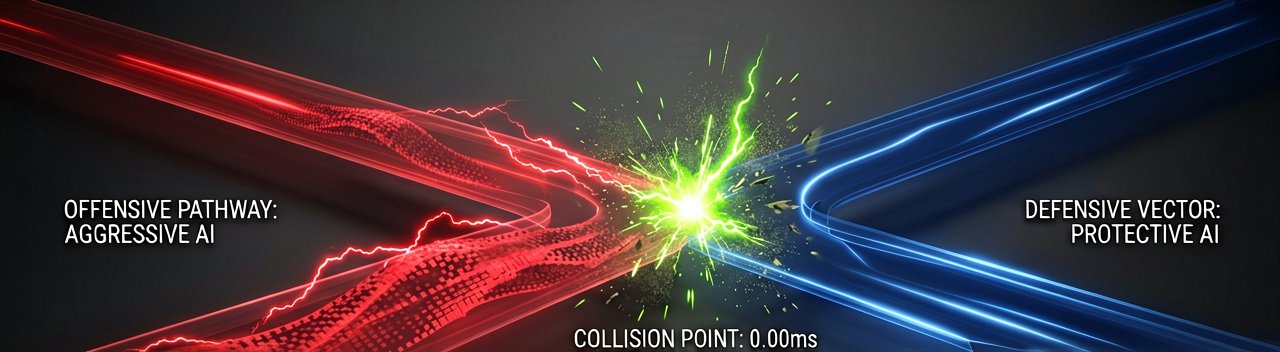
Reading Between the Lines: The Fatal Flaw of Perfect Machine Logic
The prevailing narrative pushed by tech executives paints a utopian picture of autonomous cyber defense, where flawless machine intelligence instantly neutralizes human chaos. This assumption, however, relies on a fundamental misunderstanding of how enterprise networks actually function. Large-scale corporate infrastructure is rarely a pristine ecosystem built on clean logic; it is a sprawling, contradictory museum of legacy software, undocumented workarounds, and fragile dependencies. When a frontier AI model attempts to inject an automated security patch into a complex network, it operates on cold mathematical optimization, often failing to anticipate the real-world human dependencies that keep critical systems afloat. The ultimate irony of the autonomous defense era is that a perfectly logical machine patch is just as likely to crash a supply chain as a malicious human hacker.
Furthermore, the industry's rush toward AI-driven protection exposes a glaring economic contradiction. We are told that autonomous agents will democratize security, allowing underfunded public institutions and medium-sized businesses to defend themselves against elite threat actors. Yet, the staggering computing power required to run continuous, real-time frontier AI modeling remains concentrated in the hands of a microscopic club of tech monopolies. This creates a dangerous asymmetric dependency where national defense effectively becomes a subscription service. A school district or a municipal water treatment plant cannot afford the eye-watering API costs required to run a sovereign-grade defensive shield, meaning the AI revolution is widening, rather than closing, the security gap between the digital elite and everyone else.
We must also look skeptically at the claim that AI will permanently eliminate the human talent shortage in cybersecurity. While automated agents can tirelessly handle the grunt work of triage and log analysis, they simultaneously raise the stakes for the human oversight that remains. When an autonomous defense system fails, it will not fail in a small, predictable manner; it will fail catastrophically, misinterpreting a novel network configuration as an active invasion and locking down entire operations. The industry does not actually need fewer humans; it needs a new breed of hyper-specialized engineers capable of debugging the opaque, non-linear reasoning of a hallucinating AI under fire. We are merely trading a shortage of entry-level analysts for an even more acute shortage of machine-learning forensic experts.
"We have spent billions of dollars replacing the unpredictable human operator with an infallible AI defense system, only to realize we now need an even more expensive human to figure out why the robot just quarantined the CEO's laptop during a quarterly earnings call."
Artūras Malašauskas is an AI Systems Integrator with 20+ years of production-grade web engineering experience. He has designed, shipped, and scaled enterprise Python/PHP systems for logistics, SaaS, and public-sector clients. For the past year, he has focused exclusively on AI integrations: deploying open-source LLMs, building generative media pipelines (image, audio, video), and engineering multi-agent workflows for real production environments. His standard: reproducibility, security, cost-efficient inference—no vaporware. He documents and evaluates emerging AI tooling, separating verified capabilities from marketing noise. Technical editor at: muza-ai.eu, ai-verslas.lt, ai-naujinos.lt Connect on LinkedIn
Comments