The David and Goliath Paradigm: Comparing Small and Large Language Models

For years, the artificial intelligence narrative followed a predictable, linear path: bigger was inherently better. Tech giants poured billions into building gargantuan Large Language Models (LLMs) boasting hundreds of billions, or even trillions, of parameters. These massive general-purpose brains mesmerized the world with their ability to write poetry, write complex code, and pass graduate-level exams. Yet, as enterprises rushed to implement these behemoths into real-world applications, they quickly ran into major barriers. High operational costs, massive latency, and data privacy concerns showed that using an LLM for every basic task was like using a massive commercial truck just to deliver a pizza.
This friction has triggered a massive shift toward Small Language Models (SLMs). Rather than relying entirely on sprawling cloud architectures, developers are turning to compact, hyper-optimized models ranging from 1 billion to 15 billion parameters. These smaller systems leverage advanced training techniques like knowledge distillation and synthetic dataset curation to achieve surprising capabilities. Strikingly, recent architectural leaps mean today's nimble models frequently match or outperform their larger counterparts on specialized enterprise workloads, completely redefining the economics of digital transformation.
What Most Reports Miss: The Hidden Economics of Inference
Behind the corporate marketing, the true battleground between large and small models is fought on the spreadsheet of inference costs. Standard enterprise reports often focus strictly on benchmark percentages, but real-world engineering teams are prioritizing resource constraints. Running a massive cloud-hosted model demands serious supercomputer-level infrastructure, resulting in ongoing subscription fees or volatile per-token API pricing. For an organization processing millions of automated requests every day, these expenses accumulate into an unsustainable financial burden.
By contrast, small models introduce a highly predictable cost structure. According to a performance analysis from Meta-Intelligence, self-hosting an SLM becomes vastly more economical than relying on proprietary frontier APIs once an enterprise surpasses a baseline threshold of daily requests. When volume hits substantial enterprise scales, migrating to a lean, local model can slash ongoing token expenses by over 80 percent. This massive margin shifts the focus away from raw parameter scale and directly toward algorithmic efficiency.
The Architecture of Punching Above Their Weight
The shrinking capability gap between giant and compact models is not an accident; it is the result of a deliberate evolution in training philosophy. Early iterations of generative AI relied on sheer volume, throwing massive, uncurated web scrapes at ever-larger networks. Today, engineers focus on data quality, utilizing highly filtered, textbook-style datasets to teach models precise reasoning patterns from the start. This allows smaller architectures to optimize their limited parameter budgets on high-value cognitive tasks.
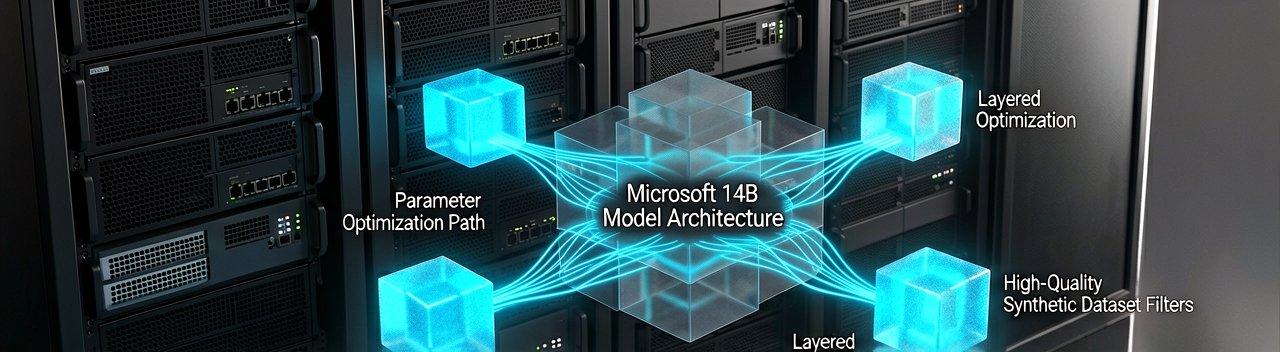
A prime example of this efficiency is Microsoft's 14-billion parameter model detailed in the Microsoft Tech Community, which managed to outperform vastly larger models on advanced mathematics and scientific reasoning benchmarks. Similarly, systems like Mistral Small have optimized their internal layering to achieve exceptional processing speeds, operating multiple times faster than competing enterprise models while generating shorter, more concise outputs. This localized speed means developers can deploy highly capable systems directly onto standard commercial servers or even consumer-grade edge hardware.
Data Sovereignty and the Specialized Edge
Beyond the immediate advantages of lower latency and reduced hosting fees, the adoption of smaller models is heavily driven by data privacy and strict compliance demands. For industries like healthcare, finance, and defense, sending sensitive user data to a third-party cloud API is an unacceptable legal and security liability. Small models resolve this problem by offering complete data sovereignty, allowing enterprises to run the network locally within their own private infrastructure.
When these compact models are combined with a localized Retrieval-Augmented Generation (RAG) framework, they effectively act as highly focused, domain-specific specialists. Instead of trying to memorize the entire internet, the model uses its compact parameter architecture to process internal corporate databases, code repositories, or customer service logs with extreme precision. The final result is a hybrid ecosystem where massive models continue to pioneer open-domain research, while nimble, efficient small models handle the heavy lifting of day-to-day business operations.
Reading Between the Lines: The Illusion of Democratization
The tech industry's sudden infatuation with small language models is frequently framed as a grand democratization of artificial intelligence. Marketing departments enthusiastically proclaim that giving developers the ability to run capable models on consumer hardware breaks the monopoly of Big Tech. However, a deeper examination of the ecosystem reveals that this narrative is largely a corporate illusion. While the final weights of these small models are often made public, the truly valuable assets—the high-quality, synthetic training pipelines and the specialized supercomputing clusters required to distill that knowledge—remain firmly concentrated in the hands of the exact same industry giants.
This reality exposes a stark contradiction in the current market dynamics. Independent developers and smaller enterprises are not actually achieving technological independence; they are simply shifting from being API consumers to becoming downstream deployers of models pre-baked by hyper-scalers. Furthermore, the supposed efficiency of these compact systems introduces a hidden maintenance tax. While a massive frontier model receives continuous server-side updates and behavior tuning from its creators, a locally deployed small model requires an internal engineering team to manually manage quantization drift, optimize local hardware configurations, and patch edge-case hallucinations.
Looking ahead, the long-term industry trajectory points toward an increasingly fragmented and complex technical architecture rather than a clean, comprehensive migration to the edge. The idea that a single, fine-tuned compact model can permanently replace a frontier model ignores the rapid rate of progress at the high end of the market. As frontier architectures integrate advanced multi-modal capabilities, native planning loops, and agentic reasoning systems, the baseline expectation for what an AI should do will shift again. Consequently, organizations will find themselves trapped in a continuous cycle of retraining and redeploying specialized models just to keep pace with a moving baseline, proving that in the world of computing, efficiency is never a one-time purchase.
The supreme irony of the AI arms race is that we spent years trying to build an omniscient digital deity capable of explaining the cosmos, only to realize that what corporate America actually wanted was just a really fast, slightly cheaper way to summarize email threads.
Artūras Malašauskas is an AI Systems Integrator with 20+ years of production-grade web engineering experience. He has designed, shipped, and scaled enterprise Python/PHP systems for logistics, SaaS, and public-sector clients. For the past year, he has focused exclusively on AI integrations: deploying open-source LLMs, building generative media pipelines (image, audio, video), and engineering multi-agent workflows for real production environments. His standard: reproducibility, security, cost-efficient inference—no vaporware. He documents and evaluates emerging AI tooling, separating verified capabilities from marketing noise. Technical editor at: muza-ai.eu, ai-verslas.lt, ai-naujinos.lt Connect on LinkedIn
Comments