Stability AI Destroys the Short-Attention Span Frontier with Six-Minute Tracks
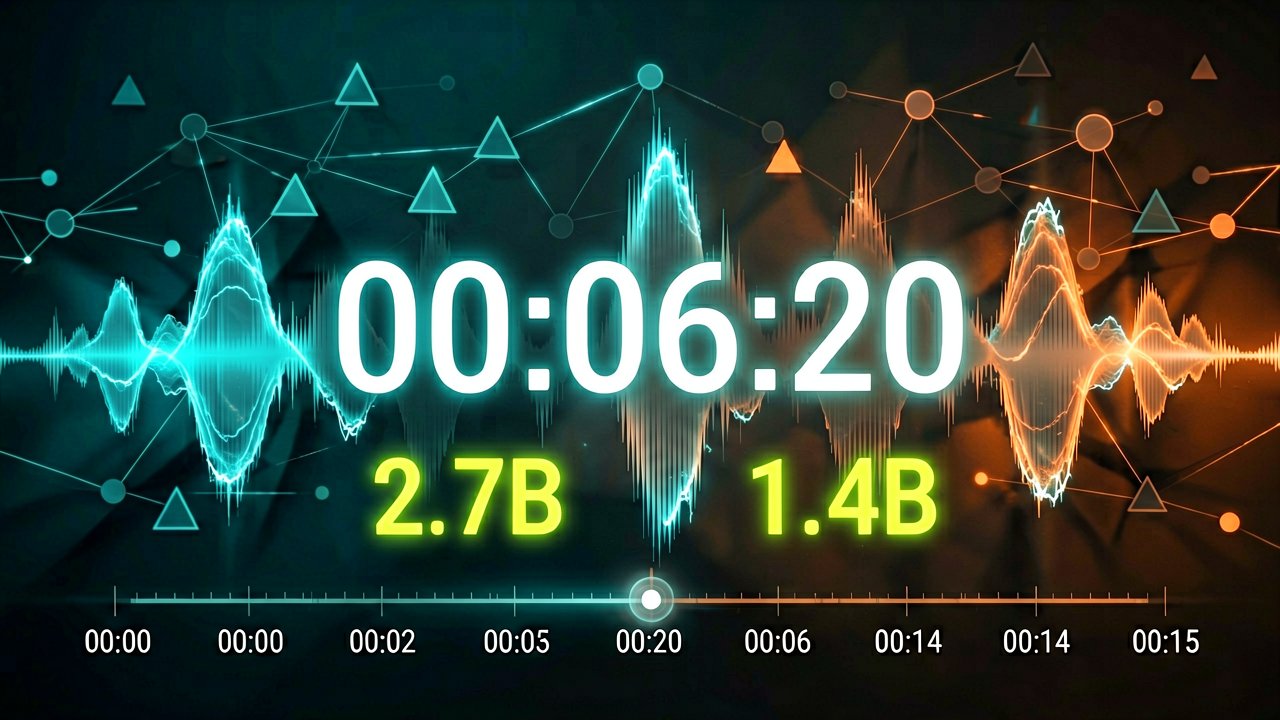
Generative audio tools have usually felt like a collection of clever parlor tricks, spitting out transient clips that fizzle out right as they start to find a groove. Stability AI wants to kill that limitation entirely. The company just pulled back the curtain on its new Stable Audio 3.0 model family, a suite of text-to-audio engines where the flagship models can spin out full, cohesive musical compositions lasting up to 6 minutes and 20 seconds. It is a massive technical leap that comfortably doubles what its predecessor managed just two years ago.
Instead of merely generating isolated loops or brief ambient pads, the updated framework aims for complete structural coherence. According to details shared by TechCrunch , the top-tier models manage to preserve melodic tone and overarching song structure throughout these extended runtimes. The underlying push is not just about making the audio longer; it is about keeping a verse, a chorus, and a bridge tied together without the AI drifting off into digital hallucinations halfway through the track.
A Stratified Lineup for Local and Cloud Production
The rollout includes four distinct variants tiered by parameter count and intended use case. On the lighter end of the spectrum sit the Small and Small SFX models, clocking in at 459 million parameters. These are designed to live natively on consumer hardware, letting users cook up sound effects and brief two-minute musical phrases directly on their laptops or mobile devices without waiting on a cloud queue.
The real heavy lifting happens when you scale up. The 1.4-billion-parameter Medium version and the 2.7-billion-parameter Large variant handle the full-length six-minute compositions. To appease the developer ecosystem, Stability AI is keeping its open-weights tradition alive by releasing the Small, Small SFX, and Medium models on Hugging Face. The top-spec Large model, meanwhile, remains locked behind the company’s commercial API for high-volume, low-latency deployment.

The Legality Battleground
Of course, you cannot talk about generative music today without tackling the legal elephant in the room. While the industry deals with messy copyright lawsuits aimed at rival platforms, Stability AI is screaming from the rooftops that its training data is completely above board. The company’s official update on Stability AI highlights that Stable Audio 3.0 was trained exclusively on fully licensed audio from the AudioSparx production library alongside meticulously filtered Creative Commons recordings. Commercial distribution is permitted under their Community License, though any enterprise clearing over $1 million in revenue will still need to cough up a corporate fee.
Behind the Scenes of the Multi-Minute Frontier
Generating a convincing thirty-second loop is fundamentally a different challenge than maintaining a coherent musical arc across six minutes. In earlier iterations of generative audio, models frequently suffered from a form of digital amnesia, forgetting the initial key signature, tempo, or melodic motifs after just a minute or two of runtime. This decay occurs because traditional diffusion transformers struggle with long-range context windows, leading to tracks that slowly degrade into chaotic noise or repetitive ambient drones. By scaling the architecture up to 2.7 billion parameters in the flagship version, engineers have essentially expanded the model's working memory, allowing it to reference the beginning of a track while simultaneously drafting the conclusion.
This technical evolution forces a massive shift in how producers and hobbyists interact with AI music tools. Instead of using these models merely to brainstorm short loops or sample snippets for a traditional digital audio workstation (DAW), creators are suddenly staring at a platform capable of delivering finished backing tracks and full-length cinematic soundscapes in a single prompt. For indie game developers and low-budget filmmakers, this drastically lowers the barrier to entry for acquiring long-form, adaptive audio. However, it also introduces intense friction within the commercial sync-licensing industry, where human composers have long relied on background television and corporate video gigs to pay the bills.
The industry's reaction to this milestone highlights a growing ideological split among stakeholders. While some traditional musicians view six-minute generations as a direct threat to the craft, a growing faction of avant-garde electronic producers are embracing the technology as a highly sophisticated collaborative partner. These artists do not see the six-minute output as a finished product, but rather as a complex sonic landscape ripe for manual chopping, arrangement, and processing. The inclusion of smaller, open-weights models that run locally on consumer hardware further democratizes this experimentation, giving creators the freedom to fine-tune the architecture on their personal sample libraries without handing their proprietary data over to a corporate cloud.
Ultimately, the true battlefield for Stable Audio 3.0 will not be fought over parameter counts or context windows, but in the courts and licensing offices. Stability AI’s explicit reliance on opt-in datasets like AudioSparx represents a deliberate tactical pivot designed to shield corporate users from the ruinous copyright litigation currently plaguing competitors. By drawing a hard line between fully cleared data and the rest of the wild-west internet, the company is betting that enterprise clients will willingly sacrifice the infinite variety of unlicensed pop-music emulation in exchange for absolute legal safety. This compliance-first strategy reflects a broader maturity in the generative tech sector, where surviving the scrutiny of copyright lawyers is now just as critical as breaking new ground in engineering.
Reading Between the Lines of the Audio Boom
The tech industry's obsession with duration metrics routinely mistakes quantity for quality, and the celebration around six-minute AI tracks is no exception. While doubling the runtime of a generated song is undeniably a triumph of computing power, it ignores the reality of how music is actually consumed and valued. Silicon Valley treats audio as a problem of linear expansion, assuming that if a model can patch together six minutes of mathematically logical sound, it has created a song. In practice, long-form music relies on emotional tension, micro-improvizations, and structural subversions—human eccentricities that algorithms do not genuinely understand, but merely simulate through statistical probability.
Furthermore, a glaring contradiction sits at the heart of Stability AI’s ethical marketing push. By boasting an entirely clean, fully licensed training diet from curated libraries, the company positions itself as the responsible adult in a room full of data-scraping toddlers. Yet, the sonic output of a model trained strictly on stock libraries and Creative Commons archives is inherently limited by the corporate, sterile nature of its source material. The tool excels at generating the exact type of inoffensive, sanitized background music found in corporate sizzle reels or lo-fi study playlists. By prioritizing legal safety, the platform risks trapping its users in a perpetual loop of elevated elevator music, locked out of the grit and cultural relevance that defines groundbreaking art.
The broader economic implications also paint a complicated picture for the creative ecosystem. Proponents argue that open-weights availability democratizes production, giving every bedroom producer the power of a studio workstation. However, when the market is flooded with an infinite supply of free, legally cleared, six-minute instrumental tracks, the economic value of background music plummets to zero. This does not democratize the music industry; it gentrifies it, squeezing out the working-class composers who rely on mid-tier licensing fees while leaving the upper echelon of superstar artists virtually untouched. The technology may democratize the tools of creation, but it simultaneously cannibalizes the commercial landscape required to sustain a career.
"We have finally achieved the ultimate tech milestone: giving computers the ability to monopolize the aux cord for six minutes straight, proving once and for all that AI can mimic not just a musician's output, but a prog-rocker's absolute lack of self-restraint."
Artūras Malašauskas is an AI Systems Integrator with 20+ years of production-grade web engineering experience. He has designed, shipped, and scaled enterprise Python/PHP systems for logistics, SaaS, and public-sector clients. For the past year, he has focused exclusively on AI integrations: deploying open-source LLMs, building generative media pipelines (image, audio, video), and engineering multi-agent workflows for real production environments. His standard: reproducibility, security, cost-efficient inference—no vaporware. He documents and evaluates emerging AI tooling, separating verified capabilities from marketing noise. Technical editor at: muza-ai.eu, ai-verslas.lt, ai-naujinos.lt Connect on LinkedIn
Comments