The Silo Era of Offensive Security Is Over: Terra Unifies Web, AI, and Network Testing
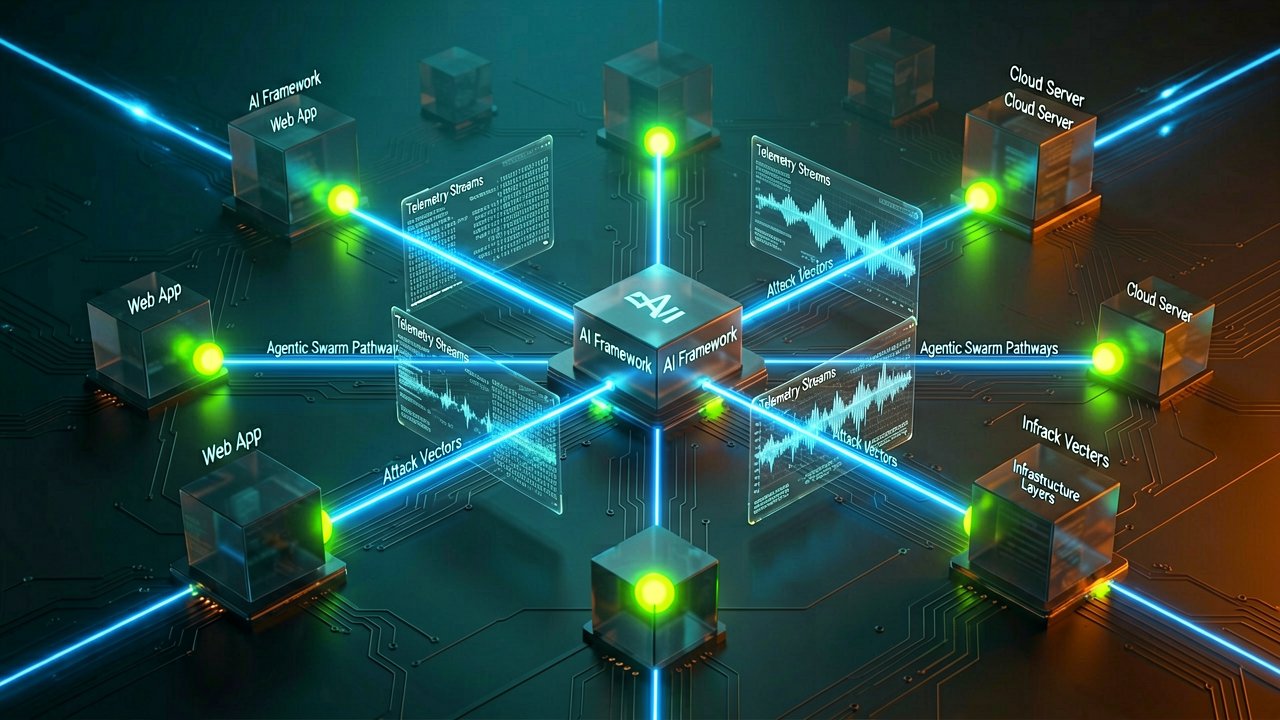
For years, enterprise offensive security has felt like an awkward game of telephone played across a fragmented landscape. One vendor scans the corporate network, another probes web applications, and artificial intelligence systems—if they are lucky—get a cursory glance from an isolated specialist team. This point-in-time, compartmentalized routine worked fine when human adversaries moved at human speed, but today's attackers are leveraging highly automated toolkits to chain exploits across multiple environments in minutes. Security teams routinely find themselves buried under a mountain of disconnected alerts, arguing over theoretical severity scores while completely blind to the actual attack paths crossing from a web application straight into their infrastructure. Breaking down these walls has become a matter of structural survival.
Enter offensive security platform provider Terra Security, which just blew the doors off this fragmented approach. The company announced the launch of continuous exploitation validation for network infrastructure, expanding its platform's footprint far beyond its initial focus on web applications and AI systems. According to a report by SiliconANGLE, this move unifies web apps, AI frameworks, and core infrastructure testing into a single connected console. Instead of treating each attack surface as an island, Terra aims to deliver a holistic view of external corporate risk, allowing defenders to track exactly how a modern adversary might leverage a minor flaw in one layer to move laterally and compromise another.
Swarming the Attack Surface with Agentic AI
At the absolute center of this structural shift is what Terra calls an agentic approach. Rather than relying on simple, rigid vulnerability scanners that just check for missing patches, the platform deploys swarms of hundreds of fine-tuned AI agents designed to act like a real, evolving red team. These autonomous agents are built to discover unknown unknowns, map out unique business logic, and physically test whether a vulnerability can actually be exploited in real time. Because the agents are trained on an organization's specific code and operational context, they weed out the typical noise that turns security dashboards into a graveyard of false positives.
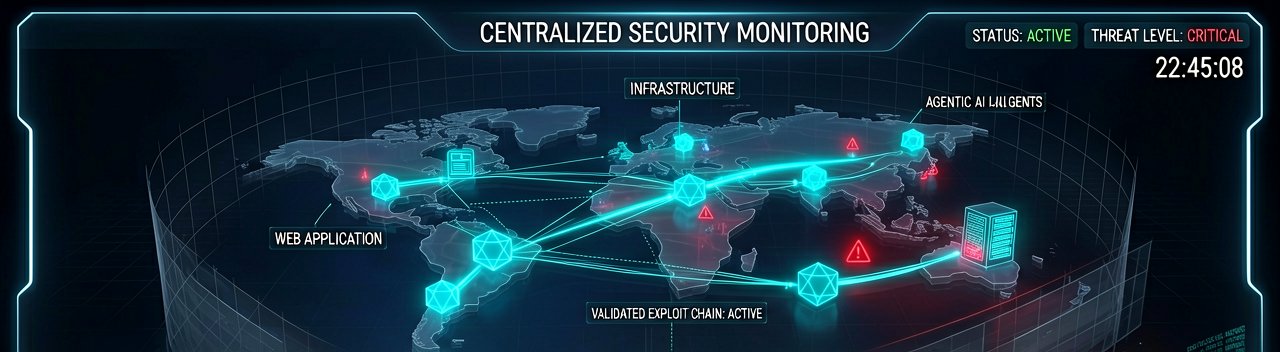
Crucially, this is not an unchecked AI running wild on production systems. The platform relies on a strict hybrid architecture, combining the sheer speed of machine intelligence with dedicated human oversight. Security teams manage and monitor the process through a central portal, keeping a human in the loop to validate findings, guarantee safety, and maintain a clear audit trail. According to the company's official announcement carried by Business Wire, this balanced setup reduces typical pentesting timelines from several weeks to just a few hours. The result is a continuous validation engine that turns offensive security into a predictable, scalable process that is naturally aligned with rapid software development cycles.
Behind the Scenes: The Engineering Reality of Agentic Pentesting
The traditional enterprise pentesting model has long harbored an open secret: it is a highly manual, artisanal process that fundamentally cannot scale. Chief Information Security Officers have historically spent hundreds of thousands of dollars on annual or quarterly assessments, only to receive static PDF reports that are obsolete the moment a developer pushes new code to production. Meanwhile, standard automated scanners have earned a reputation for being blunt instruments, generating overwhelming lists of theoretical vulnerabilities without the contextual intelligence to prove if those bugs actually pose a material threat. By integrating autonomous AI agents across the entire digital estate, the industry is shifting away from simple vulnerability management and moving toward true continuous exposure validation.
Engineering a platform capable of safely executing these automated attacks requires solving a massive telemetry problem. It is one thing to let an AI agent scan a public-facing website, but it is an entirely different risk profile to let an autonomous swarm poke at legacy database servers, container orchestration layers, and sensitive AI training pipelines. Industry analysts point out that the real breakthrough here lies in the deterministic guardrails guiding the agentic behavior. Terra's agents operate within a highly orchestrated framework, meaning they can chain complex exploits together to prove a breach is possible without ever taking down critical production services or corrupting active business databases.
This architectural unification comes at a critical inflection point for corporate AI adoption. Over the past few years, enterprises rushed to deploy large language models and retrieval-augmented generation systems, often completely bypassing standard security reviews in the race to innovate. Attackers quickly capitalized on this blind spot, leveraging novel techniques like prompt injection, data poisoning, and model inversion to manipulate corporate systems. By treating AI infrastructure as a core component of the network rather than an isolated software novelty, the platform allows security teams to see how an attacker might exploit an LLM vulnerability to pivot into the underlying cloud infrastructure.
From a operational standpoint, the consolidation of these testing silos directly addresses the severe talent shortage plaguing modern cybersecurity departments. Experienced red-teamers and penetration testers are exceptionally difficult to hire and retain, leaving most internal security teams playing a permanent game of catch-up. Automating the routine, repetitive aspects of exploit validation frees up high-tier human analysts to focus on complex architecture reviews and strategic threat modeling. Instead of wasting valuable hours sorting through duplicate alerts and chasing false positives, defenders can finally allocate their limited time to remediating verified, high-risk attack paths that threaten their core operations.

Reading Between the Lines: The Friction Point of Autonomous Defense
The promise of an all-seeing, autonomous security swarm is undeniably alluring, but it relies on a premise that seasoned infrastructure teams will view with healthy skepticism. For decades, the fundamental law of IT operations has been stability, often summarized as the golden rule of not fixing what is not broken. Injecting hundreds of autonomous AI agents into an active, fragile corporate network to intentionally validate exploits introduces an unpredictable variable into a system that is meticulously engineered for predictability. While a software vendor can safely promise that its agents operate within strict deterministic guardrails, the reality of corporate infrastructure is an unruly mess of undocumented legacy systems and delicate middleware that can fail simply from an unexpected volume of traffic.
Furthermore, this push toward absolute automation highlights a glaring contradiction in the way modern enterprises approach cybersecurity risk. Organizations are rushing to buy AI tools to defend against threats that are increasingly driven by other AI tools, effectively turning corporate infrastructure into a digital battlefield where machine fights machine. This creates a dangerous paradox: as defensive platforms grow more complex and autonomous, they inherently become harder for human administrators to fully comprehend. If an enterprise becomes entirely dependent on an agentic platform to find and validate its flaws, it risks creating a new layer of technical debt, where security teams understand the underlying mechanics of their own network less than the automated systems tasked with testing it.
There is also the looming question of how the broader compliance and insurance industries will adapt to this continuous testing paradigm. Regulatory frameworks like SOC 2, ISO 27001, and various federal mandates were explicitly written for a world governed by periodic, human-led assessments and static documentation. A platform that identifies and fixes structural vulnerabilities every few hours breaks the traditional compliance cycle, forcing security leaders to negotiate with traditional auditors who prefer the clean simplicity of a quarterly PDF over a dynamic, ever-changing telemetry dashboard. True security may be a continuous process, but bureaucratic accountability remains stubbornly rooted in point-in-time checkmarks.
Ultimately, the success of this unified approach will not be measured by the sophistication of the AI models, but by how effectively it bridges the deep cultural divide between security researchers and operations engineers. An automated tool can generate a flawless, validated attack path crossing from a web app to a core server in minutes, but that discovery is entirely useless if the systems administration team lacks the bandwidth or the institutional will to deploy the necessary patch. Technology can accelerate the discovery of enterprise risk at an astonishing pace, but fixing the flaws remains a stubbornly human bottleneck that no amount of agentic code can fully solve.
"We have spent twenty years wishing for a security tool that could think like a real attacker and move at the speed of light. Now that we finally have autonomous AI swarms hunting for vulnerabilities around the clock, our primary reward is the distinct privilege of panicking in real time instead of waiting for the quarterly audit."
Artūras Malašauskas is an AI Systems Integrator with 20+ years of production-grade web engineering experience. He has designed, shipped, and scaled enterprise Python/PHP systems for logistics, SaaS, and public-sector clients. For the past year, he has focused exclusively on AI integrations: deploying open-source LLMs, building generative media pipelines (image, audio, video), and engineering multi-agent workflows for real production environments. His standard: reproducibility, security, cost-efficient inference—no vaporware. He documents and evaluates emerging AI tooling, separating verified capabilities from marketing noise. Technical editor at: muza-ai.eu, ai-verslas.lt, ai-naujinos.lt Connect on LinkedIn
Comments