The Map Becomes the Metaverse: Google’s Genie Learns to Walk Your Neighborhood
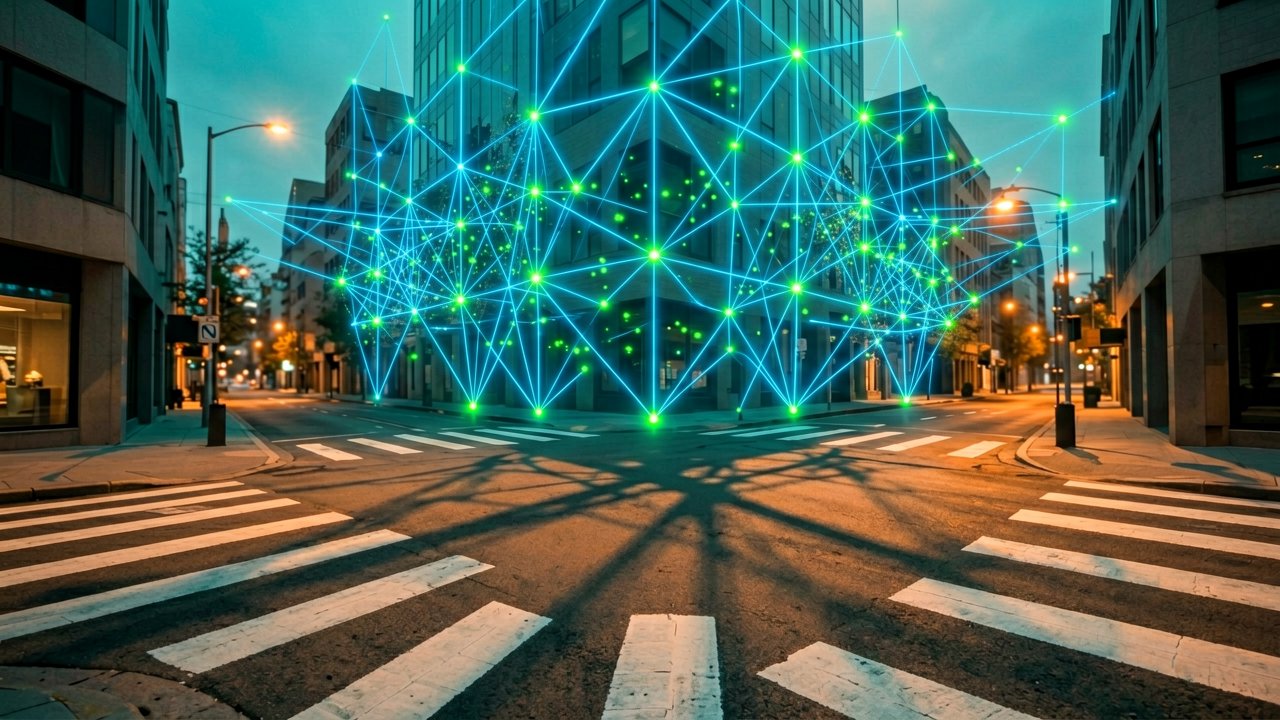
Google’s latest trick at I/O 2026 isn’t just another chatbot update; it’s a full-blown reconstruction of the physical world. By plugging its Genie world model into the staggering 280-billion-image archive of Street View, DeepMind has essentially turned the entire planet into a playable, interactive simulation. It’s a massive leap for spatial AI, moving beyond the dreamlike, hallucinated landscapes of early generative models toward environments that are stubbornly anchored in reality. As reported by TechCrunch, users can now drop a pin anywhere in the U.S. and watch as the AI builds a navigable 3D world out of existing imagery, allowing for a level of immersion that makes standard navigation feel like looking at a paper map.
What makes this technically impressive isn't just the "where," but the "how." Genie 3 doesn't just display pictures; it simulates physics and spatial continuity in real-time at 24 frames per second. According to The Next Web, the model maintains a "memory" of the scene, so if you spin your character around 360 degrees, the street behind you doesn't vanish or morph into a different neighborhood—it stays exactly where it should be. While it's currently a playground for Google AI Ultra subscribers, the underlying tech is already doing heavy lifting behind the scenes. Waymo, for instance, is using these grounded simulations to train its self-driving fleet on "edge case" scenarios that would be too dangerous or rare to find on actual asphalt.
From Navigation to Imagination
The real fun starts when you stop treating Genie like a GPS and start treating it like a director’s chair. Google has introduced "Maps Imagery Grounding," which lets users apply stylistic filters to real locations. You could take the Golden Gate Bridge and, with a quick prompt, submerge the entire scene underwater or rewrite the architecture into a "Stone Age" aesthetic. It’s a weird, wonderful hybrid of Street View's precision and generative AI's total lack of restraint. While Google Maps director Jonathan Herbert notes that the system isn't a "perfect reconstruction" yet, the goal is clear: creating a seamless, interactive mirror of the world that agents—and eventually us—can explore without limits.
A Stepping Stone to AGI
Beyond the novelty of walking through a cyberpunk version of your hometown, DeepMind is positioning this as a critical pillar for Artificial General Intelligence (AGI). By grounding AI agents in real-world data rather than synthetic data, they learn the messy, unpredictable nuances of physical space. As noted by Google DeepMind, world models allow agents to "predict both how an environment will evolve and how their actions will affect it." This isn't just about making better video games; it's about teaching machines to understand the rules of our reality by letting them break those rules in a perfectly safe, AI-generated sandbox.

The Architectural Shift: How DeepMind Solved the Continuity Crisis
What Most Reports Miss: The true breakthrough in Genie’s integration with Street View isn't just the sheer volume of pixels it can access, but the transition from "video generation" to "causal world modeling." In earlier iterations, generative AI struggled with object permanence; if you looked away from a building and turned back, the windows might have rearranged themselves or the color of the bricks might have shifted. By anchoring the latent space of the model to the geolocated, static data of Street View, Google has effectively given the AI a "skeletal" truth to lean on. This prevents the hallucinatory drift that plagued previous models, ensuring that the spatial layout remains consistent even during high-speed simulated movement.
Industry insiders point out that this is a direct response to the "data wall" many AI labs are currently hitting. While text-based LLMs have nearly exhausted the internet's supply of high-quality human writing, the physical world remains a largely untapped dataset for machine learning. By utilizing the 280 billion images Google has been collecting since 2007, DeepMind isn't just teaching a model to recognize a stop sign; they are teaching it the inherent logic of urban planning, the physics of light hitting different road surfaces, and the geometric relationships between objects in three-dimensional space. This "embodied data" is far more valuable for long-term AI development than another trillion tokens of web-scraped text.
Stakeholders within Google’s Geo division have hinted that this tech will eventually phase out the traditional "stitch and zoom" method of Street View entirely. Instead of a gallery of static panoramas, the future of Maps looks like a continuous, neural-rendered stream. For the end user, this means a shift from clicking arrows on a screen to a fluid, video-game-like experience where they can float through a neighborhood. However, this raises significant questions about the "freshness" of the world model. If Genie simulates a street based on a photo taken three years ago, the discrepancy between the simulation and the current reality could lead to confusion, requiring a massive, real-time update loop that Google is still figuring out how to scale.
Historically, this project is the spiritual successor to "DeepMind Lab" and "Voyager," earlier attempts to build agents that could navigate complex environments. The difference here is the removal of the "walled garden" of a game engine like Minecraft or Quake III. By using the real world as the training ground, the transferability of skills from the simulation to physical robots—like those being developed by the Everyday Robots team—becomes significantly more efficient. We are seeing the birth of a "Sim-to-Real" pipeline that could drastically shorten the development cycles for everything from delivery drones to assistive household robotics.

There is also a subtle but vital competitive angle at play here. While competitors like OpenAI and Meta are focusing on cinematic video generation with models like Sora, Google is pivoting toward "functional" video. While a Sora-generated clip might look visually stunning, it lacks the underlying geographic metadata that allows it to be used for navigation or precise engineering simulations. Google is betting that the utility of a "grounded" world model will far outweigh the aesthetic appeal of a purely creative one, positioning Genie as a tool for industry and infrastructure rather than just entertainment.
Finally, the privacy implications of a "playable" real world are only just beginning to be discussed by digital rights advocates. While Street View already blurs faces and license plates, a world model capable of simulating and modifying these environments adds a layer of complexity to digital ownership and privacy. If an AI can perfectly recreate your private driveway and then allow a user to simulate "interacting" with it, the boundary between public data and personal space becomes thinner than ever. As this technology moves from a research preview to a core feature of the Google ecosystem, the debate over who owns the "digital twin" of our physical reality is set to become a central pillar of tech policy.
The Ghost in the Machine: Skepticism Amidst the Simulation
Reading Between the Lines: For all the marketing luster surrounding Genie’s "world-building" capabilities, there is a fundamental tension between a pixel-perfect simulation and a reliable utility. Google is pitching this as a leap toward AGI, yet the model remains a prisoner of its training data—a static snapshot of the past masquerading as a living present. While it is technically marvelous that an AI can "predict" what is behind a corner based on 2024 Street View data, that prediction is functionally useless if a new skyscraper was erected in 2025. We are witnessing the creation of a "perfect map" that risk being obsolete the moment it is rendered, a digital taxidermy of our cities that lacks the entropy of the real world.
Furthermore, the move toward "stylized" grounding—turning a suburban street into a medieval village—reveals a curious contradiction in Google’s strategy. On one hand, they tout Genie as a rigorous training tool for Waymo’s autonomous safety; on the other, they treat it as a psychedelic playground for AI Ultra subscribers. This duality suggests that Google is still searching for a definitive commercial purpose for world models. If the goal is high-fidelity simulation for robotics, the "Stone Age" filters are a distracting novelty. If the goal is entertainment, the massive computational overhead required to ground these scenes in geographic reality seems like an expensive over-engineering of what could simply be a standard game engine.
The skepticism deepens when considering the "black box" nature of neural rendering. Traditional 3D engines, like Unreal or Unity, operate on clear mathematical rules that humans can audit and adjust. Genie, conversely, operates on probabilistic guesses. In a safety-critical context like self-driving car training, the lack of a "ground truth" physics engine is a significant hurdle. An AI might simulate a car crash that looks visually convincing but fails to account for the actual structural integrity of the vehicles involved. Trusting a generative model to teach a robot how to navigate the physical world requires a leap of faith that many safety regulators may not be ready to take.
There is also the matter of the "sim-to-real" gap, which has historically been the graveyard of ambitious robotics projects. Proponents argue that Genie’s vast scale will finally bridge this divide, but scale doesn't necessarily equate to accuracy. A model that has seen a billion images of roads still doesn't "know" what it feels like for tires to lose traction on black ice; it only knows how to make that event look cinematic. By prioritizing visual continuity over physical law, Google risks creating an AI that is an expert in cinematography but a novice in mechanics, potentially leading to agents that are confident in their movements but fundamentally disconnected from the laws of motion.
Economically, the sustainability of these models remains a giant question mark. Running a 24fps real-time world model for millions of Google Maps users would require a staggering amount of TPU compute power, likely dwarfing the energy consumption of standard search queries. It’s hard not to wonder if this is a "solution in search of a problem," a showcase for Google’s hardware dominance rather than a feature that fundamentally improves how a person gets from point A to point B. Until the cost per frame drops by orders of magnitude, Genie remains a high-status laboratory experiment rather than a practical tool for the masses.
Ultimately, Google’s vision of a "playable world" may be less about helping us navigate reality and more about keeping us within their digital ecosystem. As the boundary between the "real" Street View and the "simulated" Genie view blurs, the search giant solidifies its role as the sole gatekeeper of the world’s digital twin. Whether this leads to a new era of human-machine harmony or simply a more immersive way to get lost in a digital hallucination remains to be seen, but for now, the map is officially weirder than the territory.
It’s a remarkable feat of engineering to turn the entire planet into a navigable video game, though it’s a bit ironic that we’ve built a billion-dollar simulation of the outside world just so we never have to actually go there.
Artūras Malašauskas is an AI Systems Integrator with 20+ years of production-grade web engineering experience. He has designed, shipped, and scaled enterprise Python/PHP systems for logistics, SaaS, and public-sector clients. For the past year, he has focused exclusively on AI integrations: deploying open-source LLMs, building generative media pipelines (image, audio, video), and engineering multi-agent workflows for real production environments. His standard: reproducibility, security, cost-efficient inference—no vaporware. He documents and evaluates emerging AI tooling, separating verified capabilities from marketing noise. Technical editor at: muza-ai.eu, ai-verslas.lt, ai-naujinos.lt Connect on LinkedIn
Comments