Google’s Agentic Ambition: Meet Gemini 3.5 Flash, Omni, and Spark
Google just dropped a massive update at I/O 2026, and if you thought the AI arms race was cooling down, think again. The search giant unveiled the Gemini 3.5 series, pivoting hard from simple chatbots toward what they’re calling the "agentic era." Leading the charge is Gemini 3.5 Flash, a model that manages to be both lean and surprisingly muscular. It isn’t just a speed demon; it’s actually outperforming the older 3.1 Pro model on key coding and reasoning benchmarks while keeping the "Flash" tier's low cost and blistering speed. According to early reports from Ars Technica, this model is fast enough to make real-time AI agents actually feel practical rather than laggy.
But the real showstopper for anyone who cares about creativity is Gemini Omni. Described as a "world model," Omni is multimodal in every sense of the word. Unlike previous tools that felt like separate pieces of tech stitched together, Omni treats text, audio, images, and video as a single language. It can take a messy video clip and, through a simple conversation, swap backgrounds or adjust camera angles with eerie precision. It’s a direct challenge to the video-generation status quo, and as Mashable notes, it effectively collapses the gap between thinking about a project and actually seeing it on screen.
Then there’s Gemini Spark, which is arguably the most ambitious part of the bunch. Spark isn't a tool you open; it’s an agent that lives in the background of your digital life. Powered by the efficiency of 3.5 Flash, it’s designed to handle the "boring stuff"—like booking flights or managing complex work projects—autonomously. To keep it from spending your life savings on a whim, Google is introducing the Agent Payments Protocol (AP2) to set strict spending limits and guardrails. It’s clear that Google wants us to stop talking to our computers and start letting them work for us.
The Flash Revolution: Intelligence per Dollar
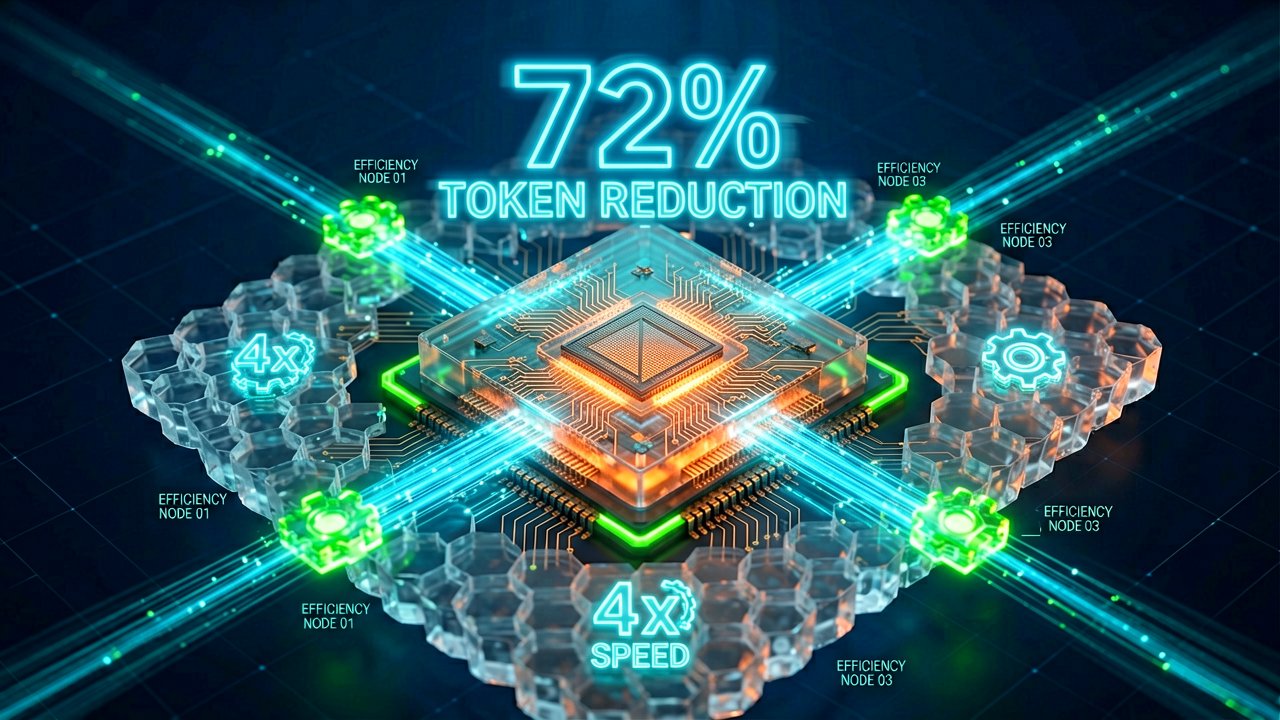
The technical leap with 3.5 Flash is where the industry should be paying attention. We’re seeing a 72% reduction in token usage compared to previous generations, which is music to the ears of developers trying to scale complex apps. On the Terminal-Bench 2.1 coding benchmark, it hit a score of 76.2%, proving it can handle the heavy lifting that used to require massive, expensive models. It’s also incredibly responsive, clocking in at four times the output speed of other frontier models, as detailed by LLM Stats. This efficiency is what allows Spark to run 24/7 without melting Google's servers or your wallet.

Omni and the Future of Creation
While Flash handles the logic, Gemini Omni handles the vibes. It’s rolling out first as Omni Flash for subscribers, bringing sophisticated video editing to tools like YouTube Shorts. The model doesn’t just generate video from text; it understands the spatial relationships in a scene. If you ask it to change the lighting in a video, it doesn't just slap a filter on it—it re-renders the scene with a deep understanding of the environment. Google DeepMind CEO Demis Hassabis called this a "meaningful step" toward artificial general intelligence (AGI) because it shows a model that truly "understands" the physical world it's depicting.
Spark: Your Always-On Assistant
If Gemini Spark lives up to the hype, the way we use Workspace is about to change forever. It connects deeply with Gmail, Docs, and over 30 third-party apps like Uber and OpenTable to execute multi-step plans. Imagine telling your phone to "organize a team dinner for six people next Tuesday," and having it find a place, check everyone's calendar, and book the table without you lifting a finger. It's rolling out to AI Ultra subscribers in the U.S. first, acting as a "digital layer" over your existing tools. Google is pitching it as a teenager with their first debit card—it has some autonomy, but you still have the final say on the big decisions.
What the Spec Sheets Don’t Tell You: The Architecture of Trust
The Real Pivot: While the tech world obsesses over benchmarks, what most reports miss is the fundamental shift in Google’s "Tensor-First" strategy. By tightly coupling Gemini 3.5 Flash with the latest TPU v6 hardware, Google has managed to shave off the latency that killed previous iterations of "agentic" AI. It’s a classic vertically integrated play, reminiscent of the early smartphone wars, where the software is optimized for the silicon it lives on. This isn't just about speed for the sake of speed; it’s about creating a "zero-latency" feedback loop where an agent like Spark can make decisions faster than a human can second-guess them.
Historical context matters here. If you look back at the original Google Gemini launch, the primary criticism was that the models felt disconnected from the user’s actual workflow. They were great at answering questions but terrible at doing work. With the 3.5 series, Google is moving away from the "search box" metaphor entirely. Gemini Omni represents the culmination of years of multimodal research that started with LaMDA and PaLM 2, moving toward a model that doesn’t "translate" video into text but rather understands it as a primary sensory input. This "native multimodality" is the secret sauce that allows Omni to edit video with such high spatial awareness.

From a stakeholder perspective, the introduction of the Agent Payments Protocol (AP2) is perhaps the most significant business move. Industry insiders see this as an olive branch to a wary financial sector and a skeptical public. For years, the Stakeholder Model of corporate responsibility has been at odds with the "move fast and break things" ethos of AI. By bake-in programmable spending limits and human-in-the-loop checkpoints, Google is attempting to solve the "hallucination problem" not through better math, but through better governance. They are essentially building a legal and financial framework into the model's core logic.
This architectural shift also addresses the looming "context window" fatigue. While competitor models brag about millions of tokens, Google’s 3.5 Flash focuses on "high-density context." Instead of just reading more data, the model is significantly better at identifying what data actually matters to the task at hand. This efficiency is what allows Spark to run as a persistent background process without draining device battery life or overwhelming the user with unnecessary notifications. It marks a transition from AI as a destination to AI as an invisible, omnipresent utility.
Finally, there is the human element that often gets buried in the technical jargon. The "Omni" experience is designed to feel less like a tool and more like a collaborator. Google’s design teams have leaned heavily into the Rhetoric of persuasion, fine-tuning the model's tone to be encouraging and adaptive rather than cold and clinical. This focus on "EQ" (Emotional Quotient) alongside "IQ" is a direct response to user feedback suggesting that people are more likely to trust agentic AI if it behaves with a level of social intelligence that matches its technical prowess.
Reading Between the Lines: The Mirage of Autonomy
The Reality Check: Despite the glossy keynotes, there is a glaring contradiction in the push for "agentic" AI: the more we automate, the more we rely on infrastructure that Google completely controls. While Gemini Spark is marketed as a tool for personal liberation from mundane tasks, it actually deepens the "walled garden" effect. For Spark to function as promised, it requires unfettered access to your emails, your calendar, and now—via the AP2 protocol—your bank account. This isn't just a tech upgrade; it is a fundamental renegotiation of digital privacy where the currency isn't just your data, but your agency. The industry assumption that users will blindly trade financial autonomy for the convenience of an auto-booked flight is a massive gamble that has yet to be tested in the wild.
There is also the matter of the "Flash" performance paradox. Google claims that Gemini 3.5 Flash is smarter and faster, yet the history of software development tells us that gains in hardware efficiency are almost always immediately swallowed by more bloated code. By making tokens cheaper and faster, Google is encouraging a high-volume, low-friction environment that could lead to an explosion of "agent noise." If every app on your phone starts deploying its own autonomous Spark agent to negotiate with every other app, we risk entering a feedback loop of digital bureaucracy that requires even more AI just to manage. The skepticism here lies in whether this efficiency actually solves problems or just creates a faster way to generate new ones.
Furthermore, the "world model" branding of Gemini Omni feels like a strategic overreach intended to spook competitors rather than describe current reality. While the ability to re-render video backgrounds is impressive, calling it a "deep understanding of the physical world" is a stretch that any physicist would find amusing. These models are still, at their core, predictive engines based on statistical patterns. They don't understand gravity or momentum; they understand how pixels usually move in relation to one another. As noted by analysts at The Verge, the gap between a model that simulates a reality and one that understands it remains the industry's most significant unbridged chasm.
The geopolitical and environmental cost of this "always-on" intelligence is the elephant in the room. To keep Spark running in the background for millions of users, the energy demands on Google’s data centers will be astronomical, regardless of the 72% token efficiency gains. We are witnessing a shift where the "greenest" AI is the one you don't use, yet Google’s business model now depends on you never turning it off. This creates a systemic tension between corporate sustainability goals and the technical requirements of a persistent AI agent that never sleeps.
Ultimately, the success of the Gemini 3.5 era won't be measured by benchmarks or "world model" claims, but by the first time an agent fails in a way that matters. When a Spark agent misinterprets a prompt and drains a user's AP2-guaranteed budget on the wrong non-refundable hotel, the legal and social fallout will define the next decade of AI regulation. Google is moving fast to set the standards, but being the first to build the "agentic" world also means being the first to be held liable when that world glitches.
The dream was a robot that would do our laundry and dishes so we could focus on art; the reality is an AI that writes our poetry and emails so we have more time to spend at our desks managing the AI.
Artūras Malašauskas is an AI Systems Integrator with 20+ years of production-grade web engineering experience. He has designed, shipped, and scaled enterprise Python/PHP systems for logistics, SaaS, and public-sector clients. For the past year, he has focused exclusively on AI integrations: deploying open-source LLMs, building generative media pipelines (image, audio, video), and engineering multi-agent workflows for real production environments. His standard: reproducibility, security, cost-efficient inference—no vaporware. He documents and evaluates emerging AI tooling, separating verified capabilities from marketing noise. Technical editor at: muza-ai.eu, ai-verslas.lt, ai-naujinos.lt Connect on LinkedIn
Comments