The Algorithmic Intervention: Can We Outsmart Extremism?

For decades, the fight against terrorism was a high-stakes game of human intuition and shoe-leather intelligence. But as we lean into 2026, the frontline has shifted. We're no longer just looking for "bad actors" in the physical world; we're trying to untangle the digital webs that trap them in the first place. Artificial Intelligence has emerged as the most polarizing tool in this arsenal. To some, it’s a digital shield; to others, it’s an algorithmic panopticon. But the most fascinating—and perhaps most hopeful—frontier isn't just detecting threats, but actively helping people leave extremist paths.
The Rise of the Digital Interventionist
We’ve seen AI used for surveillance and "predictive policing" before, but the shift toward "disengagement" is a relatively new pivot. Disengagement isn't just about stopping an attack; it’s about moving an individual away from the violence they’ve already embraced. It’s messy, psychological work that has traditionally required a level of human resources that simply doesn’t scale. Enter "Aldous," a large language model (LLM) developed by Mythos Labs. According to GNET, this tool was deployed in 2025 to help rehabilitate 52 former terrorists in Indonesia and the Philippines. Instead of a cold interrogation, these individuals interacted with a chatbot via WhatsApp and Facebook Messenger, designed to steer them away from violent fantasies and toward constructive, prosocial goals.
The results were surprisingly promising. Internal data showed that after three months of these "digital chats," 61% of the participants showed a lower risk level, and remarkably, none showed an increase. It turns out that for some, talking to a machine feels safer than talking to a person. There’s a certain lack of judgment in an algorithm that can foster the kind of "self-compassion" necessary for psychological recovery. It’s a bit of a tech-journalist’s paradox: using one of our most dehumanizing technologies to help people regain their humanity.
Opportunities: More Than Just a Better Filter
The opportunities here extend beyond just rehabilitation. AI excels at finding the needle in the haystack of online ecosystems. As noted by the United Nations, responsibly used AI can help us understand complex digital radicalization patterns that are invisible to the naked human eye. It’s about more than just flagging keywords; it’s about understanding the "continuum" of radicalization—identifying when a person is just beginning to spiral and offering "tailored messaging" to counteract the poison of extremist propaganda.

We’re also seeing AI used to strengthen early warning systems by analyzing illicit financial flows and terrorist networks. In a world where extremists are already using Generative AI to bypass content moderation by changing the "digital fingerprints" of their videos, as reported by the International Centre for Counter-Terrorism (ICCT), the "good guys" have no choice but to upgrade their tech. It’s an arms race of algorithms, where the goal is to create a digital environment that is simply too resilient for radical narratives to take root.
Challenges: The Algorithmic Bias and Privacy Trap
However, let's not get too comfortable. The "challenges" side of the ledger is heavy with ethical debt. The biggest fear? That these systems will become "infallible" in the eyes of their human operators, leading to what many call "automation bias." The Office of the United Nations High Commissioner for Human Rights (OHCHR) has sounded a sharp alarm, noting that AI systems are far from neutral. If the data used to train them is biased, the output will be discriminatory, potentially profiling individuals based on race, religion, or associations rather than actual threat.
There is also the profound risk of over-surveillance. When you give a government an AI that can analyze every social media post, financial transaction, and travel record, the line between "terrorism prevention" and "suppressing dissent" becomes razor-thin. Critics argue that these predictive models turn ordinary citizens into suspects without solid grounds, a concern echoed by Privacy International. The transparency of these "black box" algorithms is often non-existent, leaving those wrongly flagged with no way to clear their names.
The Human-in-the-Loop Necessity
If there’s a consensus forming, it’s that AI should be a co-pilot, not the captain. The FBI, for instance, maintains that while they use AI for massive video analytics, a human being is ultimately accountable for any action taken. This "human-in-the-loop" philosophy is critical. We can't let algorithms decide who is a threat and who isn't; we can only let them show us where to look.
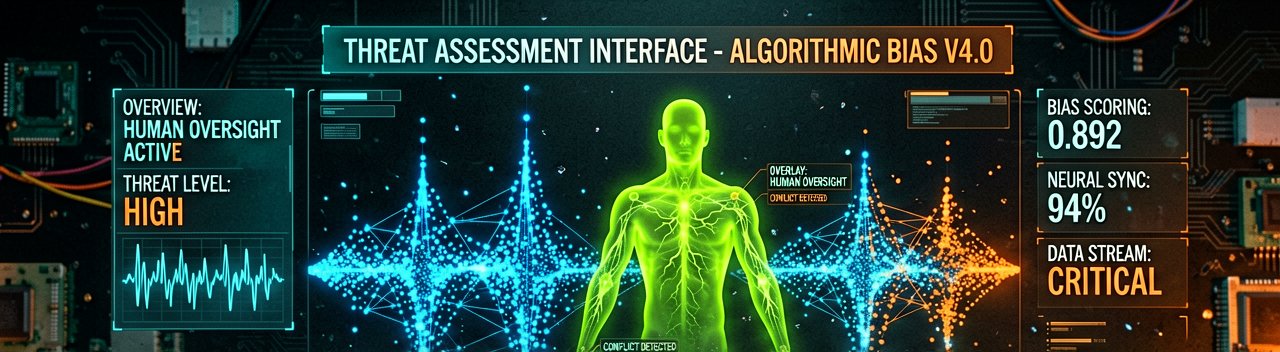
Ultimately, AI in counter-terrorism is a double-edged sword. It offers us a way to scale empathy through rehabilitation and a way to spot threats before they turn into tragedies. But without "do-no-harm" safeguards and a rigid commitment to human rights, we risk building a world where the cure for terrorism is as invasive as the disease itself. The future of this tech isn't just about how smart the AI is, but about how wise we are in choosing when—and when not—to use it.
Should we prioritize the efficiency of AI interventions over the inherent risks of "algorithmic profiling"?
The Quiet Crisis of the "False Positive": While the marketing brochures for AI defense systems promise surgical precision, the reality on the ground is often far messier. What most reports miss is the psychological toll these systems take on the communities they are meant to protect. When an algorithm incorrectly flags a non-violent political activist or a student researching history as a potential radical, the fallout isn't just a digital error—it’s a profound breach of trust that can actually fuel the very resentment extremists exploit for recruitment.
The Architecture of the Digital Echo Chamber
To understand why AI is such a high-stakes tool, you have to look at how radicalization has evolved from backroom meetings to "algorithm-induced" rabbit holes. In the early 2010s, recruitment was manual. Today, it’s semi-automated. Extremist groups have become adept at "algorithmic gaming," using specific engagement metrics to ensure their content bypasses safety filters and lands directly in the feeds of vulnerable individuals. Seasoned intelligence analysts argue that we are no longer fighting organizations; we are fighting feedback loops.
This is where the "counter-bot" strategy comes in. Experts from GNET have observed that the most effective interventions don't just "block" content—they interrupt the flow. By injecting "alternative narratives" into the same digital space where radicalization occurs, AI can act as a circuit breaker. However, this raises a thorny ethical question: is it the role of a tech company or a government to "nudge" a citizen’s ideology, even if that ideology is leaning toward violence?
The "Black Box" Accountability Gap
From a journalist's perspective, the most concerning trend is the lack of "explainability" in these systems. When a machine learning model identifies a pattern of behavior as "terroristic," even the engineers who built the system often can't explain *why* it reached that conclusion. This "black box" nature of AI creates a massive legal vacuum. If a person is denied a visa, a job, or their freedom based on an unexplainable algorithmic score, the core tenets of due process begin to crumble.
Human rights advocates at OHCHR have pointed out that without rigorous, independent auditing of these tools, we are essentially outsourcing our justice system to private tech firms. These firms often prioritize "accuracy" over "fairness," two metrics that sound similar but are mathematically distinct. A system can be 99% accurate at catching threats while still disproportionately targeting a specific ethnic minority, a nuance that "dry" reporting often overlooks in favor of flashy headlines about "AI breakthroughs."
The Future: Coexistence or Control?
The transition toward a more "human-centric" AI approach in 2026 isn't just a moral choice; it’s a tactical one. We are seeing a move toward "hybrid intelligence," where AI handles the massive data-crunching—scanning millions of hours of encrypted propaganda—while human experts handle the final "threat assessment." This preserves the nuance of human judgment, which can distinguish between a teenager’s edgy online persona and a genuine intent to cause harm.
As we look ahead, the goal isn't to build a perfect machine that can predict the future. That’s a sci-fi fantasy that usually ends in a dystopia. Instead, the focus is shifting toward "resilience-building." If AI can be used to strengthen the digital literacy of at-risk populations, making them "immune" to extremist manipulation, we might finally move from a reactive posture to a proactive one. It’s a long game, and in the world of tech journalism, it’s the only one worth watching.
Are we comfortable with "benevolent" algorithms shaping our political and social beliefs if it means a statistically significant reduction in violence?
Reading Between the Lines: There is a seductive comfort in believing that the "terrorist problem" is simply a data problem waiting for a more powerful processor. We treat radicalization as if it were a software bug that can be patched with the right combination of sentiment analysis and behavioral tracking. But this perspective overlooks a glaring contradiction: the same AI infrastructure that we hope will "de-radicalize" the masses is built upon the very engagement-at-all-costs architecture that fractured our social discourse in the first place.
The Paradox of Predictability
The tech industry’s current obsession with "predictive indicators" assumes that human behavior follows a linear, logical trajectory that a machine can map. Yet, history shows us that radicalization is often spurred by the chaotic and the irrational—a personal loss, a chance encounter, or a sudden perceived injustice. By training AI to look for "patterns," we risk creating a security apparatus that is perfectly calibrated to fight the last war while remaining blind to the novel, "out-of-distribution" threats of the future. We are, in effect, building a digital Maginot Line.
Furthermore, there is a certain irony in using opaque, proprietary algorithms to "bring people back into the light" of democratic transparency. If the path to disengagement is paved with "nudge" bots and shadow-banning, we aren't necessarily fostering a more resilient citizenry; we are simply substituting one form of digital manipulation for another. The risk isn't just that the AI might fail, but that it might succeed so well that we forget how to address the underlying socioeconomic grievances that make extremism an attractive alternative to the status quo.
The Sovereignty of the Silicon Valley Sentinel
We must also confront the reality of who actually holds the keys to this preventive kingdom. While government agencies like the FBI provide the legal framework, the actual "intelligence" is increasingly housed within private corporations. This creates a bizarre scenario where a handful of product managers in Menlo Park or Mountain View have more influence over global stability than many mid-sized nation-states. When we automate "terrorism prevention," we are effectively privatizing a core function of the state, often with zero public oversight and even less democratic accountability.
Ultimately, the "AI as a savior" narrative feels like a convenient way to avoid the hard, expensive work of human-led community policing and social reform. It’s much cheaper to deploy a WhatsApp bot than it is to fix a broken education system or integrate a marginalized community. As we move forward, the real test won't be how many "risky" profiles our algorithms can flag, but whether we have the courage to acknowledge that some human problems simply cannot be solved by an upgrade to the latest version of an LLM.
"We’ve spent billions trying to teach machines to think like humans so they can stop us from killing each other, only to find that the machines are mostly confused by our lack of a clear API for common sense. It turns out that 'fixing' humanity is the one task that even the most advanced neural network would prefer to leave in the 'Too Hard' folder."
Artūras Malašauskas is an AI Systems Integrator with 20+ years of production-grade web engineering experience. He has designed, shipped, and scaled enterprise Python/PHP systems for logistics, SaaS, and public-sector clients. For the past year, he has focused exclusively on AI integrations: deploying open-source LLMs, building generative media pipelines (image, audio, video), and engineering multi-agent workflows for real production environments. His standard: reproducibility, security, cost-efficient inference—no vaporware. He documents and evaluates emerging AI tooling, separating verified capabilities from marketing noise. Technical editor at: muza-ai.eu, ai-verslas.lt, ai-naujinos.lt Connect on LinkedIn
Comments