NVIDIA SANA-WM: The One-Minute World Model and the End of Camera Constraints
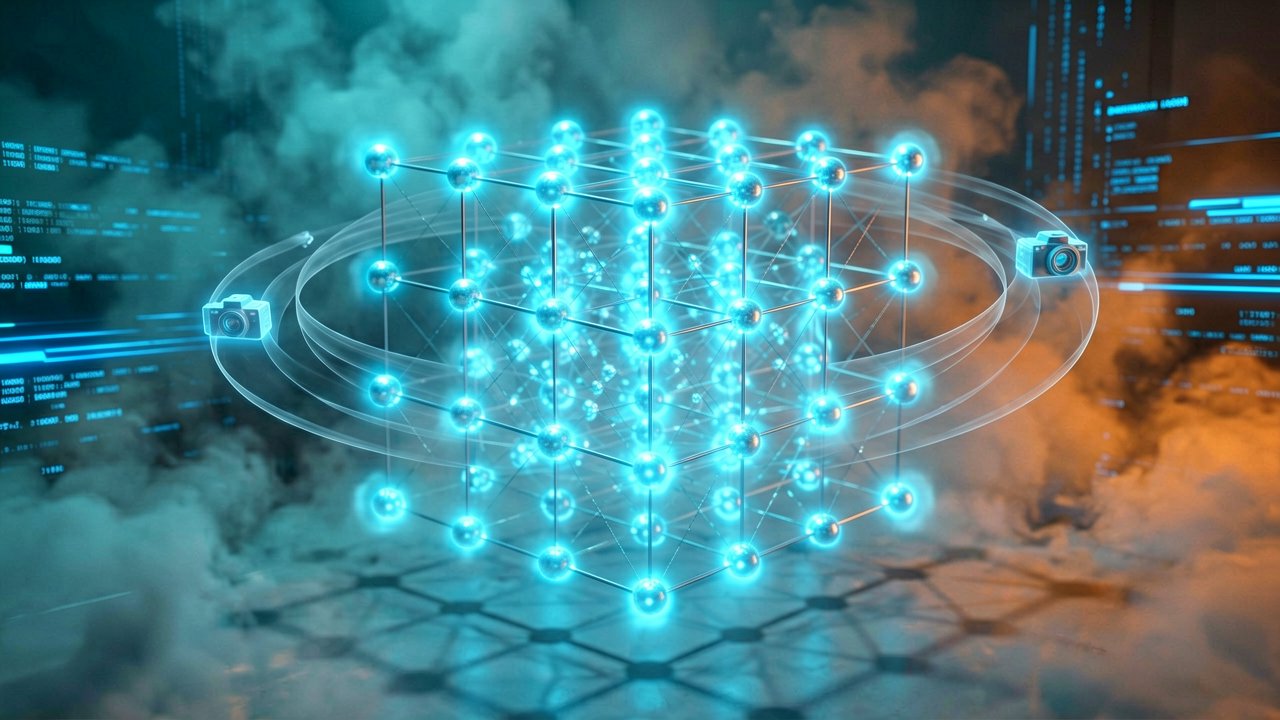
In the breakneck world of generative AI, we’ve grown accustomed to flashy five-second clips that look great but lack any real staying power. NVIDIA is ready to change that narrative. The tech giant just took the wraps off SANA-WM, a "world model" that doesn’t just dabble in short bursts—it generates full, cohesive 60-second videos at 720p resolution. It’s a significant leap from the blink-and-you-miss-it loops we’ve seen from competitors, signaling a shift toward AI that can actually tell a story or simulate a consistent environment.
What makes SANA-WM more than just a longer video generator is its "world model" pedigree. According to NVlabs, this 2.6-billion-parameter model is designed to understand the spatial and physical relationships within a scene. It isn't just predicting the next pixel; it's predicting how a camera moves through a 3D space. This allows for what NVIDIA calls "precise 6-DoF camera control"—meaning you can dictate exactly how the camera pans, tilts, and dollies through a scene with professional-grade precision.
The Architecture of Efficiency
Generating a full minute of video is a computational nightmare because standard AI "attention" mechanisms tend to eat up memory exponentially as a clip gets longer. NVIDIA’s engineers bypassed this with a Hybrid Linear Attention system. By pairing a frame-wise "Gated DeltaNet" with periodic softmax attention, the model keeps its memory footprint constant regardless of the video length. It’s a clever bit of engineering that lets the model maintain a coherent "world" for sixty seconds without the usual glitches or "melting" artifacts that plague longer AI generations.
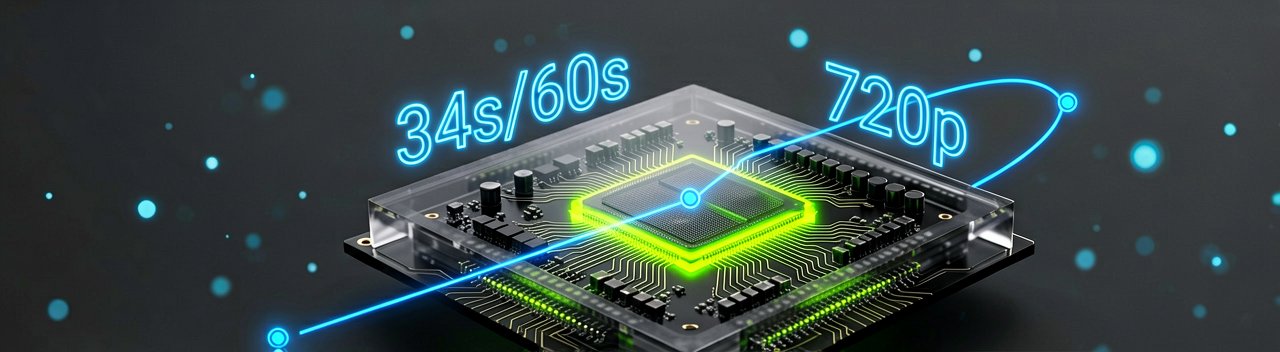
The speed here is equally startling. While many high-end AI models require a server rack’s worth of power, a distilled version of SANA-WM can reportedly run on a single consumer-grade RTX 5090. In fact, early benchmarks shared by arXiv researchers suggest a 60-second 720p clip can be denoised in just 34 seconds. That’s faster-than-real-time generation on hardware you can actually buy, which is a massive win for independent creators and small game studios.
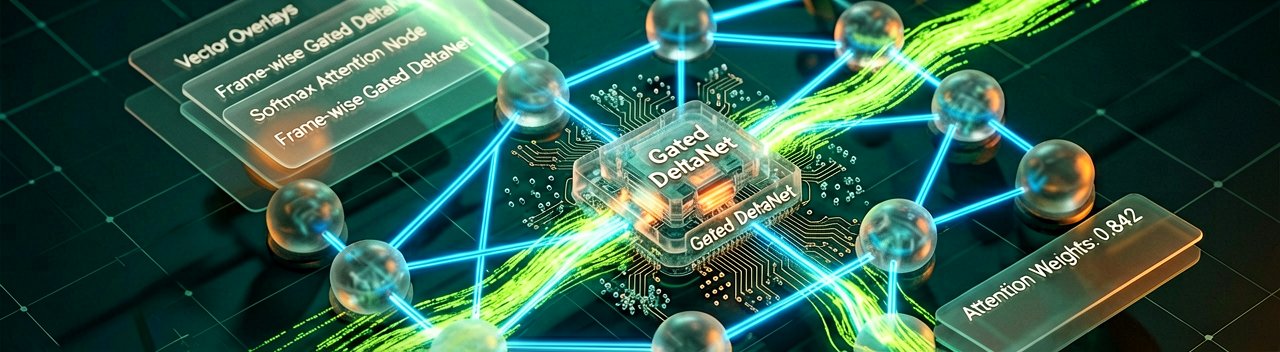
NVIDIA didn't just build this in a vacuum; they trained it on roughly 213,000 public video clips, using a robust annotation pipeline to extract metric-scale camera poses. This "dual-branch" approach to camera control means the AI can follow a specific trajectory while simultaneously refining the fine, pixel-aligned details. It's essentially like having a virtual cinematographer who never gets tired and follows your blocking instructions to the millimeter.
Why This Matters for the Industry
The practical applications for SANA-WM extend far beyond making cool YouTube clips. For filmmakers, it’s a powerhouse for background plate generation—feed it a reference image and a camera path, and you get a spatially consistent environment ready for compositing. In the realm of robotics, as noted by GIGAZINE, this tech allows for high-fidelity simulations where a robot can "visualize" 60-second futures to plan its movements in a complex virtual space before trying them in the real world.
Of course, it’s not perfect. Like any generative model, there are still occasional hiccups with temporal consistency—objects might slightly morph or lighting might shift unexpectedly during complex turns. But by releasing SANA-WM under an Apache 2.0 license, NVIDIA is inviting the community to help iron out those kinks. We’re moving into an era where the barrier between "rendered" and "simulated" is getting thinner by the day, and SANA-WM is currently leading the charge into that one-minute frontier.
Will SANA-WM's open-source nature push other industry leaders like OpenAI or Sora to finally release their tools to the public? We'll have to see if the competition can keep up with NVIDIA's efficiency.
Under the Hood of the Hype: While most headlines are obsessing over the "one-minute" milestone, the real story here is NVIDIA’s pivot toward absolute spatial authority. For years, AI video has been a bit of a hallucinatory mess—beautiful, sure, but physically nonsensical. If you asked an AI to "pan left," it might give you a blurry smear of pixels that vaguely resembled motion. SANA-WM changes the game by treating video not just as a sequence of frames, but as a rigid 3D environment. By baking 6-DoF (Six Degrees of Freedom) camera control directly into the latent space, NVIDIA has effectively given the AI a "sense of balance" and a tripod.
Industry veterans will recognize this as the "Sim-to-Real" bridge that many have been waiting for. Historically, training autonomous systems or robots required painstaking manual labor in game engines like Unreal or Unity. SANA-WM suggests a future where a developer can simply describe a scenario—"a rainy street at night with a drone banking 45 degrees"—and receive a physically accurate, one-minute simulation that serves as training data. This moves the needle from "cool art tool" to "industrial-grade utility," a distinction NVIDIA is keen to maintain as it battles for dominance in the enterprise AI sector.
The Geometric Advantage
What sets SANA-WM apart from competitors like Sora or Kling is its reliance on "metric-scale" camera poses. Most models are trained on raw video where the AI has to guess where the camera is. NVIDIA’s researchers, as highlighted by NVlabs, used a specialized pipeline to label their dataset with precise XYZ coordinates. This means when you prompt the model to move forward five meters, it actually understands the scale of that distance relative to the objects in the frame. It’s the difference between a painter guessing perspective and an architect using a ruler.
There’s also a subtle but vital conversation happening around the "distilled" version of the model. By releasing a version that fits on a single RTX 5090, NVIDIA isn't just catering to the elite; they are democratizing high-end simulation. This puts immense pressure on closed-source rivals who keep their models behind expensive API walls. As noted in technical breakdowns on arXiv, the Hybrid Linear Attention mechanism is the secret sauce here, allowing the model to "remember" the beginning of the minute while it's generating the end without the typical memory crash we’ve come to expect from long-form transformer models.
From a stakeholder perspective, this is a strategic masterstroke for NVIDIA’s hardware ecosystem. By making the most advanced video world model open-source but optimized for their latest Blackwell and Ada Lovelace architectures, they’ve created a "golden cage." You can have the code for free, but if you want it to run at the breakneck speeds promised—generating a minute of video in 34 seconds—you’re going to need their latest silicon. It’s a classic "razor and blade" strategy updated for the AI age, ensuring that even as the software becomes open, the hardware remains the gatekeeper.
Finally, we have to look at the "temporal coherence" problem that has haunted AI since its inception. SANA-WM’s ability to maintain a character’s face or a building’s structure for 60 consecutive seconds is a shot across the bow for traditional VFX houses. We aren't quite at the point of "one-click movies" yet, but the trajectory is clear. With SANA-WM, NVIDIA isn't just generating video; they are building a predictable, controllable, and scalable digital twin of reality. The question now is how quickly creators can adapt to a world where the camera is no longer a physical object, but a line of code.
Reading Between the Lines: For all the talk of "democratization" and "world modeling," we need to cast a skeptical eye on the sheer computational tax SANA-WM imposes. NVIDIA is pitching a future where 60-second clips are generated in half that time, but that benchmark relies on the staggering horsepower of an RTX 5090—a piece of hardware that remains a luxury for the average creator. There is a glaring contradiction in promoting an open-source "Apache 2.0" model that requires a several-thousand-dollar gatekeeper to function at advertised speeds. We are seeing the birth of a new digital divide, where "creative freedom" is directly proportional to your cooling bill.
Furthermore, the term "World Model" is being used quite loosely here. While SANA-WM excels at maintaining geometric consistency for a minute, it is still essentially a sophisticated statistical mirror. It understands that a camera move usually looks like *this*, but it doesn't truly grasp the underlying physics of gravity or friction beyond what it has seen in its 213,000-clip training set. If you push the model outside the bounds of "normal" cinematography, the "world" begins to fray. We have to wonder if we are actually building models that understand reality, or just models that have become exceptionally good at faking the perspective of a GoPro.
The Paradox of Precision
There is also the matter of "precision" in a generative context. NVIDIA claims 6-DoF control, yet anyone who has worked on a professional film set knows that "close enough" isn't good enough for high-end visual effects. If SANA-WM’s 3D trajectory drifts by even a few millimeters over its 60-second runtime, it becomes useless for professional compositing without significant manual cleanup. As noted by critics on GIGAZINE, the model is a marvel of efficiency, but whether it can replace the pixel-perfect accuracy of a traditional render engine remains a massive "if."
Lastly, we have to consider the data. NVIDIA's reliance on public video clips for training raises the evergreen ghost of copyright and "fair use" in the AI era. By releasing the model openly, NVIDIA effectively shifts the legal and ethical burden onto the end-user. It’s a brilliant tactical move: provide the engine, let the public provide the fuel, and stay at arm's length when the inevitable questions about training provenance arise. We are racing toward a future of infinite content, yet we’ve never been more uncertain about the foundation that content is built upon.
"We’ve finally reached the point where AI can simulate a minute of reality faster than it takes to actually live it; now we just have to find something interesting to do with those extra twenty-six seconds besides rendering another cat playing a piano in 6-DoF."
Artūras Malašauskas is an AI Systems Integrator with 20+ years of production-grade web engineering experience. He has designed, shipped, and scaled enterprise Python/PHP systems for logistics, SaaS, and public-sector clients. For the past year, he has focused exclusively on AI integrations: deploying open-source LLMs, building generative media pipelines (image, audio, video), and engineering multi-agent workflows for real production environments. His standard: reproducibility, security, cost-efficient inference—no vaporware. He documents and evaluates emerging AI tooling, separating verified capabilities from marketing noise. Technical editor at: muza-ai.eu, ai-verslas.lt, ai-naujinos.lt Connect on LinkedIn
Comments