The Shrink-Wrap Revolution: Mastering LLM Optimization with llmcompressor
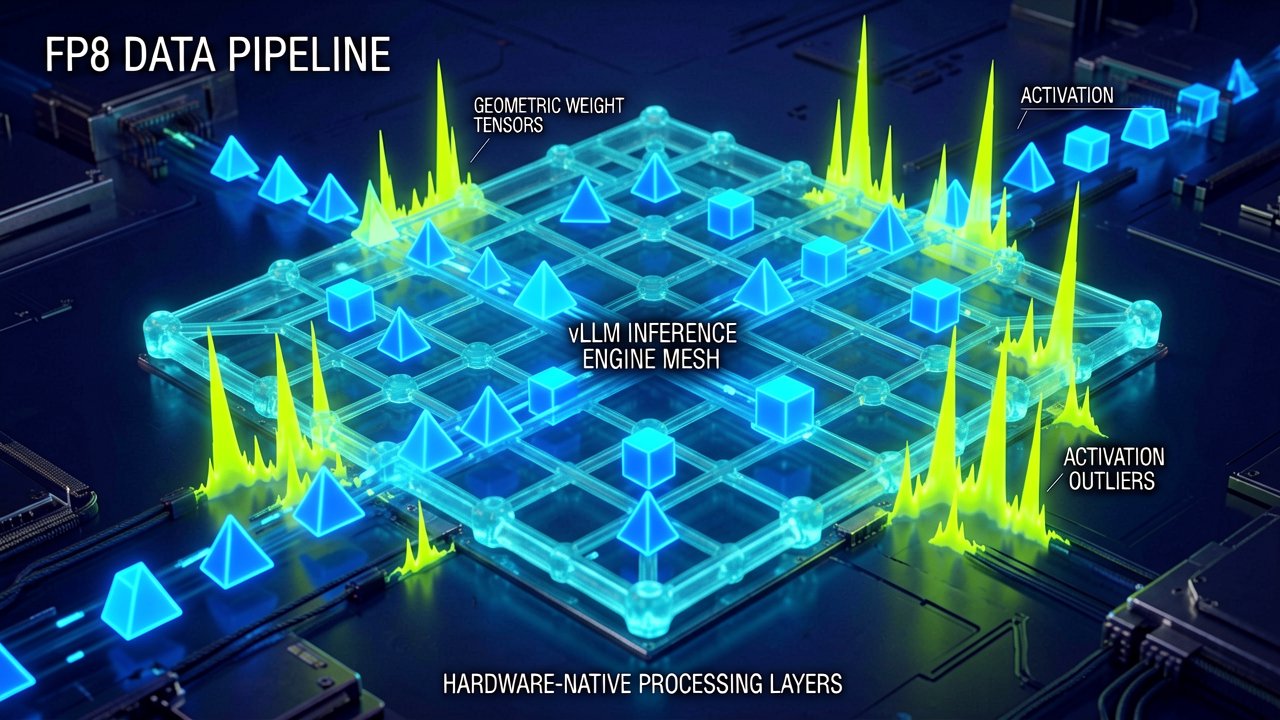
Deploying large language models (LLMs) used to be a luxury reserved for those with massive GPU clusters. But as the open-source community moves toward efficiency, tools like vLLM-Project's llmcompressor are leveling the playing field. This library, born from the efforts of Neural Magic, isn't just another quantization tool; it’s a unified powerhouse designed to optimize instruction-tuned models for deployment on vLLM without the usual headache of juggling multiple fragmented libraries like AutoGPTQ or AutoAWQ.
The Triple Threat: FP8, GPTQ, and SmoothQuant
Quantization is essentially the art of "slimming down" a model's weights and activations from high-precision floats (like FP16) to smaller formats to save memory and boost throughput. According to the LLM Compressor Docs, different methods serve different needs. FP8 (8-bit Floating Point) is the new gold standard for modern hardware like NVIDIA’s H100s, offering a "data-free" pathway that maintains high accuracy with minimal effort. However, if you're dealing with stubborn activation outliers that usually break 8-bit precision, SmoothQuant steps in to "smooth" those spikes by migrating the difficulty from activations to weights.
Then there’s GPTQ, a more surgical approach that uses second-order information to minimize the error in each layer's output. While it's slower to run—requiring a calibration dataset to "re-learn" how to behave—the accuracy recovery is often superior for highly sensitive instruction-tuned models. The beauty of llmcompressor is that it allows us to compose these techniques. For instance, combining GPTQ with SmoothQuant creates a robust W8A8 (8-bit weight and activation) model that is both fast and remarkably intelligent.
A Hands-On Implementation
Implementing this doesn't require a PhD in linear algebra. First, you'll need to install the library via pip install llmcompressor. The workflow generally follows a "one-shot" recipe pattern. You load your instruction-tuned model—say, a Llama 3 or Mistral variant—from Hugging Face, define your quantization algorithm, and let the compressor do its magic. Below is a simplified conceptual flow for a GPTQ + SmoothQuant compression:

This snippet demonstrates how llmcompressor uses a "recipe" system to apply complex transformations. By targeting specific layers and providing a small calibration sample, the model learns to adapt its 8-bit representation to the specific nuances of human-like instruction following, rather than just rounding numbers blindly.
Benchmarking for Real-World Wins
You can't manage what you don't measure. After compression, benchmarking is vital to ensure your "slimmed-down" model hasn't lost its mind. Industry experts at NVIDIA often suggest looking beyond just "perplexity" scores. For instruction-tuned models, you should evaluate Time to First Token (TTFT) and Total Throughput. A quantized model using FP8 or W8A8 can leverage Tensor Cores to double its teraflops compared to FP16, often leading to a 2x to 5x increase in serving speed.
Finally, keep an eye on accuracy degradation. While researchers on arXiv note that 8-bit quantization is generally "safe," smaller models (under 10B parameters) are more sensitive. Using llmcompressor gives you the flexibility to use non-uniform quantization—keeping sensitive layers like the first and last blocks in higher precision while squashing the rest. It’s this level of control that makes the library a essential tool for anyone serious about production-grade AI.
How do you plan to balance model size against response accuracy in your next deployment?
The Real-World Friction Point: While marketing slides often paint quantization as a "free lunch," any engineer who has spent 3:00 AM debugging a hallucinating chatbot knows the reality is far messier. The industry is currently locked in a fascinating tug-of-war: we want the speed of 8-bit precision, but instruction-tuned models are notoriously "brittle" compared to their base-model counterparts. When you tune a model to follow specific human constraints, you’re essentially sharpening its weights to a fine edge; quantization, if handled poorly, is like trying to sharpen a scalpel with a sledgehammer.
The Hardware-Software Handshake
What most high-level reports gloss over is the sheer importance of the "vLLM-native" ecosystem. In the past, if you quantized a model with one library, you prayed it was compatible with your inference engine. The shift toward llmcompressor represents a strategic consolidation. By aligning the quantization kernels directly with the inference runtime, developers are finally seeing a reduction in the "quantization tax"—that frustrating gap where a model's theoretical speedup is eaten away by software overhead. From a stakeholder perspective, this isn't just a technical win; it’s a massive reduction in the Total Cost of Ownership (TCO) for AI products.
Historically, we moved from 16-bit to 4-bit (GPTQ/AWQ) because memory capacity was the primary bottleneck. However, as NVIDIA's Blackwell and Hopper architectures have matured, the bottleneck has shifted toward compute throughput. This is why FP8 is suddenly the talk of the town. Unlike 4-bit integer formats, which require expensive dequantization steps during every calculation, FP8 can be processed natively by the hardware. It’s the difference between translating a book as you read it versus reading it in your native tongue; the latter is always going to be faster, even if the vocabulary is slightly smaller.
The Ghost in the Machine: Activation Outliers
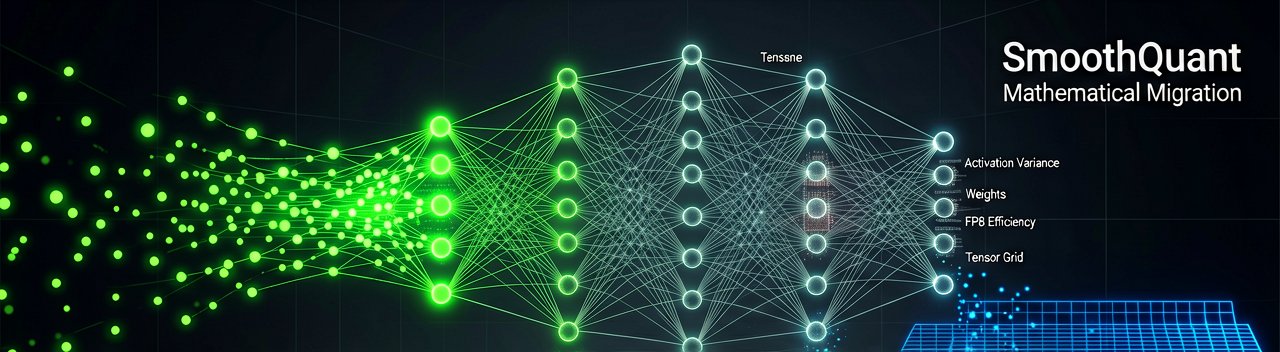
Deep-dive into the weights of a model like Llama 3, and you’ll find "outlier features"—specific dimensions where values are significantly larger than others. These are the "VIPs" of the neural network; if you squash them too hard during quantization, the model loses its ability to reason logically. This is where the SmoothQuant integration within llmcompressor proves its worth. By mathematically migrating the variance from the activations to the weights, we essentially "level the terrain" before the quantization happens. It’s a sophisticated bit of mathematical sleight of hand that keeps the model’s instruction-following capabilities intact while dropping the memory footprint by half.
Ultimately, the move toward unified compression tools signals a maturing industry. We are moving away from the "wild west" of experimental scripts and toward a disciplined, recipe-driven approach to model optimization. For the tech journalist or the CTO, the takeaway is clear: the goal is no longer just to make models smaller, but to make them efficiently intelligent. As we look toward the next generation of 70B and 400B parameter models, these quantization workflows won't just be an option; they will be the only way to keep the lights on in the data center.
Which specific latency threshold is your team willing to trade for a 50% reduction in VRAM usage?
The Diminishing Returns of "Slimming Down": There is a seductive narrative in the AI world that we can infinitely compress models with zero consequence, but we are rapidly approaching a "complexity floor." While llmcompressor and its ilk are technical marvels, we must challenge the assumption that a quantized 8-bit model is always a direct substitute for its FP16 progenitor. In the rush to optimize for throughput and VRAM, we often overlook "semantic drift"—subtle shifts in a model's persona or ethical guardrails that standard benchmarks like MMLU are notoriously bad at catching. A model might pass a logic test while losing the "vibe" or nuanced tone that made the original instruction-tuning valuable.
The Hardware Lock-in Paradox
There is also a glaring contradiction in the push for FP8: it democratizes deployment while simultaneously narrowing the hardware funnel. While llmcompressor makes it easier to target FP8, this format is essentially a love letter to NVIDIA’s latest architectures. If your infrastructure isn't running H100s or newer, the much-touted performance gains of FP8 remain largely theoretical. This creates a secondary digital divide where "optimized" AI is only truly optimal for those with the capital to refresh their server racks every eighteen months. Measured skepticism suggests that while software tools are becoming more open, the underlying performance is becoming increasingly proprietary.
Furthermore, the reliance on "one-shot" calibration datasets like UltraChat introduces a hidden bias. We are essentially asking a model to re-learn its entire world view through the lens of a few thousand lines of text in a matter of minutes. If that calibration data doesn't perfectly mirror your specific production edge cases, you risk "overfitting to the compression." The industry’s obsession with benchmarking speed often masks a decline in creative flexibility. As we project forward, the danger isn't that models will become "stupid," but that they will become "rigid"—hyper-optimized for specific tasks but lacking the generalized spark that made LLMs a breakthrough in the first place.
"We’ve reached a point in the industry where we spend millions of dollars training a model to be a genius, only to spend millions more trying to lobotomize it just enough so it fits into a cheaper suit."
Artūras Malašauskas is an AI Systems Integrator with 20+ years of production-grade web engineering experience. He has designed, shipped, and scaled enterprise Python/PHP systems for logistics, SaaS, and public-sector clients. For the past year, he has focused exclusively on AI integrations: deploying open-source LLMs, building generative media pipelines (image, audio, video), and engineering multi-agent workflows for real production environments. His standard: reproducibility, security, cost-efficient inference—no vaporware. He documents and evaluates emerging AI tooling, separating verified capabilities from marketing noise. Technical editor at: muza-ai.eu, ai-verslas.lt, ai-naujinos.lt Connect on LinkedIn
Comments