OpenAI’s Vocal Grab: The Acquisition of Weights.gg and the Future of Synthetic Sound
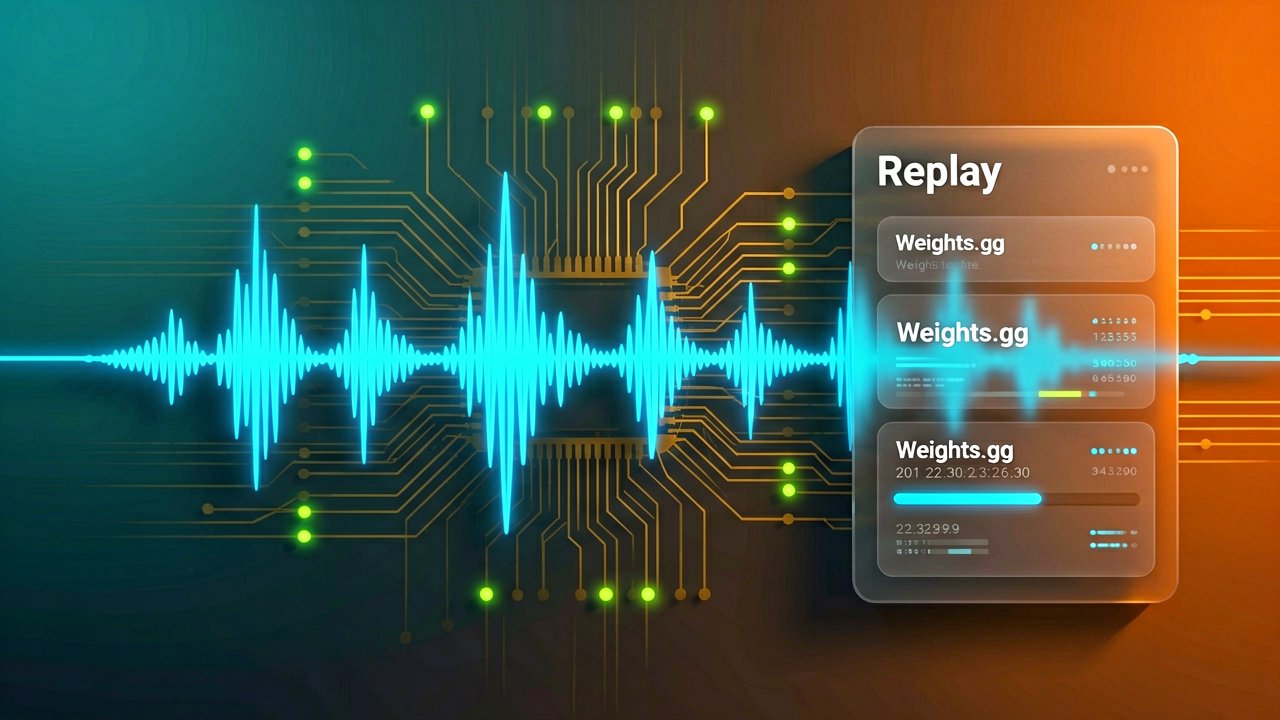
The Quiet Gobble: OpenAI’s Vocal Ambitions Reach for Weights.gg
If you’ve been paying attention to the Silicon Valley game of hungry-hungry-AI-hyenas, you’ll know that OpenAI doesn't just innovate; it absorbs. The latest name to vanish into the Sam Altman-led collective is Weights.gg, a scrappy voice AI startup that’s been making waves—and perhaps a few nerves—in the world of synthetic audio. While neither party made a grand stage announcement, the move signals a sharp, tactical pivot for the company that once claimed its voice tech was too dangerous for the public to touch, as noted by The New York Times.
Weights.gg wasn't your run-of-the-mill TTS (text-to-speech) engine. It functioned more like a creative social hub where users could trade AI algorithms and models like baseball cards. Its claim to fame? Allowing enthusiasts to clone the voices of celebrities and artists with startling, and often controversial, accuracy. From Samuel L. Jackson to Taylor Swift, the platform’s "Replay" app made it easy for anyone to whip up a deepfake cover song or a custom narration, a capability that eventually drew both a massive fan base and the wary eyes of legal teams across the entertainment industry, according to reports from PYMNTS.
So, why is the creator of ChatGPT interested in a startup that essentially built a digital playground for impersonation? It’s not just about the code; it’s about the talent. OpenAI reportedly bought out both the intellectual property and the small, half-dozen-strong team behind the project, as confirmed by Seeking Alpha. These engineers have already been scattered across various internal teams at OpenAI, likely injecting their expertise into the next generation of conversational models. By the time the news hit the wire, the Weights.gg website had already posted its final "closed" sign, citing an official shutdown as of April 1st, 2026.
A Shift in Strategy or a Defensive Play?
This acquisition feels like a classic "talent-grab" mixed with a healthy dose of risk management. Two years ago, OpenAI was sounding the alarm bells, keeping its Voice Engine under lock and key to prevent "voice cloning" from wreaking havoc on elections or personal security. But as Mint points out, the landscape has changed. With competitors like Anthropic and Meta making aggressive moves into multi-modal AI, OpenAI can't afford to be the only player sitting on the sidelines of the audio revolution—even if that means bringing some "dangerous" tech into the fold to better understand how to leash it.

Moreover, the acquisition trend is accelerating. OpenAI has been on a shopping spree in 2026, snapping up firms like Astral and Promptfoo to bolster its developer ecosystem and testing tools. Bringing Weights.gg into the stable suggests that "voice" is the next major frontier for ChatGPT’s evolution. We’re likely moving toward a world where your AI assistant doesn’t just sound human; it sounds exactly like whoever you want it to, assuming OpenAI can navigate the ethical minefield that Weights.gg lived in. For now, the "voice cloning" playground is closed, and the keys belong to the biggest player in the game.
The Hidden Calculus: Why Weights.gg Matters More Than the Price Tag
Beyond the Press Release: While the surface-level narrative paints this as a simple expansion of OpenAI's toolset, the reality is a high-stakes chess move aimed at the very heart of the creator economy. Weights.gg didn't just build a voice engine; they built a community that understood the nuance of vocal texture—the grit, the breath, and the imperfections that make a voice sound human rather than synthesized. For a seasoned reporter, this isn't just a "buy" for tech; it’s a "buy" for the data and the specific methodologies used to capture the "soul" of a voice without needing hours of studio-grade recording.
Historically, OpenAI has been criticized for its "walled garden" approach to safety, often releasing sanitized versions of technology that feel a step behind the raw energy of the open-source community. By absorbing the Weights.gg team, OpenAI is effectively hiring the rebels who figured out how to do more with less. This is particularly relevant when you consider the legal headwinds. As The Verge and other industry watchdogs have noted, the music industry has been in a tailspin over "AI Drake" and similar clones. OpenAI isn't just getting developers; they’re getting a team that has already navigated the front lines of copyright infringement and "fair use" debates in the audio space.
There is also the matter of the "Replay" app—the consumer-facing side of Weights.gg that turned complex RVC (Retrieval-based Voice Conversion) models into a one-button experience. Most corporate AI feels like a utility, but Weights.gg felt like a toy, and that’s a distinction that Sam Altman’s team desperately needs as they try to keep ChatGPT from feeling like a stale office assistant. Integrating that level of user-centric frictionlessness could be the key to making AI voice interaction feel less like a "feature" and more like a primary interface for the next billion users.
The Talent Drain and the Moral Hazard
We shouldn't ignore the "acqui-hire" aspect of this deal, which has become OpenAI’s favorite way to neutralize potential rivals. By bringing the core architects of Weights.gg into the fold, they’ve effectively decapitated one of the most vibrant hubs for decentralized voice research. It’s a classic Silicon Valley defensive maneuver: if you can’t beat the open-source momentum, you buy the people driving it. This leaves the independent voice-cloning scene momentarily adrift, but it also consolidates an incredible amount of power over the "future of sound" within a single building in San Francisco.
Ultimately, this acquisition is a signal that OpenAI is preparing for a world where "Voice" isn't just about reading your emails back to you. It's about entertainment, emotional connection, and perhaps, the eventual replacement of traditional voice acting in gaming and media. As they fold this startup’s DNA into their proprietary models, the question isn't whether the tech will improve—it will—but whether the spirit of open experimentation that birthed Weights.gg can survive inside the world’s most scrutinized AI company.
The Paradox of Safe Sound: Reading Between the Lines
The Great Contradiction: There is a delicious irony in OpenAI—a company that has spent the last year preaching the gospel of AI safety and "watermarking" digital content—swallowing a startup whose primary legacy is a library of celebrity deepfakes. On one hand, OpenAI’s communications team would have us believe this is about "robustness" and "alignment." On the other, the Weights.gg acquisition looks suspiciously like a company realizing that the only way to win the voice race is to master the very "wild west" techniques they once publicly decried. It raises a cynical but necessary question: is it only a "dangerous deepfake" when someone else builds it?
We are witnessing a pivot from protectionism to pragmatism. For months, the narrative was that voice cloning was a nuclear option, too volatile for the public to handle responsibly. Yet, by absorbing the Weights.gg brain trust, OpenAI is essentially admitting that the demand for high-fidelity, personalized synthetic audio is too lucrative to ignore. The skepticism here lies in the "safety" layer they will inevitably wrap around this tech. Will the resulting product be a revolutionary creative tool, or will it be a sanitized, corporate version of its former self, hamstrung by so many digital guardrails that it loses the very "humanity" the Weights.gg team worked so hard to replicate?
Furthermore, the long-term implications for the labor market in the "vocal arts" are looking increasingly grim. If OpenAI successfully integrates these low-data, high-fidelity cloning methods into ChatGPT, the barrier to entry for high-quality synthetic narration drops to zero. This isn't just about making Siri sound better; it’s about the industrialization of the human voice. While the tech world celebrates the "efficiency" of these new models, the reality is that the "stable" OpenAI is building might just be a warehouse for the digital ghosts of an industry they are about to disrupt into extinction. The measured view? OpenAI didn't just buy a startup; they bought the silence of their most effective competitors.
"In the end, we’re essentially trading the chaotic, copyright-infringing fun of the open web for a world where your AI sounds perfectly like Scarlett Johansson—but only after you’ve signed a thirty-page terms-of-service agreement and promised not to make it say anything ‘unaligned.’ Progress is truly exhausting."
Artūras Malašauskas is an AI Systems Integrator with 20+ years of production-grade web engineering experience. He has designed, shipped, and scaled enterprise Python/PHP systems for logistics, SaaS, and public-sector clients. For the past year, he has focused exclusively on AI integrations: deploying open-source LLMs, building generative media pipelines (image, audio, video), and engineering multi-agent workflows for real production environments. His standard: reproducibility, security, cost-efficient inference—no vaporware. He documents and evaluates emerging AI tooling, separating verified capabilities from marketing noise. Technical editor at: muza-ai.eu, ai-verslas.lt, ai-naujinos.lt Connect on LinkedIn
Comments