The Aesthetic Mirage: Why AI Video Still Can't Grasp the Real World

The Aesthetic Mirage: AI Video's "Soul" Problem
We’ve all seen the clips: swirling nebulae that look like big-budget sci-fi, or photorealistic golden retrievers frolicking in high-definition sunlight. On the surface, AI video generation has reached a breathtaking milestone. However, a comprehensive new benchmark has confirmed what many researchers feared—while these models have mastered the "look" of reality, they remain fundamentally illiterate regarding the physical laws that govern it. According to recent findings shared by MIT Technology Review, there is a massive gulf between generating beautiful pixels and understanding "world logic."
Testing the "Vibe" vs. the Physics
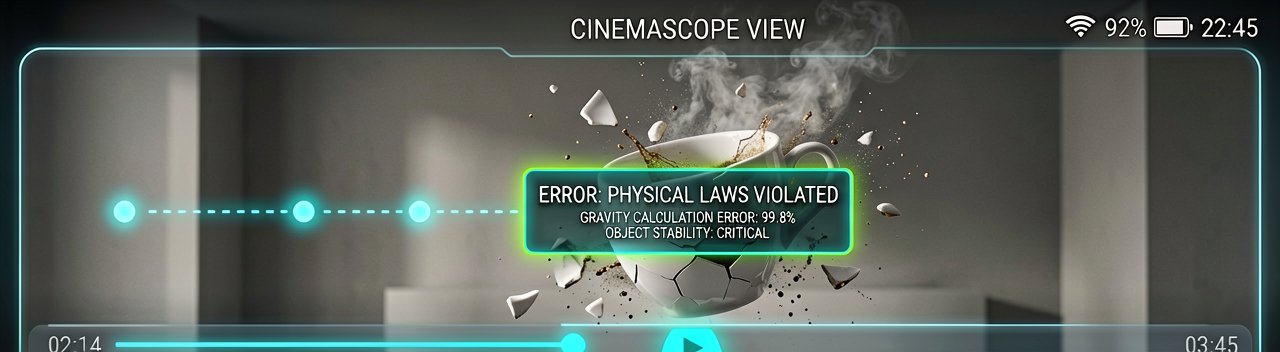
The study utilized a rigorous testing framework designed to push models like Sora, Runway Gen-3, and Luma Dream Machine past their comfort zones. Instead of asking for "a sunset over the ocean," researchers focused on complex physical interactions—like a glass shattering or a person pouring water. The results were telling. While the lighting and textures were often flawless, the videos frequently showcased "hallucinated physics," where objects merged into one another or gravity seemed to operate as a mere suggestion rather than a rule. As noted by The Verge, these models are essentially "stochastic parrots" for motion, mimicking the appearance of movement without any underlying engine to calculate weight, friction, or causality.
The Reasoning Gap
The core of the issue lies in how these models are trained. Unlike a human who learns that a dropped ball falls down through lived experience, AI models learn by predicting the next frame in a sequence based on massive datasets of 2D video. This leads to a profound lack of spatial reasoning. When a model is asked to render a person walking behind a tree, it often fails to understand that the person still exists while out of sight, leading to "teleportation" glitches or morphological shifts. Experts interviewed by Wired suggest that until we integrate symbolic reasoning or world models into the training architecture, AI video will remain a "dreamlike" medium rather than a reliable simulation tool.
Why High Benchmarks Matter for the Industry
This reality check arrives at a critical moment for the industry. Millions of dollars are being poured into "generative cinema," but if a director can't guarantee that a character will hold a coffee cup consistently from frame to frame, the technology remains a novelty rather than a professional utility. The benchmark scores highlight that we are currently in the "uncanny valley of physics." As reported by TechCrunch, the next frontier for developers isn't adding more resolution or better textures; it's teaching the AI that two objects cannot occupy the same space at the same time.
The Path Toward "World Models"
Despite the shortcomings, the pace of improvement is undeniable. Developers are now looking toward "World Models"—a type of AI architecture that attempts to build an internal map of 3D space and physical properties before rendering a single pixel. While the current benchmark shows we aren't there yet, it provides a vital roadmap for what needs to change. For now, we can enjoy the stunning visuals, but we shouldn't trust an AI to accurately depict how a house of cards might actually fall. The "wow" factor is here; the "why" factor is still loading.
The Architects of the Benchmark: VBench and VBench-2.0
Peering behind the curtain of AI evaluation: The findings discussed in the previous section were primarily driven by VBench, a massive collaborative project led by researchers from Nanyang Technological University (NTU) and the Shanghai Artificial Intelligence Laboratory. Introduced as a highlight at the 2024 IEEE/CVF Conference on Computer Vision and Pattern Recognition (CVPR), VBench was the first systematic attempt to break "video quality" into 16 distinct dimensions. As documented on the project’s VBench GitHub, the team moved beyond single-number metrics like FVD (Fréchet Video Distance) to scrutinize specific failures in subject consistency, temporal flickering, and spatial relationships.
The latest iteration, VBench-2.0, published in early 2025, has specifically sharpened its focus on what the researchers call "intrinsic faithfulness." According to technical details on , this new framework integrates advanced Vision-Language Models (VLMs) to act as automated judges, checking if a video adheres to basic commonsense and physics. This version was designed to keep pace with the exponential growth of "Sora-class" models, shifting the evaluation from mere visual aesthetics to the underlying logic of the scene.
Commercial Leaders: Sora, Runway, and Luma under the Microscope
The companies at the heart of this struggle—OpenAI, Runway, and Luma AI—represent the vanguard of generative video. While OpenAI's Sora is often cited as the gold standard for visual fidelity, independent testing within benchmarks like PhyGenBench has revealed that even these high-capacity models struggle with conservation laws. As reported by Google Research, their own VideoPhy benchmark found that closed models like Luma Dream Machine and Runway Gen-3 frequently fail tasks involving material interactions—such as marbles rolling down a slanted surface or fluids pouring correctly.

Runway, in particular, has been vocal about its pursuit of a "General World Model." According to the company's vision shared by TechCrunch, their goal is to move past 2D pixel prediction toward systems that possess an internal representation of 3D space. However, current benchmark data suggests that while these companies are successfully scaling up the "imagination" of their models, the "reasoning" component—often called "Physical Commonsense"—is lagging. This has led to a split in the industry: one side focusing on cinema-grade aesthetics and the other on scientific accuracy for simulations.
The "World Model" vs. "Next-Frame" Debate
The fundamental tension explored by these benchmarks is the difference between next-token prediction and true world modeling. Most current generators function similarly to LLMs; they predict the "most likely" next group of pixels based on statistical patterns. Researchers at the Shanghai AI Lab argue that this approach will always hit a ceiling when it comes to reasoning. As detailed in the 2025 AI Index Report from Stanford HAI, the industry is now pivoting toward hybrid architectures. These "Physics-Aware" models attempt to bake Newtonian mechanics directly into the latent space, ensuring that if a digital glass is dropped, it doesn't just disappear or merge with the floor—it shatters according to the laws of mass and momentum.
The "Media Simulation Gap": Why Pixels Aren't Reality
Decoding the visual-logic paradox: The fundamental insight from recent benchmarks is that the industry has hit a "media simulation gap"—a term used by researchers from to describe the chasm between videos that are visually plausible for a few seconds and those that actually respect the laws of physics. While top-tier models like Cling 3.0 and Veo 3.1 have pushed visual quality to undisputed leads in ELO rankings, their mastery is purely surface-level. They have effectively solved the "uncanny valley" of aesthetics, yet they remain trapped in the "uncanny valley" of physics, where objects may possess 4K textures but lack the permanence required for real-world reasoning.
From a market perspective, this reasoning deficit is already causing commercial friction. The rapid decline in engagement for standalone video apps—highlighted by seeing a massive drop in active users by early 2026—suggests that visual novelty alone cannot sustain a platform. Without the ability to guarantee "intrinsic faithfulness," these tools remain confined to creating b-roll, dreamlike sequences, or social media eye candy. For high-stakes industries like robotics training or professional VFX, a model that allows a coffee cup to merge with a character's hand is not just a glitch; it is a broken simulation that renders the data useless for downstream applications.
The strategic pivot for 2026 is clearly moving toward "World Models" that go beyond next-token pixel prediction. As analyzed in the Stanford HAI 2025 AI Index, the next frontier isn't just "more data," but better architectural memory. Current systems suffer from weak memory mechanisms that cause "morphological drift" in longer clips. Until developers can bake Newtonian mechanics directly into the latent space—ensuring that mass, gravity, and causality are hard-coded constraints—AI video will continue to be a medium that can show us a miracle but can't explain how a ball bounces.
"We've reached a point where AI can paint a perfect masterpiece of a cat, but it still thinks the cat should be able to walk through a solid brick wall if the lighting is right. It turns out that teaching a machine the 'vibes' of reality is easy; teaching it that gravity isn't optional is the real final boss."
Artūras Malašauskas is an AI Systems Integrator with 20+ years of production-grade web engineering experience. He has designed, shipped, and scaled enterprise Python/PHP systems for logistics, SaaS, and public-sector clients. For the past year, he has focused exclusively on AI integrations: deploying open-source LLMs, building generative media pipelines (image, audio, video), and engineering multi-agent workflows for real production environments. His standard: reproducibility, security, cost-efficient inference—no vaporware. He documents and evaluates emerging AI tooling, separating verified capabilities from marketing noise. Technical editor at: muza-ai.eu, ai-verslas.lt, ai-naujinos.lt Connect on LinkedIn
Comments