Chris Bird Launches Two AI Ventures for Filmmakers After Prime Video Exit

After more than 14 years at Amazon, Chris Bird has stepped away from Prime Video UK to launch two AI-powered businesses targeting independent content creators. The former managing director departed in March 2025 and is now positioning himself at the intersection of data analytics and visual development for film and television.
The announcement came during the Cannes Film Festival, where Bird unveiled HawksHead AI and CineMe as complementary tools for early-stage content development. Both platforms are currently in beta testing with a group of production and distribution companies, according to Screen Daily.
HawksHead AI functions as a predictive data analytics platform. It takes scripts or synopses and analyzes how projects might perform with specific audience demographics. The tool suggests adjustments to scripts, casting choices, or creative approaches to improve resonance with target viewers. A "synthetic panel" capability allows creators to test changes and gauge results in hours rather than weeks (which is actually a massive improvement over traditional focus group timelines).
CineMe, co-founded with BAFTA-nominated director Dan Hartley, takes a different approach. The platform automatically generates photo-realistic visual storyboards from scripts in seconds. Hartley's credits include the HBO/Sky documentary The Boy Who Lived, which followed stunt performer David Holmes. The tool is designed to enable collaboration between producers, directors, production designers, DPs, locations, costume designers, and VFX teams.

According to Deadline, CineMe plans to introduce generative AI VFX capabilities over time, allowing productions to create visual effects like explosions or large-scale set pieces entirely through AI. The founders describe it as accessible and affordable compared to traditional studio-system tools.
Bird's pitch centers on democratizing data access. "Streamers and platforms have for years used sophisticated data analysis to make investment decisions, and that data was their exclusive preserve," Bird stated. "Now, through HawksHead AI and CineMe, we're levelling the playing field, putting that same power into the hands of British filmmakers and content creators at the point where it matters most: before a single frame is shot."
The businesses are privately funded by UK-based tech investors. Both founders acknowledge the industry is undergoing significant transformation. Hartley noted CineMe was born from frustration with slow, laborious systems for getting projects off the ground. He's seen the financial insecurity firsthand after the pandemic and Hollywood strikes affected freelance workers.
Perhaps the most notable aspect is the CineMe Future Fund. Bird and Hartley are allocating 5% of the company to a charitable trust designed to support the existing film and TV workforce and new talent amid the AI transition. The fund aims to provide enterprise-grade AI access to screen-based creative industries workers.
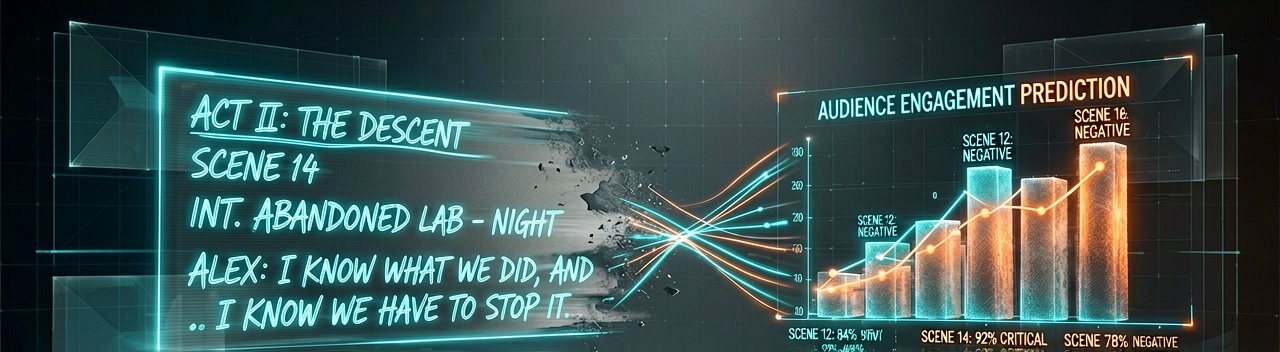
The physical reality of using these tools differs sharply from traditional development. Instead of waiting until a film is made to see it, creators can now visualize concepts before committing to production budgets. The friction of coordinating multiple departments around a shared vision gets reduced to clicking through generated storyboards rather than scheduling endless meetings.
Whether this actually levels the playing field or simply creates another layer of competition remains to be seen. Streamers have spent years building proprietary data moats; independent creators now have tools to mimic that advantage. But the real question is whether having better data actually translates to better commissions or just more polished pitches that still get rejected.
Bird's 15 years at Amazon gave him firsthand experience with how technology reduces costs and improves decision-making. He's bringing that ethos to the UK content creation space. The industry sits on the precipice of significant change, and these tools are positioned to help creators bring visions to screen more easily than ever before.
That said, the film industry has seen plenty of "game-changing" tools that ultimately just added another step to an already exhausting process. Whether filmmakers actually pay for this or whether it becomes another checkbox in the development pipeline is the real test. Time will tell if data-driven development helps or just creates more anxiety before the cameras even roll.
Artūras Malašauskas is an AI Systems Integrator with 20+ years of production-grade web engineering experience. He has designed, shipped, and scaled enterprise Python/PHP systems for logistics, SaaS, and public-sector clients. For the past year, he has focused exclusively on AI integrations: deploying open-source LLMs, building generative media pipelines (image, audio, video), and engineering multi-agent workflows for real production environments. His standard: reproducibility, security, cost-efficient inference—no vaporware. He documents and evaluates emerging AI tooling, separating verified capabilities from marketing noise. Technical editor at: muza-ai.eu, ai-verslas.lt, ai-naujinos.lt Connect on LinkedIn
Comments