Mistral Medium 3.5 Unifies Chat, Reasoning, and Code in 128B Model
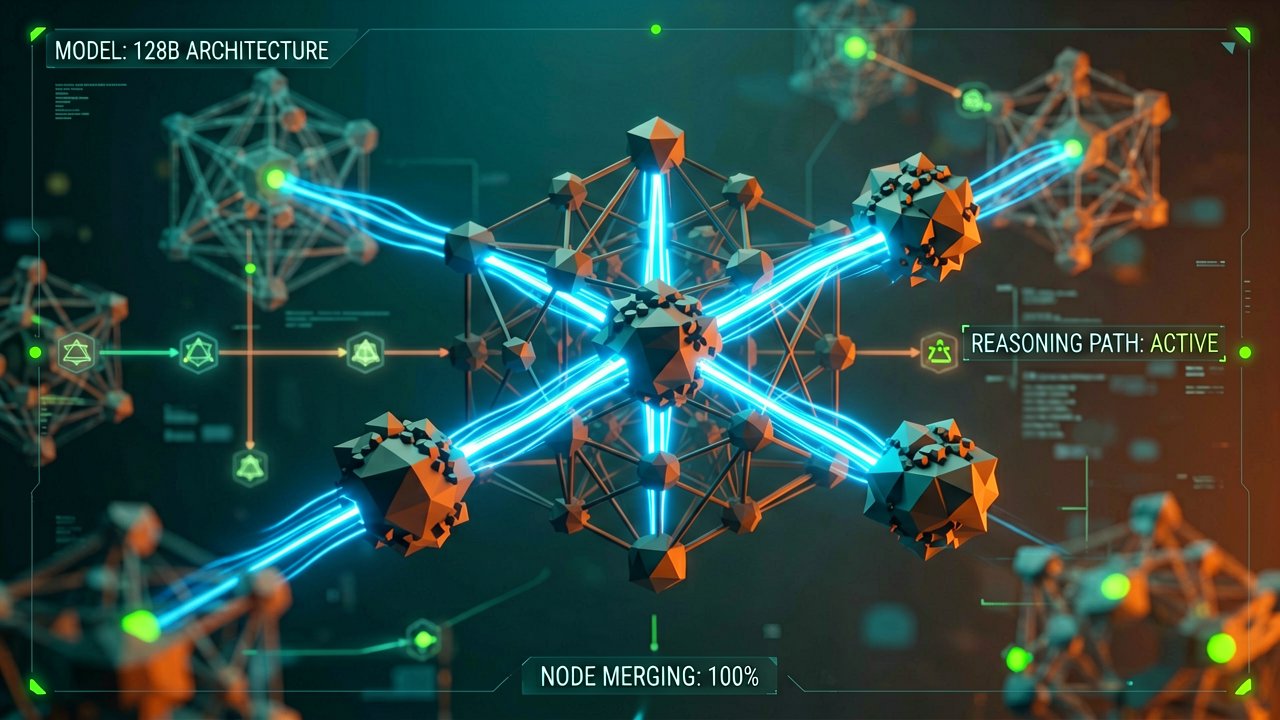
Mistral AI launched Medium 3.5 on April 29, 2026, consolidating chat, reasoning, and code capabilities into a single 128-billion-parameter dense model. The release replaces three separate endpoints—Mistral Medium 3.1, Magistral, and Devstral 2—with one unified weight set that handles instruction-following, reasoning, and coding in a single deployment.
The architecture departs from the Mixture-of-Experts approach used in Mistral Large 3, which activated 41 billion parameters per token out of 675 billion total. Medium 3.5 loads all 128 billion parameters for every token generated, trading sparsity for predictable per-token costs and a smaller GPU footprint. This matters when capacity planning must land inside a fixed datacenter budget.
According to the official Mistral AI announcement, the model carries a 256,000-token context window and runs on as few as four GPUs. Pricing sits at $1.50 per million input tokens and $7.50 per million output tokens. The company markets it as "a system that can run on just four GPUs, yet delivers outstanding real-world performance."
Reasoning effort is now configurable per request. Developers toggle between a fast instant reply mode and a reasoning mode that boosts performance with test-time compute when needed. This single endpoint replaces the routing complexity of choosing between a chat model, a reasoning model, and a code model. One billing line, one runtime flag, and the model decides how hard it has to think.

Self-hosting on four GPUs lowers the deployment floor for enterprises that want to keep weights inside their own networks. The physical reality of this change: fewer GPU cards to rack, less power draw, and a simpler procurement process for IT teams who've spent months negotiating hardware contracts.
License terms shifted more quietly than the model specs. Medium 3.5 weights ship on Hugging Face under a Modified MIT License that allows commercial and non-commercial use but carves out specific revenue thresholds. This is a step away from the Apache 2.0 license used for Mistral Large 3. The carve-outs matter for vendors shipping the weights inside a paid product: Apache 2.0 let resellers redistribute Large 3 with no revenue gate, while the new license routes higher-revenue commercial users back through Mistral's paid channels.
Benchmarks show Medium 3.5 scoring 77.6 percent on SWE-Bench Verified and 91.4 percent on T3-Telecom. The company claims the model outperforms Devstral 2 and Qwen3.5 397B A17B in coding and agentic benchmarks. Independent reviewers were not uniformly impressed. Pedro Domingos, a machine learning professor at the University of Washington, was unsparing and followed up with a sharper question on whether Europe is better or worse represented in the AI race by Mistral's posture.
"Regular AI companies brag about how much better their model is on benchmarks. Only Mistral brags about how much worse its one is."
Mistral paired the model with two surfaces it wants enterprises to use in practice. Vibe remote agents extend the company's coding tool into the cloud, where each agent runs in an isolated sandbox, can open a pull request when finished, and integrates with GitHub, Linear, Jira, Sentry, and Slack. The cloud agents run on workflows from Mistral Studio, originally developed for internal and enterprise use, so the connector matrix arrives with patterns Mistral has already validated against paying customers.
A second surface adds a Work Mode to Le Chat, running on Medium 3.5 with a new agent harness that sustains sessions across many turns. Connectors to mailboxes and calendars are enabled by default, and Le Chat requires explicit approval before sensitive actions go through. Every tool call and thinking rationale is visible to the user. This is less of an evolution and more of a coat of paint on a rusted gate—familiar patterns repackaged for enterprise workflows.
The vision encoder was trained from scratch to handle variable image sizes and aspect ratios. Multimodal input accepts both text and image input with text output. The model supports dozens of languages including English, French, Spanish, German, Italian, Portuguese, Dutch, Chinese, Japanese, Korean, and Arabic. System prompt adherence is strong, and native function calling with JSON output is built in.
Competitive pressure is real. Alibaba's Qwen 3.6 scores 72.4 percent on SWE-Bench Verified at roughly a quarter of the cost. Medium 3.5 lands as the only non-Chinese open-weight flagship aimed at a leaderboard already topped by Alibaba's Qwen, GLM from Zhipu AI, and Xiaomi's MiMo-V2. The release is a commercial bet from a company valued at $14 billion.
For developers used to picking between a chat model, a reasoning model, and a code model, the toggle is the practical change. Routing a chat-style query through the lighter setting and reserving the heavier mode for an agent that has to plan a multi-step refactor or read a long codebase keeps latency and token costs of the trivial cases close to where Medium 3.1 sat. Meanwhile, the harder calls get a reasoning budget that used to live in a separate Magistral endpoint.
Deployment options include vLLM, llama.cpp, LM Studio, SGLang, and Transformers. The model is also available on NVIDIA build.nvidia.com endpoints and as an NVIDIA NIM containerized microservice. A modest benchmark lead over a much smaller Qwen, a premium API price, and license carve-outs explain why the developer reaction has stayed combative since launch day.
Whether users actually pay for it remains the real question. The model works, the specs check out, and the unified architecture simplifies deployment. But the license shift and pricing position it squarely against cheaper alternatives that may not need to justify every token with a revenue carve-out.
Artūras Malašauskas is an AI Systems Integrator with 20+ years of production-grade web engineering experience. He has designed, shipped, and scaled enterprise Python/PHP systems for logistics, SaaS, and public-sector clients. For the past year, he has focused exclusively on AI integrations: deploying open-source LLMs, building generative media pipelines (image, audio, video), and engineering multi-agent workflows for real production environments. His standard: reproducibility, security, cost-efficient inference—no vaporware. He documents and evaluates emerging AI tooling, separating verified capabilities from marketing noise. Technical editor at: muza-ai.eu, ai-verslas.lt, ai-naujinos.lt Connect on LinkedIn
Comments