NVIDIA DLSS 4.5 SDK Now Available for Unreal Engine 5 Game Development
Game developers can now begin integrating NVIDIA DLSS 4.5 into their projects, marking another iteration in the company's AI-driven rendering pipeline. The update brings Dynamic Multi Frame Generation, Multi Frame Generation 6X, and a second-generation transformer model for Super Resolution to the Unreal Engine ecosystem.
The announcement came via NVIDIA Developer's official blog post, which details the SDK availability and integration pathways for developers working on both new and existing titles.
DLSS 4.5 extends the foundation laid by DLSS 4, which already achieved support in more than 250 games and applications with Multi Frame Generation. Overall, DLSS technologies now span over 700 games and apps, making it one of the fastest-adopted gaming technologies from NVIDIA.
At CES 2026, NVIDIA introduced the core DLSS 4.5 features. The second-generation transformer model for Super Resolution delivers improved image quality, while Dynamic Multi Frame Generation allows the frame multiplier to adjust automatically during gameplay. This means the technology can hit a player's target frame rate or match their display's refresh rate without manual intervention.
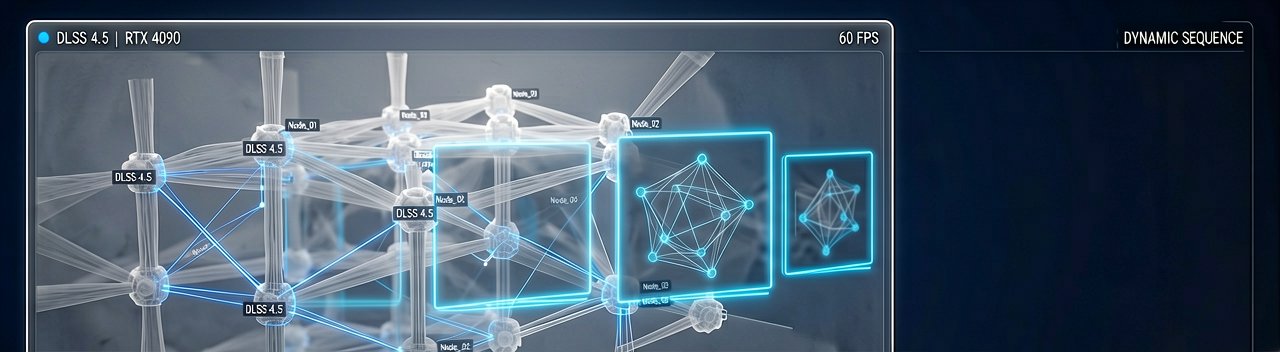
Multi Frame Generation 6X can generate up to five additional frames per rendered frame. That's a significant jump from previous iterations, though it requires GeForce RTX 50 Series GPUs with fifth-generation Tensor Cores. The physical reality here matters: developers need to test on actual hardware, not just emulators, because the Tensor Core workload behaves differently than traditional rasterization pipelines.
The DLSS 4.5 SDK is built on Streamline, NVIDIA's open-source cross-IHV solution. This framework simplifies integration by allowing developers to implement a single integration path while enabling multiple super resolution technologies. Updated APIs, documentation, and sample code help reduce integration time.
For Unreal Engine specifically, the official DLSS plugin provides access to Multi Frame Generation, Frame Generation, Ray Reconstruction, Super Resolution, DLAA, Reflex Low Latency, and NVIDIA Image Scaling. The plugin works with Unreal Engine 5.7.2's RTX Branch, which includes new features like path-traced hair.
Independent reporting from NVIDIA GeForce news confirms the timeline and lists upcoming game titles incorporating DLSS 4.5, including 007 First Light, CONTROL Resonant, and Tides of Annihilation.
007 First Light, developed by IO Interactive, will launch with native support for DLSS 4.5 Dynamic Multi Frame Generation and DLSS Ray Reconstruction. The game's visuals will be fully path traced, maximizing both frame rates and image quality on GeForce RTX PCs and laptops.
From March 31st, GeForce RTX 50 Series gamers can accelerate their favorite games with DLSS 4.5 Dynamic Multi Frame Generation and 6X Multi Frame Generation using the NVIDIA app. An official release will follow at a later date, but the beta is available via Settings > About in the NVIDIA app.
GeForce Game Ready Driver 595.79 WHQL or newer is required to use all new features. That's a hard requirement—older drivers simply won't expose the necessary APIs.
Beyond rendering, NVIDIA is pushing AI integration deeper into the development workflow. The TensorRT for RTX plugin provides a runtime for Unreal Engine's Neural Network Engine (NNE), enabling efficient deployment of AI models directly within real-time applications.
In practice, developers can see 1.5x performance improvements compared to DirectML-based approaches. This makes it easier to integrate responsive AI-driven features into games while maintaining strong performance on consumer hardware.
NVIDIA Kimodo represents another frontier: a research project exploring kinematic motion generation for interactive applications. Built as a motion generation model, Kimodo can synthesize realistic 3D character animation from simple inputs like text, keyframes, or trajectory constraints.
For game developers, this highlights a path toward more scalable animation workflows. Instead of relying entirely on authored or captured animation clips, developers can generate motion data to prototype behaviors, create variations, or fill gaps between animations. This reduces iteration time while maintaining consistency with existing animation systems.
ComfyUI, an open-source node-based workflow platform, runs locally on all NVIDIA RTX GPU platforms. It connects image generation, video synthesis, 3D object generation, and language models into pipelines that teams own and customize without cloud dependencies.
NVIDIA has published a guide walking creators through three production-ready workflows from the GenAI Creator Toolkit. Each workflow runs on any NVIDIA RTX GPU with 16 GB or more of VRAM and works on both Windows and Linux.
At GDC and GTC 2026, NVIDIA hosted more than a dozen sessions highlighting how RTX neural rendering and AI are defining the next era of gaming. Standout sessions include discussions on path tracing best practices, what's new in RTX for Unreal Engine 5, and real-time path tracing implementations in RE ENGINE for Resident Evil Requiem and PRAGMATA.
The April "Level Up with NVIDIA" webinar focused on path-traced hair in Unreal Engine 5.7. It covered the latest updates in the NVIDIA RTX Branch, including optimization opportunities and image quality improvements when using RTX technologies.
Whether studios actually adopt these tools at scale remains the real question. The SDK is available, the documentation exists, and the hardware requirements are clear. But integration time, QA overhead, and the need for RTX 50 Series hardware for full feature support create friction points that not every studio can absorb.
DLSS 4.5 represents another step in NVIDIA's strategy of bundling AI capabilities into their graphics stack. The technology works, the benchmarks are promising, and the developer tools are genuinely useful. Whether that translates to widespread adoption depends on whether the performance gains justify the integration costs for smaller studios.
Artūras Malašauskas is an AI Systems Integrator with 20+ years of production-grade web engineering experience. He has designed, shipped, and scaled enterprise Python/PHP systems for logistics, SaaS, and public-sector clients. For the past year, he has focused exclusively on AI integrations: deploying open-source LLMs, building generative media pipelines (image, audio, video), and engineering multi-agent workflows for real production environments. His standard: reproducibility, security, cost-efficient inference—no vaporware. He documents and evaluates emerging AI tooling, separating verified capabilities from marketing noise. Technical editor at: muza-ai.eu, ai-verslas.lt, ai-naujinos.lt Connect on LinkedIn
Comments