NVIDIA Unveils Nemotron 3 Nano Omni for Multimodal Enterprise Agents

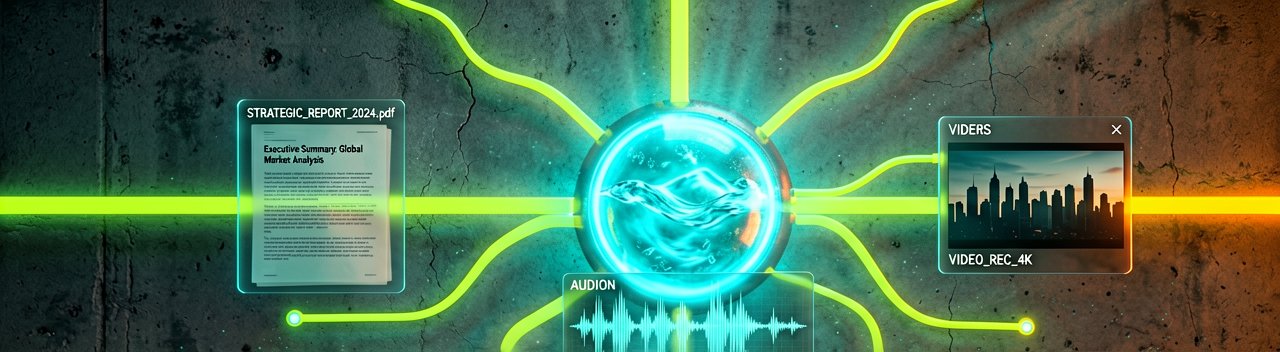
NVIDIA has released Nemotron 3 Nano Omni, an open multimodal model designed to handle text, images, audio, and video within a single unified system. The announcement landed on April 28, 2026, with checkpoints available through Hugging Face alongside official documentation and training recipes.
This isn't just another vision-language model with audio tacked on. The architecture combines a hybrid Mamba-Transformer Mixture-of-Experts backbone with dedicated vision and audio encoders. Specifically, it pairs the Nemotron 3 Nano 30B-A3B language backbone with C-RADIOv4-H for visual processing and Parakeet-TDT-0.6B-v2 for audio. The result is a system that can reason across modalities rather than just process them sequentially.
Performance claims are aggressive. NVIDIA states the model delivers 9x higher throughput and 2.9x single-stream reasoning speed compared to alternatives with similar interactivity. On benchmarks, it scores 65.8 on OCRBenchV2-En for document understanding, 72.2 on Video-MME for video comprehension, and 89.4 on VoiceBench for audio tasks. These numbers matter because they represent real-world constraints—enterprise documents aren't clean, meetings have background noise, and screen recordings run for hours.
The model targets five specific workload categories. First, real-world document analysis beyond simple OCR. Think contracts, technical papers, compliance packets, and multi-page forms where understanding depends on layout, tables, figures, and cross-page references. The model handles 100+ page documents natively.

Second, automatic speech recognition across diverse audio conditions. Long-form audio with varying speakers, accents, and background noise gets transcribed and analyzed. Third, long audio-video understanding for screen recordings with narration, training videos, meetings with slides, and customer support captures. Fourth, agentic computer use—interpreting screenshots, monitoring UI state, and helping with workflow automation in graphical environments. Fifth, general multimodal reasoning that synthesizes information across long context windows.
Under the hood, the architecture interleaves three components: 23 Mamba selective state-space layers for efficient long-context processing, 23 MoE layers with 128 experts using top-6 routing, and 6 grouped-query attention layers for global interaction. This hybrid design maintains reasoning performance while scaling to very long multimodal contexts (which drastically reduces latency for enterprise workflows, frankly).
Adoption is already moving. Companies including Aible, Applied Scientific Intelligence, Eka Care, Foxconn, H Company, and Palantir have adopted the model. Dell Technologies, DocuSign, Infosys, Oracle, and Zefr are evaluating it. Vultr, the cloud infrastructure provider, announced deployment of Nemotron 3 Nano Omni on dedicated GPU clusters and through its serverless inference service accelerated by NVIDIA Dynamo 1.0.
J.J. Kardwell, CEO of Vultr, stated the company embraced NVIDIA Nemotron to reinvent enterprise AI inference. The deployment enables developers to access the model without unnecessary lock-in or developer overhead. Later this year, Vultr plans to expand NVIDIA Dynamo deployment into its fleet of next-generation NVIDIA Vera Rubin platform systems.
From a developer perspective, the model is available with open weights, datasets, and training techniques. Organizations can customize it using NVIDIA NeMo tools and deploy across environments from local systems to cloud platforms. Checkpoints come in BF16, FP8, and NVFP4 formats. The Nemotron 3 family has recorded over 50 million downloads in the past year.
Physical interaction matters here. When an agent interprets a full HD screen recording at 1920×1080 pixel resolution, it's not just recognizing pixels—it's grounding reasoning in on-screen visuals, monitoring UI state changes, and selecting actions. That's the difference between a chatbot and an agent that can actually navigate software.
Efficiency highlights show 7.4x higher system efficiency for multi-document use cases and 9.2x for video use cases compared to other open omni models with the same interactivity. These gains compound when you're running multiple agents simultaneously or processing archival video content.
The training recipe uses staged multimodal alignment and context extension, followed by preference optimization and multimodal reinforcement learning. Documentation from NVIDIA details the architecture, training recipe, data pipelines, and benchmarks for those building on the foundation.
Whether enterprises actually pay for this infrastructure remains the real question. The model is open, but running it requires serious GPU resources. The 30B-A3B architecture means 30 billion total parameters with 3 billion activated per forward pass. That's efficient for a model of this capability, but still demands hardware that costs money.
Time will tell if the throughput gains translate to cost savings at scale. For now, the technical specifications are clear and the benchmarks are public. The market will decide if multimodal agents deliver enough value to justify the compute investment.
Artūras Malašauskas is an AI Systems Integrator with 20+ years of production-grade web engineering experience. He has designed, shipped, and scaled enterprise Python/PHP systems for logistics, SaaS, and public-sector clients. For the past year, he has focused exclusively on AI integrations: deploying open-source LLMs, building generative media pipelines (image, audio, video), and engineering multi-agent workflows for real production environments. His standard: reproducibility, security, cost-efficient inference—no vaporware. He documents and evaluates emerging AI tooling, separating verified capabilities from marketing noise. Technical editor at: muza-ai.eu, ai-verslas.lt, ai-naujinos.lt Connect on LinkedIn
Comments