Google Tears Up the LLM Script with DiffusionGemma, a Non-Sequential Powerhouse
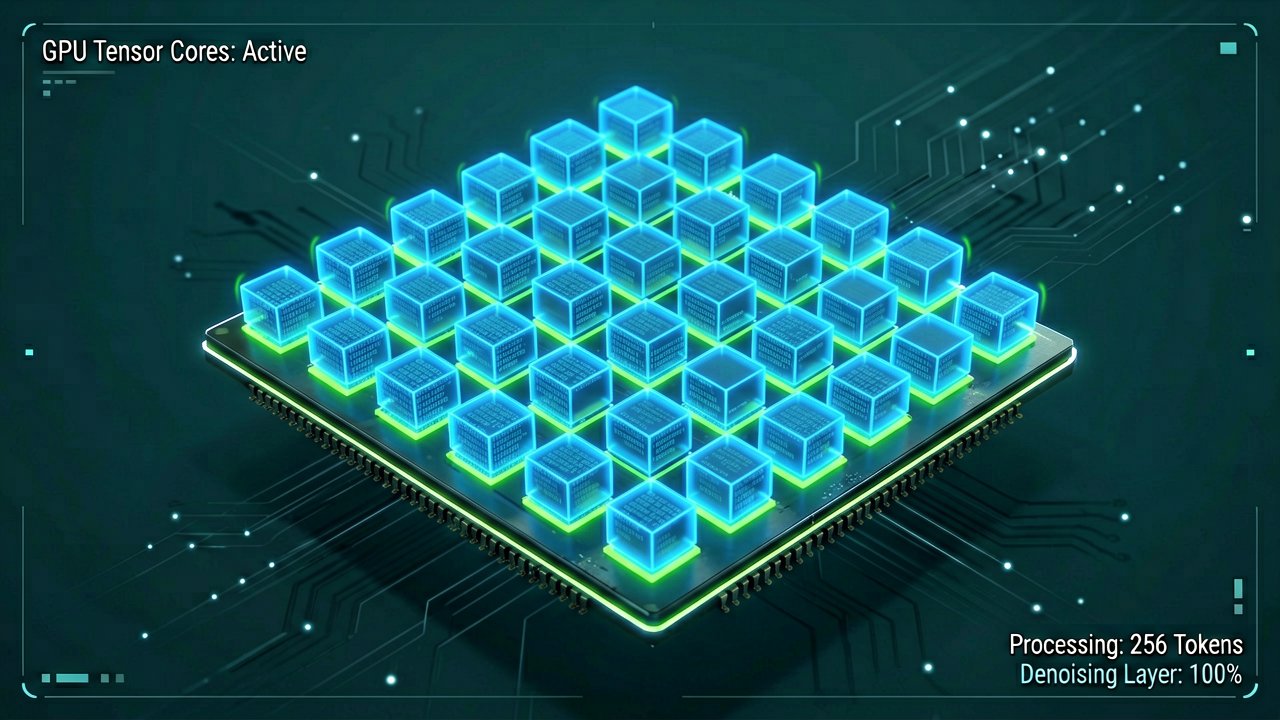
Google DeepMind shattered the traditional AI paradigm on June 10, 2026, by introducing DiffusionGemma, an experimental open-weights language model that abandons standard word-by-word text generation. Instead of acting like a digital typewriter spitting out one token at a time from left to right, this architecture borrows a trick from image-generation systems. It throws a 256-token canvas of random placeholder noise onto the screen and refines the entire block simultaneously, essentially transforming how hardware handles complex sequential data.
For years, local AI deployments have suffered from a persistent memory-bandwidth bottleneck because graphics cards spend more time waiting to fetch weights for the next token than they do actually computing. By printing massive 256-token paragraphs in parallel, DiffusionGemma shifts the execution bottleneck entirely to raw compute, letting local GPUs flex their tensor cores to their maximum potential. While it might sound like a niche engineering flex, this approach represents a massive architectural pivot away from the autoregressive dominance that has defined generative AI since the dawn of ChatGPT.
Breaking the Typewriter Bottleneck
To truly understand why this matters, you have to look at how traditional transformers choke on local hardware. When you run an AI model in the cloud, providers can batch thousands of user requests together to keep their heavy iron fully saturated. On a local workstation, a standard model leaves your desktop GPU sitting idle for a massive percentage of the generation cycle. According to a technical deep dive from Google Developers Blog, DiffusionGemma tackles this by replacing causal token generation with discrete text diffusion, enabling a block-autoregressive multi-canvas sampling technique.
The model relies on bidirectional attention inside each canvas block, which means every single token position can look forward and backward at every other position at the same time. If the model feels shaky about a word choice midway through a sentence, it uses a re-noising sampler to self-correct and swap the token out during a subsequent pass. Once a 256-token chunk is completely denoised and finalized, it locks into the context cache, and the system initializes a fresh canvas to start the process all over again.
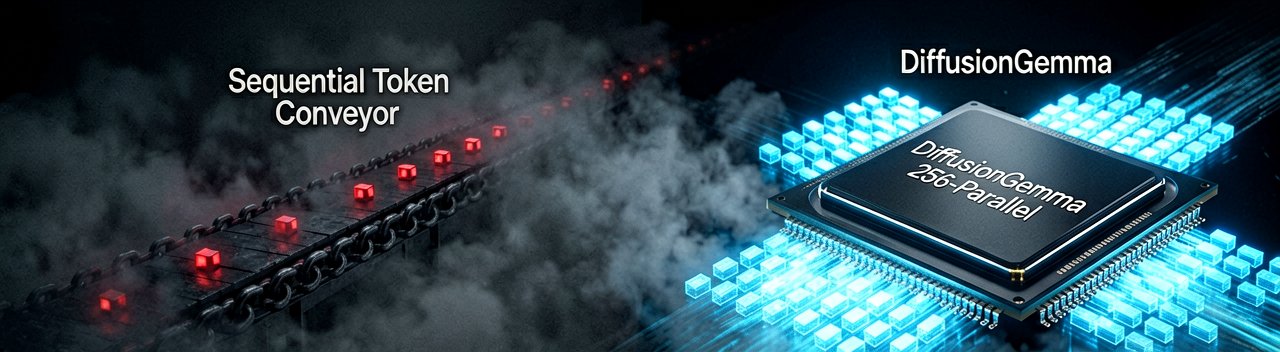
The Real-World Speed Gains and Quality Trade-offs
The payoff for this mechanical rewrite is raw, unadulterated speed for single-user scenarios. Benchmark data shows that DiffusionGemma can push text generation speeds up to four times faster than its traditional counterparts on dedicated hardware, blowing past 1,000 tokens per second on an enterprise Nvidia H100 and clocking more than 700 tokens per second on a consumer-grade GeForce RTX 5090, as reported by Ars Technica. This lightning-fast latency makes it a dream for developers building interactive inline editing tools, real-time code infilling, or complex mathematical layouts where responsiveness is paramount.
However, this blistering speed does come with a caveat that Google isn't trying to hide. Built on top of the 26-billion parameter Mixture-of-Experts backbone found in the Gemma 4 family, the model actively utilizes only about 3.8 billion parameters during inference, leading to a noticeable dip in general reasoning and conversational quality compared to standard models. As highlighted by VentureBeat, Google openly recommends sticking with the standard autoregressive Gemma 4 variants for applications where maximum output quality and nuanced logic outweigh raw speed. It is best to look at DiffusionGemma not as a direct replacement for production chatbots, but as an incredibly valuable research artifact proving that the post-autoregressive future of AI is closer than we think.
What Most Reports Miss: The Architectural Bet Against Sequential Slavery
Look closely at the history of generative AI, and you will find an industry trapped by the very mathematical trick that made it famous. The autoregressive loop has dominated the landscape since 2017, functioning as a beautiful but deeply inefficient sequence of dominoes. Every time an AI writes a word, it must read everything it has written before, run a massive matrix multiplication, and guess the next single syllable. It is a brilliant strategy for maximizing predictability, but it turns the world’s most powerful AI supercomputers into glorified sequential assembly lines. DiffusionGemma’s arrival represents a desperate, necessary jailbreak from this compute-bound prison.
By forcing the system to predict an entire 256-token canvas at once, Google’s researchers are betting on an approach called discrete text diffusion. This technique essentially treats a block of text like a blurry JPEG that slowly snaps into focus. Instead of adding words linearly from left to right, the model adjusts the semantic probability of every slot in the paragraph simultaneously over several iterative passes. In practice, this completely upends how developers approach localized AI hardware utilization, shifting the operational bottleneck away from memory bandwidth—which has plagued edge AI deployment for years—and back to the raw, brute-force math capabilities of modern tensor cores.

Silicon architects and local software engineers are watching this shift with intense interest. Under the old left-to-right regime, a consumer graphics card running a local large language model often hovers around a depressing ten to fifteen percent utilization rate because the GPU spends most of its clock cycles waiting for memory to fetch model weights for the next single token. With a 256-token canvas, the data stays loaded on the chip while the processor frantically recalculates the relationships across the entire block. This structural rewrite finally allows consumer hardware to stretch its legs, transforming high-end gaming rigs into hyper-efficient local AI workstations that can run sophisticated workflows without sending data to a corporate cloud.
Yet, within the open-source community, this paradigm shift is met with a healthy dose of journalistic skepticism regarding the immediate creative utility of the technology. Writers and prompt engineers who have experimented with early open-weights releases note that text diffusion struggles heavily with long-form narrative coherence and stylistic nuance. Because the model is trying to solve an entire paragraph simultaneously, it occasionally hallucinates bizarre, ungrammatical compound words or loses the thematic thread by the time it reaches the end of a canvas block. It acts less like a deliberate, focused storyteller and more like a frantic speed-painter throwing broad strokes of meaning onto a canvas and desperately refining them before the timer runs out.
Ultimately, Google’s strategy here is not about delivering a flawless chatbot to compete with mainstream consumer apps tomorrow; it is about establishing a foundational beachhead for the next decade of AI infrastructure. By open-sourcing the DiffusionGemma weights, the tech giant is effectively crowdsourcing the refinement of non-sequential sampling algorithms to global research labs and indie developers. As the broader industry begins to hit a ceiling on what traditional autoregressive models can achieve through scale alone, this pivot toward parallel text processing provides a critical alternative pathway, proving that the future of machine intelligence might rely less on how fast an AI can think, and more on how much it can comprehend at a single glance.
Reading Between the Lines: The Illusion of Speed Versus the Reality of Reason
The tech industry’s obsession with raw metrics has a funny way of blinding us to structural compromises, and the breathless praise surrounding DiffusionGemma’s four-fold speed increase is a textbook example. On paper, crossing the thousand-tokens-per-second threshold looks like a triumphant leap forward for local computing hardware. In reality, this blistering velocity masks an uncomfortable truth about how the model actually thinks—or rather, fails to. By reducing its active parameter count to just 3.8 billion per inference pass, Google has essentially traded the deep, associative intellect of its larger Mixture-of-Experts architecture for a hyper-caffeinated text engine that operates at a fraction of its baseline cognitive capacity.
This trade-off exposes a glaring contradiction in the current push for post-autoregressive AI models. We are told that parallel processing represents a more human-like way of creating, supposedly mirroring how a writer maps out an entire paragraph in their mind before committing ink to paper. Yet, human cognition does not function by generating a cloud of randomized linguistic noise and iteratively filtering out nonsense until a coherent sentence remains. By forcing text into an architectural framework originally designed to render pixels, DiffusionGemma often trades semantic depth for physical structure, resulting in a system that can draft a complex mathematical table in milliseconds but completely misses the logical nuance required to solve a basic logic puzzle.
Furthermore, the economic and operational narrative pushed by major tech players regarding local AI sovereignty deserves a healthy dose of skepticism. While the ability to maximize consumer GPU utilization sounds like a win for open-source independence, the sheer computational overhead of running multiple denoising passes over a 256-token canvas cancels out a significant portion of the hardware’s power efficiency. A system that pegs a desktop graphics card at one hundred percent utilization for bursts of text generation is pulling maximum wattage from the wall, shifting the financial burden of AI operation from cloud server farms directly onto the user's electricity bill.
Looking forward, the true value of DiffusionGemma will likely not be found in the text-generation market at all, but rather in how its non-sequential architecture can be hijacked for entirely different data structures. Synthetic biology, genomic sequencing, and advanced materials design all rely on massive, non-linear sequences where information flows back and forth simultaneously rather than left-to-right. In these highly specialized scientific domains, where human-like conversational nuance is irrelevant and raw pattern-matching speed across a fixed canvas is everything, Google’s architectural experiment could quiet the skeptics and deliver genuine, industry-shifting breakthroughs.
"We have spent years demanding that artificial intelligence slow down, think deeply, and act with human-like deliberation. Google’s brilliant solution is a model that prints nonsense at lightning speed and fixes its own typos before you notice—proving that in the AI arms race, looking busy at a thousand tokens per second is almost as good as actually knowing the answer."
Artūras Malašauskas is an AI Systems Integrator with 20+ years of production-grade web engineering experience. He has designed, shipped, and scaled enterprise Python/PHP systems for logistics, SaaS, and public-sector clients. For the past year, he has focused exclusively on AI integrations: deploying open-source LLMs, building generative media pipelines (image, audio, video), and engineering multi-agent workflows for real production environments. His standard: reproducibility, security, cost-efficient inference—no vaporware. He documents and evaluates emerging AI tooling, separating verified capabilities from marketing noise. Technical editor at: muza-ai.eu, ai-verslas.lt, ai-naujinos.lt Connect on LinkedIn
Comments