Kingston Unveils 30.72TB Gen5 U.2 SSD for Enterprise Data Centers
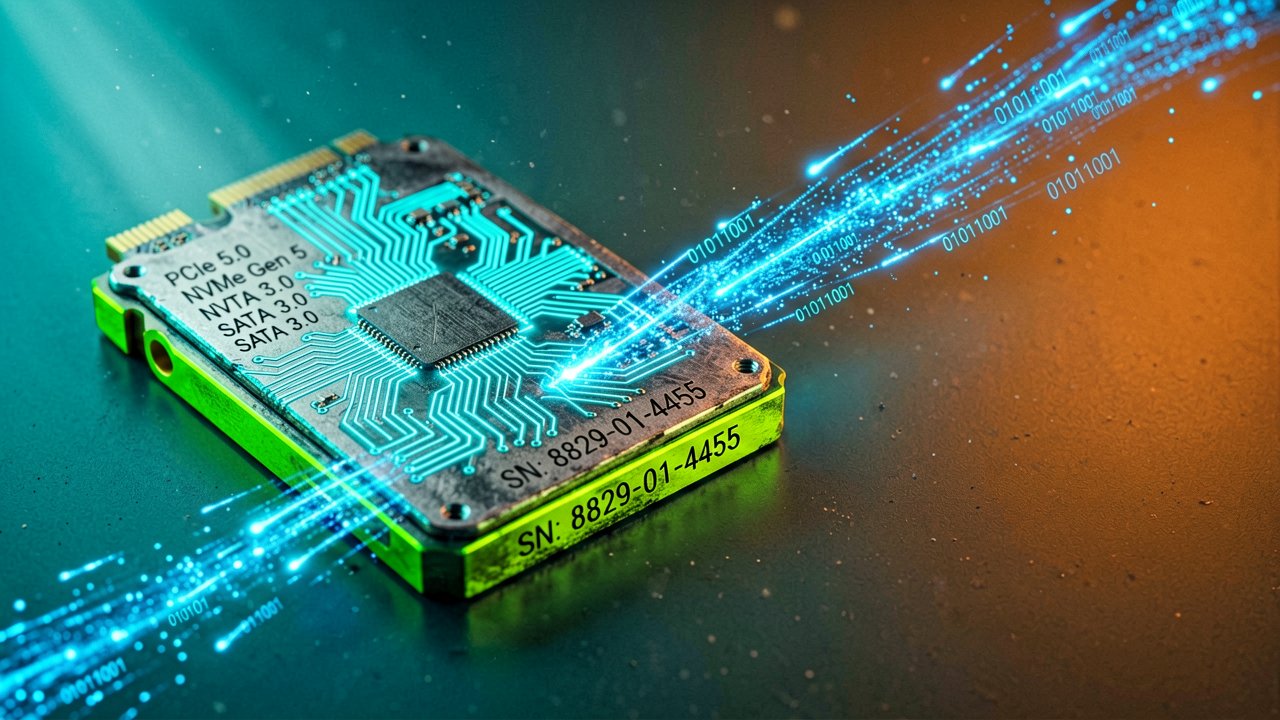
The storage density arms race just got another participant. Kingston announced the DC3000ME Gen5 U.2 NVMe SSD with a new 30.72TB capacity tier, expanding its data center portfolio to meet the escalating storage demands of AI and high-performance computing environments. The announcement came via Kingston's official press release on April 27, 2026.
This isn't a consumer drive you'll find in a retail box. The DC3000ME uses a U.2 form factor, the standard hot-pluggable connector for enterprise servers. That means data center technicians can slide it into a chassis without shutting down the system. The physical reality matters here: a single 30.72TB drive replaces what would have been multiple smaller drives, reducing cable clutter and power consumption in tightly packed server racks.
Performance specifications are aggressive. Sequential read speeds reach 14GB/s over the PCIe 5.0 NVMe interface. Random read performance tops out at 2.8 million IOPS. For context, that's the kind of throughput needed when training large language models or running real-time analytics on massive datasets. The drive also maintains full backward compatibility with PCIe 4.0 systems, allowing organizations to deploy it across mixed server environments while preparing for future platform upgrades.
Kingston built the DC3000ME with 3D eTLC NAND flash memory. The "eTLC" designation indicates enterprise-grade TLC (triple-level cell) NAND, which balances cost and endurance better than MLC or SLC alternatives for most data center workloads. On-board power loss protection (PLP) safeguards data during unexpected power failures—a critical feature when a single drive failure could mean hours of lost productivity or corrupted datasets.

Security features include AES 256-bit encryption and TCG Opal 2.0 self-encrypting drive (SED) capabilities. These help organizations meet compliance requirements without adding external encryption appliances to the infrastructure. The drive handles encryption at the hardware level, which means the CPU doesn't need to dedicate cycles to the task. That's a small optimization, but in a data center running thousands of drives, those saved cycles add up.
Cameron Crandall, data center SSD business manager at Kingston, called the 30.72TB launch "an important milestone" for the company's data center portfolio. He noted that customers are looking to maximize storage density without compromising performance or reliability. The DC3000ME with 30.72TB delivers exactly that, according to the company's messaging.
Independent coverage from TechPowerUp corroborates the technical specifications and warranty terms. All DC3000ME capacities, including the newly launched 30.72TB model, carry a 5-year limited warranty. That's standard for enterprise SSDs, though some competitors offer 3-year terms on similar capacity drives.
The pricing remains unannounced. Kingston's press release doesn't mention MSRP or availability timelines beyond "now available." Enterprise SSDs typically sell through distribution channels rather than direct retail, so pricing will vary based on volume, region, and negotiation. Expect the 30.72TB variant to command a premium over lower-capacity models in the DC3000ME family.
Competitive positioning is interesting. Samsung, Seagate, and Western Digital all offer Gen5 enterprise SSDs in similar capacity ranges. The 30.72TB tier isn't new to the market, but Kingston's entry adds another vendor option for procurement teams. More competition typically drives down prices and accelerates innovation, though the enterprise storage market moves slower than consumer hardware.
Thermal management deserves mention. PCIe 5.0 drives generate significant heat during sustained workloads. The U.2 form factor includes provisions for heatsinks and thermal pads, but data center operators need to ensure their server chassis can handle the thermal load. A drive running at 70°C consistently will throttle performance and potentially reduce lifespan. (Nobody wants to replace enterprise SSDs every 18 months.)
The DC3000ME targets three primary workloads: AI training and inference, high-performance computing, and cloud infrastructure. Each has different performance characteristics. AI workloads favor sequential throughput for loading model weights. HPC applications need consistent low-latency random access. Cloud environments require a balance of both plus high reliability. Kingston's specifications suggest the DC3000ME can handle all three, though real-world performance will depend on workload patterns and server configuration.
Power consumption isn't explicitly stated in the press release. Enterprise SSDs typically draw 20-30W during peak operation, with idle power around 3-5W. A 30.72TB drive will likely be on the higher end of that range. Multiply that by hundreds of drives in a data center, and power costs become a significant operational expense. Kingston's 3D eTLC NAND should offer reasonable efficiency, but the numbers matter for total cost of ownership calculations.
Endurance ratings (TBW—terabytes written) are also absent from the announcement. Enterprise SSDs typically rate 1-3 DWPD (drive writes per day) over their warranty period. A 30.72TB drive at 1 DWPD would handle 30.72TB of writes daily for five years. That's 56,000TB total over the warranty period. Without official TBW figures, procurement teams will need to request detailed specifications from Kingston's sales channel.
The timing aligns with broader industry trends. AI infrastructure spending continues to surge, and storage is a bottleneck for many deployments. Training large models requires massive datasets that must be read quickly and repeatedly. Gen5 SSDs provide the bandwidth needed to keep GPUs fed with data. The alternative—spinning hard drives—simply can't keep up with modern AI workloads.
Whether users actually pay the premium for 30.72TB capacity remains the real question. Many data centers still run on PCIe 4.0 infrastructure, where the DC3000ME will operate at reduced speeds. The backward compatibility is useful, but organizations investing in Gen5 storage should also invest in Gen5 servers to realize the full performance benefit. Otherwise, they're paying for bandwidth they can't use.
Kingston's 5-year warranty provides some confidence, but enterprise storage procurement involves more than specs and warranty terms. Vendor support, supply chain reliability, and integration with existing management tools all factor into the decision. Kingston has built a reputation in the memory market, but the enterprise SSD space is more competitive and demanding.
The DC3000ME 30.72TB joins a crowded field of Gen5 enterprise SSDs. It offers solid specifications and enterprise-grade features, but the market will judge it on real-world performance, pricing, and availability. For now, it's another option for data center architects navigating the storage density challenge. Whether it becomes a preferred choice depends on factors beyond the press release.
Artūras Malašauskas is an AI Systems Integrator with 20+ years of production-grade web engineering experience. He has designed, shipped, and scaled enterprise Python/PHP systems for logistics, SaaS, and public-sector clients. For the past year, he has focused exclusively on AI integrations: deploying open-source LLMs, building generative media pipelines (image, audio, video), and engineering multi-agent workflows for real production environments. His standard: reproducibility, security, cost-efficient inference—no vaporware. He documents and evaluates emerging AI tooling, separating verified capabilities from marketing noise. Technical editor at: muza-ai.eu, ai-verslas.lt, ai-naujinos.lt Connect on LinkedIn
Comments