HP Pushes AI Workstations to Cut Cloud Reliance, Expand Local Computing
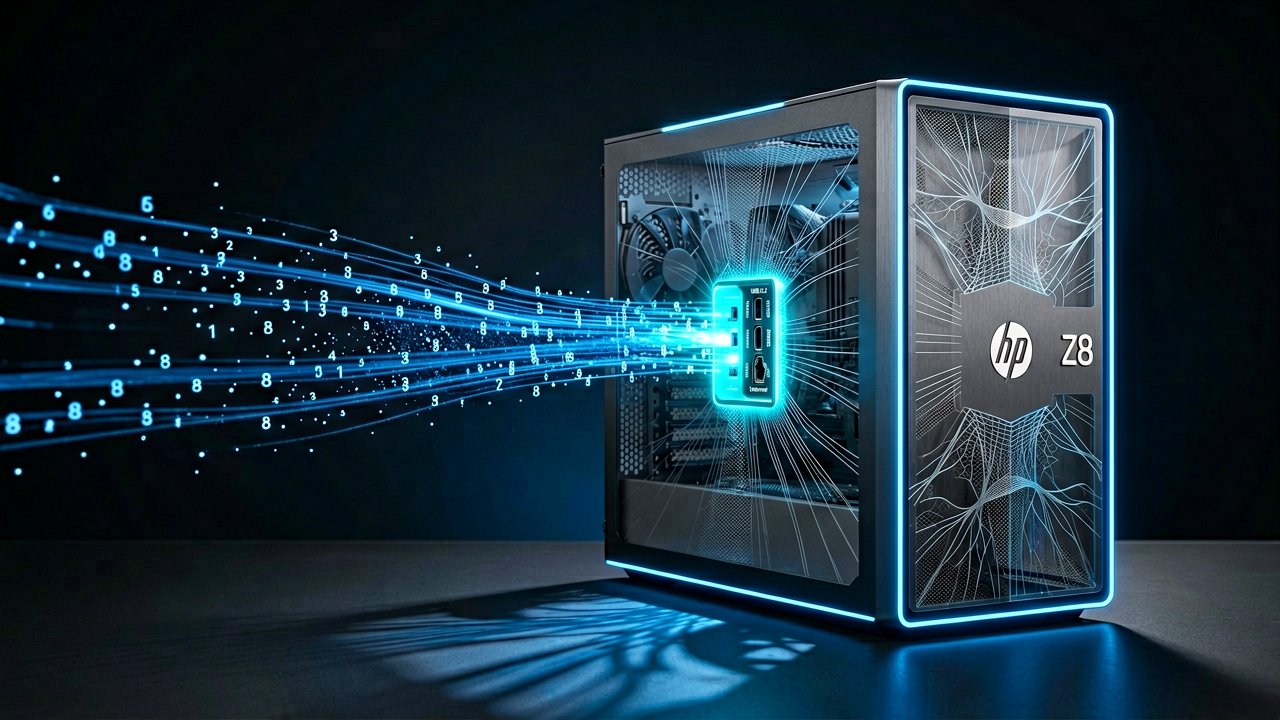
At HP Imagine 2026, HP announced a new generation of AI workstations designed to shift computing power from centralized cloud infrastructure to local devices. The company is betting that the next phase of artificial intelligence will demand more than just inference—it will require systems capable of handling agentic AI workloads directly on the workstation.
The flagship HP Z8 Fury G6i desktop workstation supports up to four NVIDIA RTX PRO 6000 Blackwell Max-Q Workstation Edition GPUs. This configuration enables AI model training, simulation, and rendering without relying on separate servers or cloud resources. According to the official HP press release, the system is purpose-built for advanced AI development and visual effects workloads.
HP introduced the HP Max Side Panel, an industry-first chassis expander that increases internal volume by 15 percent. The tool-free design allows power users to install larger graphics cards while maintaining thermal performance. It's a physical acknowledgment that workstation users need to upgrade hardware without wrestling with screws and thermal paste (a problem that has plagued users for years, frankly).
Mobile workstations received updates too. The HP ZBook X G2i and HP ZBook 8 G2i deliver workstation-class performance for professionals who need to work outside the office. The ZBook X features up to 128GB of RAM and powerful 3000-level graphics, eliminating bottlenecks during rendering tasks. A mobile engineer using Autodesk Inventor on a ZBook 8 G2i can render designs 3.3x faster according to HP's benchmarks.
The software pillar paired with the hardware is HP IQ, an on-device AI platform that performs document summarization, work automation, and file organization directly on the device. The platform aims to strengthen security by not sending data outside the device and to secure fast responsiveness without delays from cloud round trips. HP IQ also automatically recognizes connections between devices and maintains a user's work context across the workflow.
HP also presented the HP Z Boost solution, which shares GPUs on an on-demand basis to extend the limits of local devices. Initial customer deployments show up to 5.7x faster rendering in applications such as Catia and Siemens NX. The HP ZBook mobile workstations serve as ideal Boost clients while HP Z desktops serve as ideal hosts, delivering an ecosystem for accessing strong local performance anywhere.
Kang Yong-nam, head of HP Korea, said AI is now redefining not just a simple function but the way we work itself. He added that HP is creating a future of work in which each device is connected like one intelligent system. So Byeong-hong, an executive director at HP Korea, noted that the PC is evolving beyond a simple device into a platform that connects the work experience.
The business PC lineup was reshuffled on the premise of using agentic AI. The HP EliteBook 6 X G2 AI PC supports up to 85 TOPS of NPU performance for local AI computing. It supports hybrid work environments with up to 28 hours of battery life and an always-connected function. All products apply security functions based on HP Wolf Security to support stable operation in corporate environments.
Local AI computing keeps sensitive data on-device, reducing reliance on cloud-based AI services and lowering data exposure risks. The typical price range for AI-ready workstations is approximately $1,800 to $3,000 depending on configuration. This is significantly lower than cloud AI services that can range from around $5,000 to $500,000 for complex solutions.
HP's strategy is not to solve all tasks with a single product, but to choose the optimal device according to the work style and role. The company plans to continue upgrading AI workstations and its on-device AI platform in line with the full-fledged evolution of agentic AI. Whether organizations actually shift their infrastructure budgets toward local hardware remains the real question.
Artūras Malašauskas is an AI Systems Integrator with 20+ years of production-grade web engineering experience. He has designed, shipped, and scaled enterprise Python/PHP systems for logistics, SaaS, and public-sector clients. For the past year, he has focused exclusively on AI integrations: deploying open-source LLMs, building generative media pipelines (image, audio, video), and engineering multi-agent workflows for real production environments. His standard: reproducibility, security, cost-efficient inference—no vaporware. He documents and evaluates emerging AI tooling, separating verified capabilities from marketing noise. Technical editor at: muza-ai.eu, ai-verslas.lt, ai-naujinos.lt Connect on LinkedIn
Comments