OpenAI Privacy Filter: Building Scalable Web Apps with On-Device PII Detection

OpenAI has released Privacy Filter, an open-source model designed to detect and redact personally identifiable information (PII) before it reaches cloud servers. The announcement marks a notable shift toward privacy-by-design infrastructure for web applications.
The model is available on Hugging Face under a permissive Apache 2.0 license. This licensing choice matters for commercial deployment—teams can integrate Privacy Filter into proprietary products without paying royalties or opening their entire codebase.
Architecturally, Privacy Filter differs from standard large language models. While most LLMs predict tokens sequentially (autoregressive), Privacy Filter operates as a bidirectional token classifier. It reads text from both directions simultaneously, which improves context understanding for ambiguous cases. The model contains 1.5 billion total parameters, but only 50 million activate during any single forward pass. This sparse mixture-of-experts design enables high throughput without massive computational overhead.
For web developers, the 128,000-token context window is the standout feature. Traditional PII filters often require chunking long documents, which breaks entity tracking across page boundaries. Privacy Filter processes entire contracts, email threads, or chat logs in one pass. Span offsets align directly with rendered text—no stitching required.
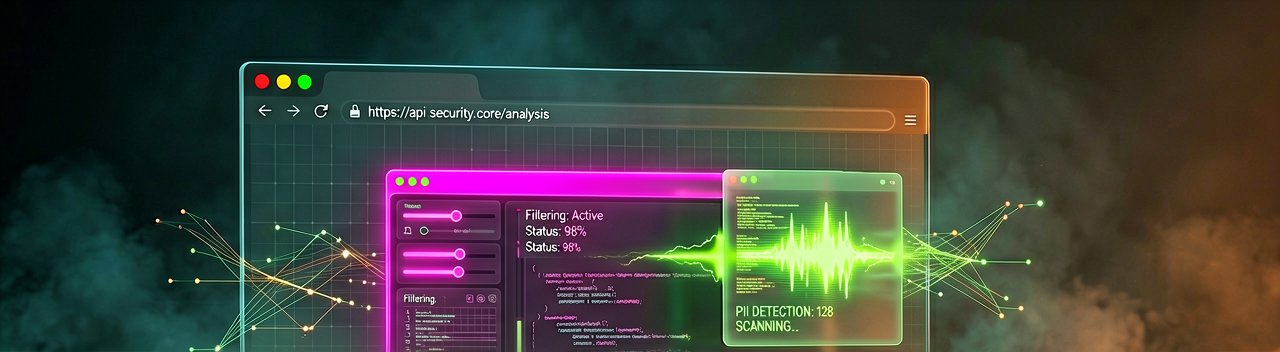
The model detects eight PII categories: private_person, private_address, private_email, private_phone, private_url, private_date, account_number, and secret. The last category specifically targets credentials, API keys, and passwords. Each category uses a BIOES (Begin, Inside, Outside, End, Single) labeling scheme, decoded via a constrained Viterbi procedure to ensure coherent spans.
Integration into web applications follows two primary paths. The first uses the official Python package from the GitHub repository. Developers install it locally with pip and run the CLI tool for one-shot redaction, evaluation, or fine-tuning. The package supports GPU and CPU execution, with model checkpoints downloading automatically to ~/.opf/privacy_filter if not found.
For browser-based applications, Privacy Filter works with transformers.js and WebGPU. This allows the model to run entirely client-side, eliminating server round-trips for sensitive data. The inference happens in the user's browser—data never leaves the device. (This is the kind of privacy guarantee that actually matters for enterprise compliance.)
A practical implementation pattern comes from the Hugging Face blog post on building scalable apps. The author demonstrates three use cases: Document Privacy Explorer, Image Anonymizer, and SmartRedact Paste. All three leverage gradio.Server to pair custom HTML/JS frontends with Gradio's queueing and ZeroGPU allocation.

The Document Privacy Explorer example shows how to handle PII-heavy files. Users upload PDFs or DOCX documents, and the backend runs a single 128k-context forward pass. The frontend renders the document with highlighted spans by category, a sidebar filter, and a summary dashboard. Client-side CSS toggles handle category filtering without re-running the model.
Code structure uses @server.api decorators to plug handlers into Gradio's queue. Concurrent uploads serialize properly, and the same endpoint serves both browser clients and gradio_client SDK calls. The frontend connects via the Gradio JS client, calling client.predict with file handles. This pattern keeps the model logic centralized while allowing custom UIs.
The Image Anonymizer workflow combines OCR with Privacy Filter. Tesseract extracts per-word bounding boxes from uploaded images. The backend reconstructs full text with character-to-box mappings, runs Privacy Filter once, then converts detected spans to pixel rectangles. The frontend renders these as editable black bars on a canvas—users can toggle, drag, or draw additional redactions before exporting.
SmartRedact Paste implements a pastebin-style service. Users paste sensitive text and receive two URLs: a public link serving redacted content with placeholder tags like <PRIVATE_PERSON>, and a private token-gated link showing the original with highlighted spans. The redaction step simply swaps detected spans with category placeholders.
Performance characteristics matter for scaling. The 50M active parameters enable fast inference on consumer hardware. On-device execution means no API costs per request, though developers must account for model download size and WebGPU compatibility. Fine-tuning support allows adaptation to specific data distributions—medical jargon, proprietary log formats, or industry-specific PII patterns.
Compliance considerations include GDPR and HIPAA requirements. Running Privacy Filter on-premises or in private clouds keeps sensitive data within controlled environments. The model masks data locally before sending sanitized text to more powerful reasoning models like GPT-5 or gpt-oss-120b. This two-stage approach maintains compliance while leveraging advanced AI capabilities.
One limitation: Privacy Filter handles text and OCR-extracted content. It does not natively process audio, video, or structured database fields. Teams building comprehensive privacy solutions will need additional components for those modalities. The model also requires calibration for precision-recall tradeoffs depending on use case tolerance.
Community reaction has been positive. Research engineers note the efficiency of achieving 128k context with such a small model. The Apache 2.0 license removes friction for commercial adoption. However, whether organizations actually deploy client-side PII filtering at scale remains uncertain—many prefer centralized control over distributed privacy enforcement.
For developers starting with Privacy Filter, the official documentation provides CLI examples, evaluation fixtures, and fine-tuning workflows. The transformers.js integration enables browser deployment with WebGPU support. Gradio Server offers a middle ground for teams wanting custom frontends with managed backend infrastructure.
The real question isn't whether Privacy Filter works technically. It's whether developers will prioritize on-device privacy over convenience. Cloud-based PII detection remains simpler to deploy and maintain. Privacy Filter shifts that burden to the client, which introduces compatibility and performance variables. Whether users actually accept that tradeoff remains the real question.
Artūras Malašauskas is an AI Systems Integrator with 20+ years of production-grade web engineering experience. He has designed, shipped, and scaled enterprise Python/PHP systems for logistics, SaaS, and public-sector clients. For the past year, he has focused exclusively on AI integrations: deploying open-source LLMs, building generative media pipelines (image, audio, video), and engineering multi-agent workflows for real production environments. His standard: reproducibility, security, cost-efficient inference—no vaporware. He documents and evaluates emerging AI tooling, separating verified capabilities from marketing noise. Technical editor at: muza-ai.eu, ai-verslas.lt, ai-naujinos.lt Connect on LinkedIn
Comments