Google DeepMind Unveils Decoupled DiLoCo for Fault-Tolerant AI Training
Google DeepMind has introduced Decoupled DiLoCo, a distributed training architecture that fundamentally rethinks how large language models handle hardware failures and network constraints. The system moves away from tightly synchronized training toward asynchronous, fault-isolated compute clusters that can continue operating even when individual components fail.
Traditional distributed training relies on single program multiple data (SPMD) paradigms where thousands of chips must stay in near-perfect synchronization. When one chip fails or slows down, the entire training run stalls. This fragility becomes increasingly untenable as models scale toward hundreds of billions of parameters. Decoupled DiLoCo addresses this by dividing training across separate "learner units" that operate independently without blocking on one another.
According to the official DeepMind blog post, the architecture builds on two prior advances: Pathways, which introduced asynchronous data flow for distributed AI systems, and DiLoCo, which reduced inter-datacenter bandwidth requirements. Decoupled DiLoCo combines these approaches to enable training across globally distributed data centers without requiring custom high-speed network infrastructure.
The bandwidth reduction is dramatic. Conventional Data-Parallel training requires approximately 198 Gbps of inter-datacenter bandwidth across eight data centers. Decoupled DiLoCo reduces this to just 0.84 Gbps—multiple orders of magnitude lower. This makes it compatible with standard internet-scale connectivity between datacenter facilities rather than requiring expensive custom network infrastructure (which is a massive cost saver for anyone running distributed training).
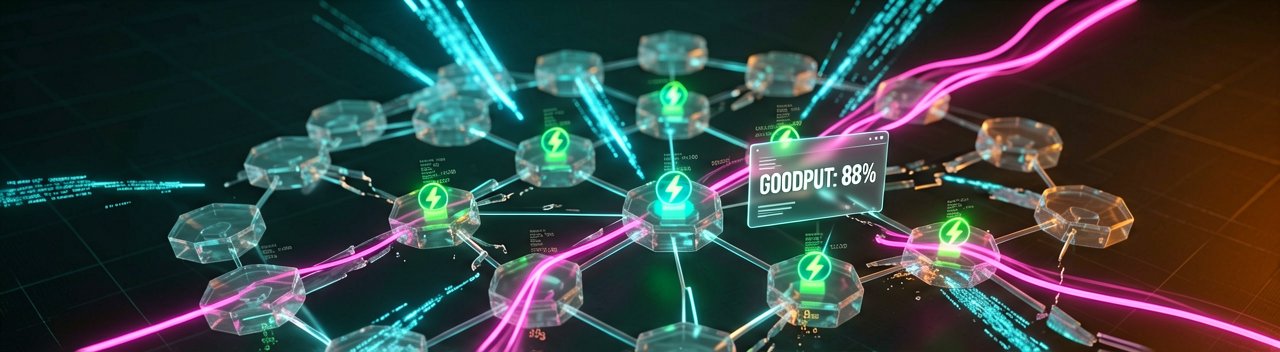
Each learner unit performs many local gradient steps before sharing compressed gradient signals with an outer optimizer that aggregates updates across all units. Because this outer synchronization is asynchronous, a chip failure in one island does not block others from continuing to train. The system incorporates required communication into longer computation periods, avoiding the "blocking" bottlenecks where one part of the system must wait for another.
Self-healing capabilities represent one of the most technically significant properties. The research team used chaos engineering to deliberately introduce artificial hardware failures during training runs. The system continued training after the loss of entire learner units and seamlessly reintegrated them when they came back online. In simulations involving 1.2 million chips under high failure rates, Decoupled DiLoCo maintained 88% goodput compared to just 27% for standard Data-Parallel methods.
The accompanying research paper details the technical implementation, including minimum quorum aggregation, adaptive grace windows, and dynamic token-weighted merging. These mechanisms allow the synchronizer to circumvent failed or straggling learners while maintaining competitive model performance across text and vision tasks.
Testing with Gemma 4 models demonstrated that the system maintains greater availability of learning clusters than traditional methods while delivering the same benchmarked ML performance. A 12 billion parameter model was successfully trained across four separate U.S. regions using 2-5 Gbps of wide-area networking. The system achieved this more than 20 times faster than conventional synchronization methods in that setting.
Hardware flexibility extends beyond fault tolerance. The architecture supports mixing different hardware generations—such as TPU v6e and TPU v5p—in a single training run. This extends the lifespan of older devices and alleviates capacity bottlenecks during hardware upgrades. For organizations managing heterogeneous compute fleets, this capability alone could justify the infrastructure investment.
The physical reality of using this system differs significantly from traditional training. Engineers no longer need to coordinate perfect synchronization across thousands of chips. Instead, they manage independent learner units that can fail and recover without human intervention. The system absorbs hardware failures as routine occurrences rather than catastrophic events requiring cluster-wide reconfiguration.
Industry analysts note this positions DeepMind differently from competitors still relying on tightly coupled training architectures. The ability to tap unused compute wherever it sits—turning stranded resources into useful capacity—represents a strategic advantage as AI training demands continue to outpace hardware supply.
Whether organizations actually adopt this architecture depends on whether the performance trade-offs justify the infrastructure changes. The 64.1% average accuracy on Gemma 4 versus 64.4% for conventional baselines shows essentially matched performance, but real-world deployments will reveal whether the resilience gains translate to cost savings at scale.
For now, the technology remains available through DeepMind's research channels. Production adoption will require significant infrastructure retooling, and the learning curve for managing asynchronous training workflows shouldn't be underestimated. Whether users actually pay for the resilience improvements remains the real question.
Artūras Malašauskas is an AI Systems Integrator with 20+ years of production-grade web engineering experience. He has designed, shipped, and scaled enterprise Python/PHP systems for logistics, SaaS, and public-sector clients. For the past year, he has focused exclusively on AI integrations: deploying open-source LLMs, building generative media pipelines (image, audio, video), and engineering multi-agent workflows for real production environments. His standard: reproducibility, security, cost-efficient inference—no vaporware. He documents and evaluates emerging AI tooling, separating verified capabilities from marketing noise. Technical editor at: muza-ai.eu, ai-verslas.lt, ai-naujinos.lt Connect on LinkedIn
Comments