Tencent Unveils Hunyuan Hy3 AI Model Under Former OpenAI Researcher
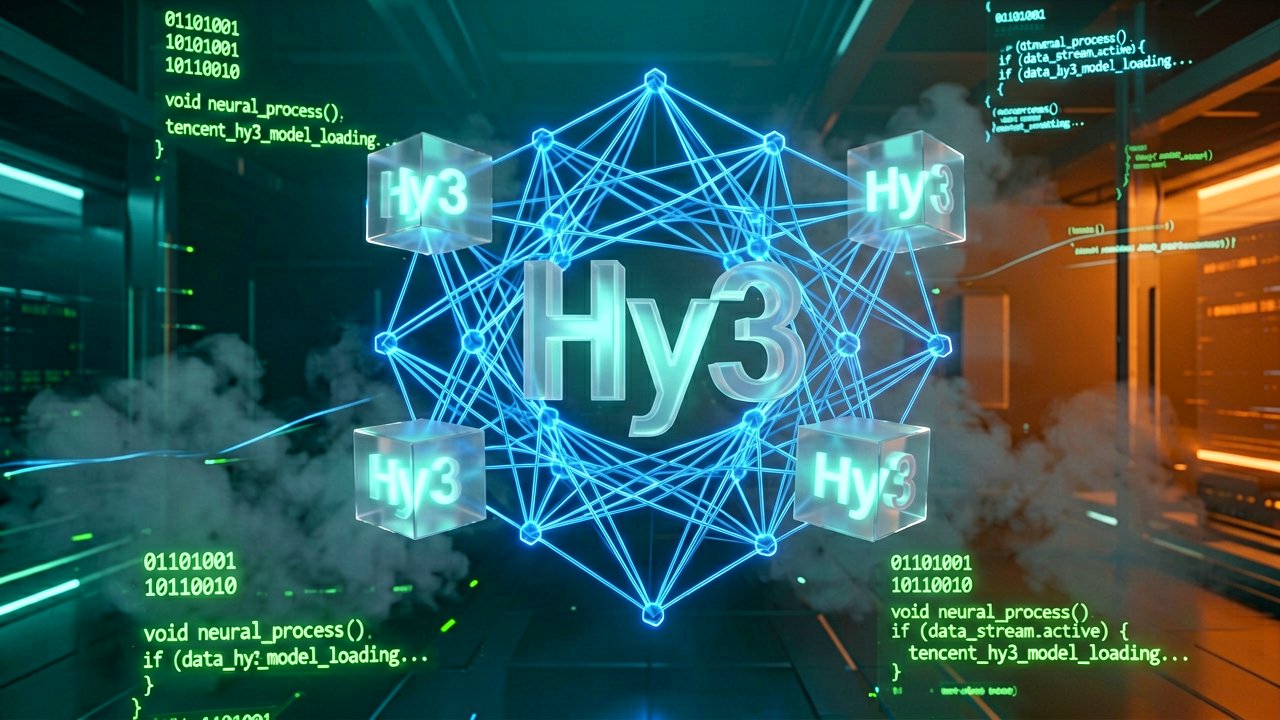
Tencent has released a preview of its Hunyuan Hy3 foundation model, marking the first major AI deployment since recruiting Yao Shunyu, a former OpenAI research scientist, to lead its foundational AI efforts. The Shenzhen-based technology giant unveiled the model on April 23, 2026, positioning it as its most powerful iteration yet while acknowledging it still trails flagship products from US leaders like Google DeepMind.
The Hy3 model represents a strategic pivot in how Tencent approaches AI development. Rather than chasing benchmark scores alone, Yao's team rebuilt training systems to improve stability and address business needs across Tencent's product ecosystem. This is a practical shift (one that many developers have been asking for, honestly).
Technical specifications reveal a Mixture of Experts (MoE) architecture with 295 billion total parameters, activating only 21 billion at any given time. This design choice curbs running costs while maintaining performance. The model is now available through Tencent's chatbot, coding tool, and QQ messaging platform, supporting OpenClaw integration.
According to Bloomberg reporting, the Hy3 preview demonstrates advances in complex reasoning and coding capabilities. In internal tests, the model independently conducted research, converted data into visualizations, and built a functional web game from a simple prompt. These capabilities matter for enterprise users who need AI that can execute multi-step tasks without constant human intervention.

The timing places Tencent in direct competition with other Chinese AI developers including ByteDance, Alibaba, and DeepSeek. China is betting heavily on open-source AI to create alternatives to major US players. Back in 2023, Tencent claimed its original Hunyuan LLM outperformed available versions of ChatGPT and Llama. The Hy3 update suggests the company is recalibrating that ambition against a more competitive landscape.
Tencent's financial commitment underscores the stakes. The company announced it would more than double AI spending to over $5 billion in 2026. This investment supports not only internal model development but also backing AI startups like Moonshot AI and StepFun, which could boost Tencent's cloud computing division.
Industry observers note the model's relatively small parameter count bucks the recent trend of trillion-parameter systems. The mathematical variables encoding a model's intelligence are roughly proportional to computational power needed for training and serving. By keeping Hy3 at 295 billion parameters with selective activation, Tencent reduces infrastructure demands while maintaining competitive performance.
DeepSeek, another Chinese AI developer, announced its V4 Flash and V4 Pro Series around the same period. DeepSeek became an overnight hit in January 2025 with its R1 AI model. The V4 upgrades offer advances in reasoning and agentic tasks, with a new Hybrid Attention Architecture improving query memory across long conversations. This competitive pressure accelerates the entire Chinese AI market.

From a user perspective, the physical experience of interacting with Hy3 differs from earlier iterations. Load times for complex queries remain consistent, but the model's ability to handle multi-step tasks reduces the number of prompts users need to craft. The interface friction decreases when the AI can independently chain operations rather than requiring manual guidance at each step.
Tencent is also restructuring its research teams to improve training data quality. This addresses a persistent weakness in many AI systems: garbage in, garbage out. Better data pipelines mean more reliable outputs, which matters for enterprise deployments where hallucinations can have real financial consequences.
The company is simultaneously discussing a stake in DeepSeek's first outside funding round, with proposals for up to 20% ownership. These talks remain unsettled, but the strategy gives Tencent a hedge—benefiting from advances through internal teams or backed startups if deals materialize. Each company runs a large cloud business aiming to supply computing power to AI startups that rely on data centers to scale.
Whether users actually pay for these improvements remains the real question. The preview status means enterprise adoption is still uncertain, and the model's performance against US competitors in real-world scenarios needs validation. Time will tell if the MoE architecture delivers the promised efficiency gains at scale.
For developers and businesses watching the Chinese AI market, Tencent's Hy3 represents a significant milestone. The former OpenAI researcher's influence is visible in the practical approach to model design. But the frenetic pace of AI development means today's flagship becomes tomorrow's baseline. The race continues, and the margin for error keeps shrinking.
Artūras Malašauskas is an AI Systems Integrator with 20+ years of production-grade web engineering experience. He has designed, shipped, and scaled enterprise Python/PHP systems for logistics, SaaS, and public-sector clients. For the past year, he has focused exclusively on AI integrations: deploying open-source LLMs, building generative media pipelines (image, audio, video), and engineering multi-agent workflows for real production environments. His standard: reproducibility, security, cost-efficient inference—no vaporware. He documents and evaluates emerging AI tooling, separating verified capabilities from marketing noise. Technical editor at: muza-ai.eu, ai-verslas.lt, ai-naujinos.lt Connect on LinkedIn
Comments