Playdate Store Bans Generative AI for Creative Assets
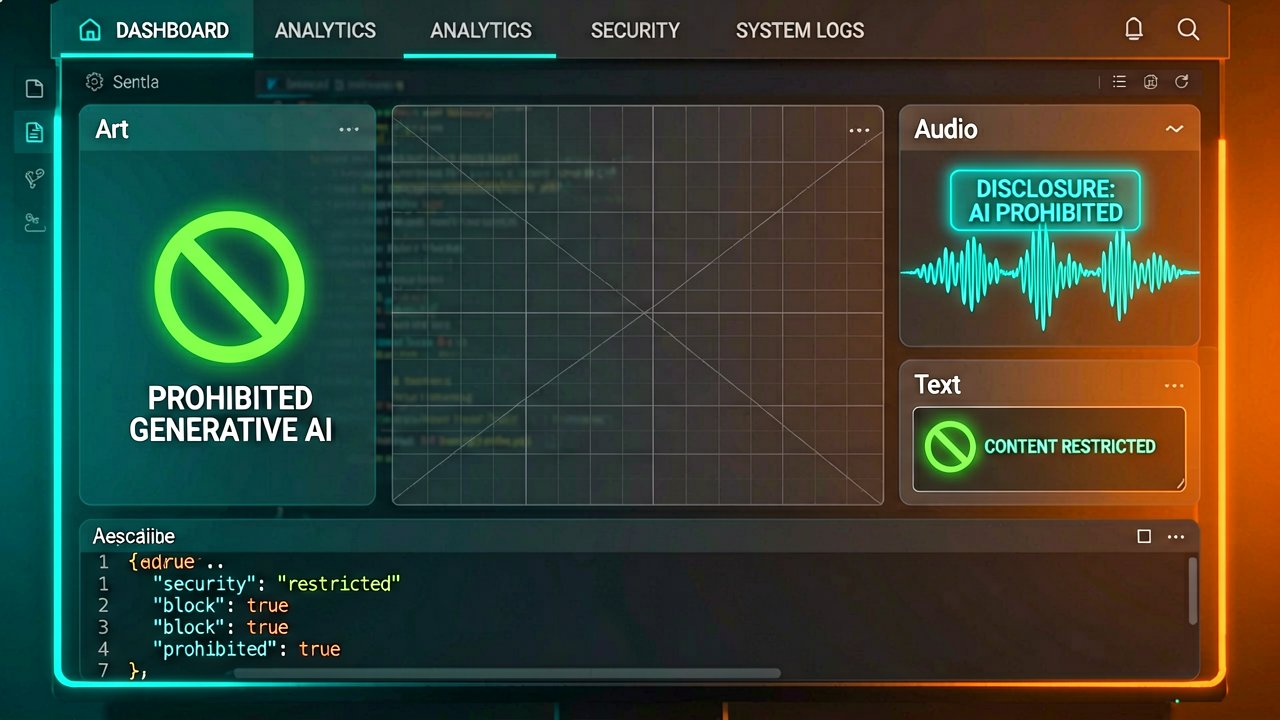
Panic Inc. has implemented a formal policy prohibiting the use of generative AI for creative assets in new Playdate Catalog game submissions, effective immediately. The company's official AI Disclosure document explicitly bans generative AI tools for art, audio, music, text, and dialogue in new titles, marking a significant stance among gaming storefronts.
The policy defines prohibited generative AI as including large language models (ChatGPT, DeepSeek, Google Gemini), image generators (Stable Diffusion, DALL-E, Midjourney), and audio tools (MuseNet, Suno, Udio). Crucially, the company permits AI assistance for coding and debugging processes—such as GitHub Copilot usage—but requires developers to disclose and flag such implementations on game pages.
Existing Catalog titles that previously used generative AI will remain available but will be "flagged as such" with detailed explanations of implementation, per the disclosure. This follows an incident where Wheelsprung, a Season 2 title, used LLMs for coding and writing without explicit policy awareness, prompting Panic co-founder Cabel Sasser to admit the oversight was "naive" and take responsibility.
Industry context reveals this policy positions Playdate as one of the first digital storefronts to ban generative AI for creative work, contrasting with Steam, Nintendo eShop, and Itch.io which permit such usage. Panic frames the move as protecting "human authorship" while acknowledging AI's utility in development workflows—a nuanced approach distinct from blanket bans.
For indie developers targeting Playdate's niche market, the policy creates clear boundaries: budget-constrained teams can still leverage AI for coding efficiency but must forgo AI-generated creative content. The company emphasizes community collaboration, directing developers to "collaborations channel in the Playdate Squad Discord" for human-driven creative support.
Technical implications include mandatory disclosure via updated Catalog Assets forms, with game pages displaying AI usage details similar to accessibility ratings. The policy also signals Playdate's curation philosophy prioritizing handcrafted creative work—a deliberate differentiator in an industry increasingly adopting generative tools.
As Panic notes, "All of this is under constant discussion and is subject to change," indicating potential future adjustments. However, the immediate effect is a clear industry precedent: curated platforms can enforce creative provenance standards beyond technical compliance, potentially influencing smaller storefronts seeking to differentiate themselves in the generative AI era.
Artūras Malašauskas is an AI Systems Integrator with 20+ years of production-grade web engineering experience. He has designed, shipped, and scaled enterprise Python/PHP systems for logistics, SaaS, and public-sector clients. For the past year, he has focused exclusively on AI integrations: deploying open-source LLMs, building generative media pipelines (image, audio, video), and engineering multi-agent workflows for real production environments. His standard: reproducibility, security, cost-efficient inference—no vaporware. He documents and evaluates emerging AI tooling, separating verified capabilities from marketing noise. Technical editor at: muza-ai.eu, ai-verslas.lt, ai-naujinos.lt Connect on LinkedIn
Comments